The Deskside Manufacturing Evolution
⚓ p3d 📅 2025-12-15 👤 surdeus 👁️ 19

When the desktop 3D printing revolution reared its beautiful head in the 2010’s the world was still suffering from a housing boom hangover. Technoptimism seemed to be the path ahead with Web 2.0 platform thinking influencing VCs, companies, and startups alike. After digitization had taken on books, music, and video, things seemed to be the next best thing. Famously, of course, hardware is hard, or rather, VCs are simple. An idea you join for free, build on with free labor, and that is valuable because it has lots of members, is going to be a bit easier to grow than a machine tool. Hockey-stick-o-nomics don’t fit well with real-world spending.
Fourth Time Lucky
Against these riptides, we ceaselessly swam, and no matter how much pension fund cash we ignited, we couldn’t really marry the economics of the real world with that of the PowerPoint-inebriated Sand Hill Road set. It’s harder to con a car company than to con a child, I guess. Or, it is comparatively easy to take time from a baby, because babies value candy. Thirty years on, 3D printing is blooming. Tens of millions of desktop 3D printers have been sold, and over six million will be sold this year. Creality will go public, with perhaps Formlabs and Bambu Lab following. Our first two attempts at relevance, our founding by Stratasys, 3D Systems, Materialise, and the rest, as well as the desktop revolution, did not work. Our third SPAC assault on rationality did not either. But. Catlike indeed, we have been given another chance at redemption. Fool me once, shame on you; fool me twice, shame on me; but fool me four times? That must finally be the Fourth Industrial Revolution!
Promises of Yesteryear Made Good
Against that backdrop, we are now seeing a raft of 3D printers that can make good on promises made by the rotting cheeses of yesteryear. Desktop 3D printers have yields of 90% or more. Companies are using desktop 3D printers en masse in intermediates, fixtures, and end-use products. We make millions of 3D printed parts each day. In dentistry, orthopedics, hearing aids, UAVs, suppressors, rocket engines, and implants, we are becoming an entrenched technology or indeed the default one. Industrial machines have become cheaper, increased yields, and reduced part costs. Thirty years of growth, application development, and refinement, married with spurts of hype and cash, have made us a pretty good manufacturing solution for some things. We can now perhaps reliably make around 3% of all things in the world at a comparable cost to other processes. More needs to happen in reliability, repeatability, material costs, access to CAD, ease of use of CAD, mass customization, software toolchains, and more, of course. But 15,000 days, or 41 years, since the 1984 invention of stereolithography, and 13,000 days since the 1988 invention of FDM, we are finally seeing broad-spectrum adoption of these additive technologies and others into the daily lives of workers and corporations. Print farms sell products that are in Target and Walmart, and the older you get, the higher the chance is of more than one 3D printed product living inside you. 3D printed products are in your plane, nuclear power plant, mouth, ears, and under your butt on your bike seat. We are lodged in your body and in corporate processes.
A Lifetime
41 years is a career, more than a lifetime for the unlucky. That’s all it took, 41 years. A herd of dinos. The first AM person I ever hugged was Graham Tromans, from whom I learned a lot. Another wise voice and an early hug for me was Patrick Ohldin. Both had storied, very different pioneering careers in AM and have sadly passed away. Multiply their efforts by several thousand people, across the decades, and that is what got us where we are today. We had many evangelists, but it was the monks who made it work. Patrick told me one thing in particular, around 2015 or so, that I think about roughly once a week. Referring to the enterprising pioneers at Avio Aero, he said, “They realized that they made the shape in the machine and the part in post-processing.” Perhaps invented by Americans, Germans, or Swedes, the various additive processes have needed the Italians to make them work in orthopedic implants and aircraft. And we all know the importance of post-processing and how extensive these processes can be. But somehow, what Patrick said really resonated with me. Rather than see post-processing as some necessary evil to get us to make parts that seem like other processes’ parts, we can use the entire chain of processes to engineer specific properties that meet specific needs by applying varying tools to and within our process. This, coupled with the particular geometry, design, microstructure, texture, and structure, means that we can, throughout the process, push and pull specific levers to make parts that are better solutions to particular problems than those from other technologies. The pre- and post-processing chain, therefore, for the first time, held an opportunity for me.
Deskside Manufacturing Revolution

The xTool F2, part of the new wave of compact deskside manufacturing tools. Image is courtesy of xTool.
Now, with us where we are, there is a broader revolution happening. We are seeing low-cost UV sticker printers, laser cutters, laser engravers, water jet machines, CNCs, lathes, mills, drills, and more. Recently, desktop CNC has taken flight, with Kickstarter funding the Carvera Air for $3.4 million, Gweike M for $2.9 million, the Makera Z1 for $6 million, and more. The Gweike is 620 by 355 by 620, a 1200W fiber laser, a 130W CO₂ laser, and a 42-kilo unit that combines cutting, engraving, manual laser work, and more. This clearly is not going to be a desktop revolution. Yes, there will be small machines for makers, especially button makers, laser cutters, printers of all kinds, and probably CNC machines. But there are many hundreds of thousands of workshops worldwide. Some companies, Roland DG foremost among them, do cater to these. But virtually all of the machine tool manufacturers have ignored them, focusing on big factories and more precision-oriented businesses.

Wonlean Tech waterjet cutting machine. Image courtesy of Wonlean.
This has left a huge opportunity. A value-engineered waterjet machine may find a maker with a hobby, a guy with a toolshed, a side gig, a business starting, or a company with limited capital in the developing world or anywhere else, really. As secondary processes or finishing processes, these tools can be very valuable. Yes, there could be a million-selling desktop component of a revolution, if pitched right. But, more interestingly, more fundamentally, growth comes from new small businesses. And these have traditionally been inhibited by the lack of money needed to access machine tools. On the one hand, a digitization revolution has brought us back to the inevitable digitization of things. But, also in China, relentless competition has brought many players to the edge of bankruptcy, scrambling for new markets, any market.
Larger, simpler machine tools are therefore also likely to emerge. To equip startup businesses, makers, and individual entrepreneurs, as well as those businesses that may need a cheap version of a tool for a single product or process, a new category of inexpensive machine tools is emerging. And these are an opportunity and a threat.
Fellow Travelers
On the one hand, dollars could go to far easier to operate machines with lower cost materials. Some machines could be much more profitable than 3D printers for makers who are selling things. So far, 3D printing sharing sites have provided a significant advantage. Downloading and producing is still easier. 3D printing is also more versatile and less dangerous than a lot of these technologies. We’ve also had a lot of hype. I’m currently the only person writing about this, as far as I can tell. This will probably change.
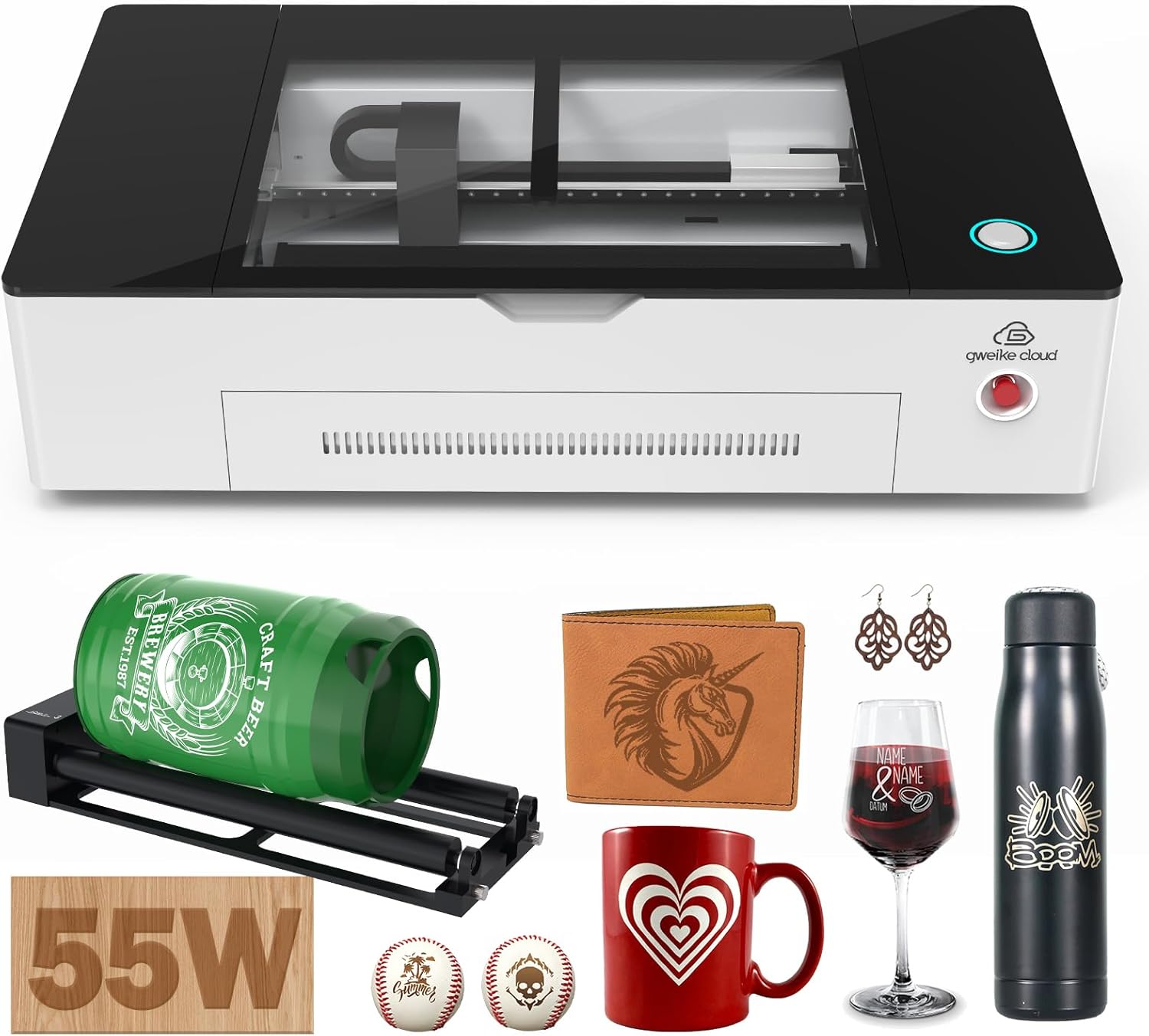
Other machines, in combination with 3D printers, can be very powerful. Colorful stickers or inkjetting on top of 3D printed parts can provide true full color much faster and more inexpensively than full-color 3D printing. A good 3D printer, together with a finishing machine and an inkjet solution, will likely be cheaper overall. We may very well see many new market entrants.
Potato Chips
What is different this time as well is the deskside nature of this wave of market entrants. We’re seeing heavier, bigger, and more dangerous machines. Noisier ones too. Those with high power requirements. Many of these you would never want in your home. Over the years, I’ve been exposed to styrene, VOCs, carbon fiber fragments, skin-irritant resins, powder, and more in my own home. But I really want to draw the line at a 1200W laser. May all the chips stuck in my sofa be potato chips.
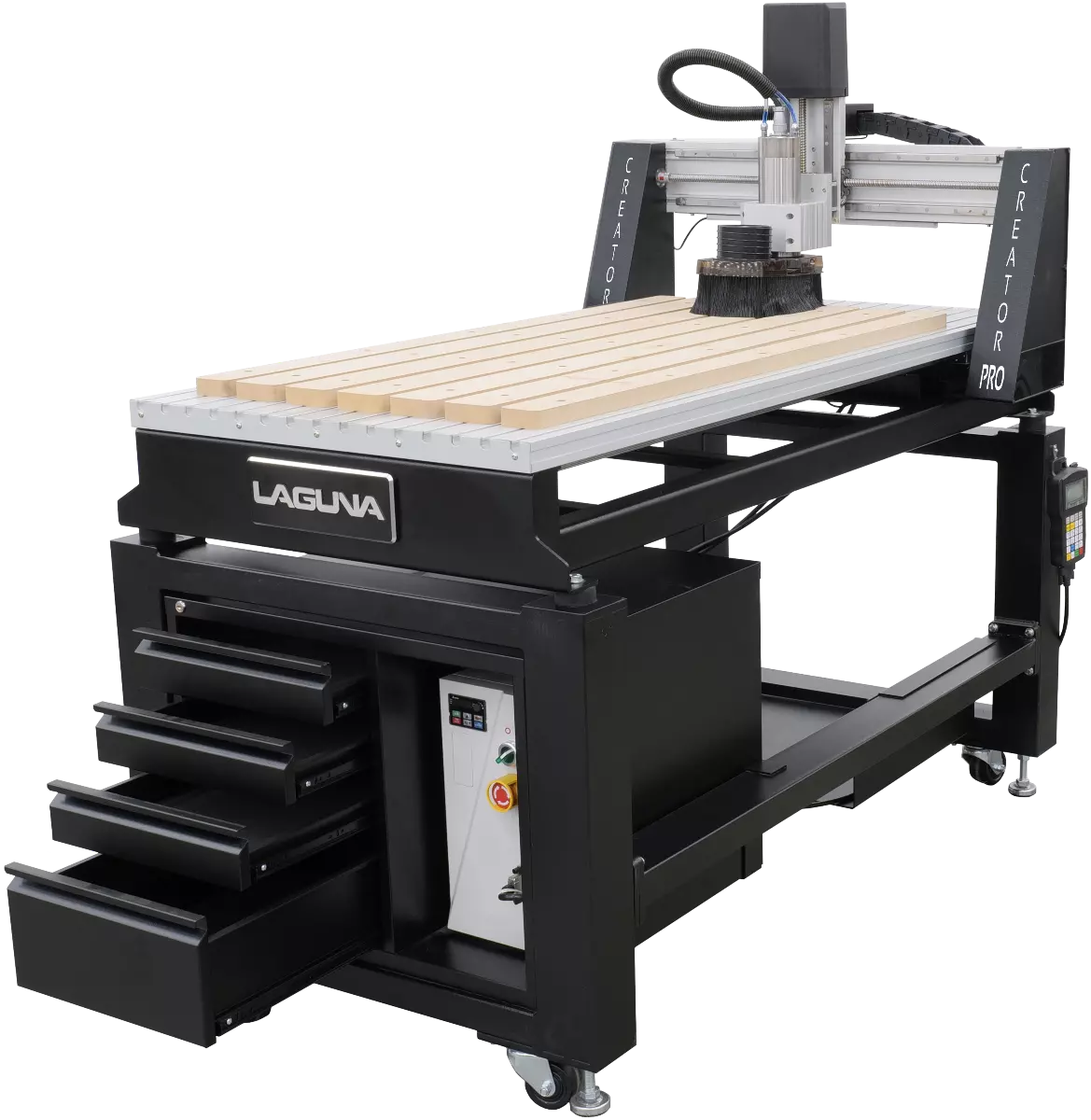
Laguna Creator Pro CNC router. Image courtesy of Laguna Tools.
Meanwhile, people’s needs have evolved. For many millions of people, a side gig is now gratifying. Bouyed by the seemingly simple success of others, or the need to shore up finances, or the wish to do something more creative than a job that you’re stuck in due to labor market insecurity, many people are turning to side gigs. Bouyed by an online industry of casual make-up millionaires and overnight cookie success people, they soldier on. The world is your Herbalife. You no longer need a company, a franchise, or a career; just the right side gig can make you millions in hot sauce.
Boomers & Fallout Shelters
A never-before-seen group of retired folks who want to be more active than ever are also ripe for hobbies, engineering pursuits, and workshops of their own. More than any other generation, the people entering retirement now have careers and skills in mechanical engineering or physical manufacturing. The Rolex generation is not only among the wealthiest but also likely to have the biggest homes and the greatest interest in mechanical things. The youngest mercantile generations, meanwhile, Alpha and Gen Z, are media-savvy and see around them people who are influencers or have made a living from inventions. Clothing is old hat. What is the next?
The social system, meanwhile, seems to have largely broken down. The belief that long, hard, diligent work leads to reward has ebbed. Many countries have no retirement system or an increasingly problematic one. Belief in the nation state, togetherness, unity, humanity, humanism, and progress has stalled as well. That crazy prepper uncle of yours who dug his own well and has gas masks for the whole family, along with six pellets of canned food, is increasingly seen as more prescient than paranoid. The breakdown of the global order and anxiety over diminishing purchasing power will cause many more people to wish to manufacture themselves. Whether trying to build a business or become more resilient, more people will want to cut, bend, and join at home.
So Much More than Coasters
I used to think that inexpensive laser cutters would mean that we’d be able to make more coasters at home. But, in combining Additive with other processes, we can enable so much more. Cut plywood could be combined with 3D printed joints to make cabinets and other furniture. A lathe and 3D printed parts can be used to make chairs and other furniture. Printed stickers and 3D prints can generally make more sophisticated products. Throw CNC into the mix, and we can make more sophisticated mechanical assemblies and products. A single shed-based lab could produce a whole host of products on its own. Working with a neighbor who has some complementary equipment, more can still be produced. Combined with FPGAs, chipsets of all kinds, and readymade electronics, completely new devices can be made as well. Will we have inexpensive desktop pick-and-place machines? I’m not sure, but it would enable even more.
Think of remotes for all kinds of things, garden spray systems, and better lamps, toys, and household items. Wholly new devices could be made. Someone could make remote controls with only the basic functions, but with one remote working the bed, living room chair, garage, and TV, for example. Or someone could make vending machines of all kinds for very specific uses, eg, a poolside vending machine for required swim caps for municipal pools. Specific security devices, such as new versions of nanny cams or cameras for specific uses, are also a potential use. Beyond this, there are legion more possibilities. The market will expand, and the products will become much more sophisticated.
Deskside is Key
The 3D printing revolution was shaped by European firms such as Prusa and Ultimaker that held fast to compact form-factor 3D printers. The RepRap project was desktop-focused as well and UK-based. Even the US-based Makerbot was uncharacteristically urban and space-constrained. There are not a lot of dens, sheds, and spare rooms in Brooklyn available for colonization into a workshop. Desktop 3D printers have kept to small form factors because of this. Laser cutting, CNC, waterjet, and lathe companies have no such predispositions. Indeed, if you look at the shed, spare room, small workshop, small factory, side piece machinery in a larger factory crowd, this market seems substantial in and of itself. Some of these devices don’t make sense much smaller, and indeed, for many, it would be more complex and expensive to make them smaller and more room-fahrig. To me, therefore, the key element here is that this revolution is set to be deskside, using much larger build volume machines. This should reduce the part cost and let more things be made. It can also lead to much quicker human-sized and commercial-sized objects, which could lead to faster commercialization.
Evolution
Forty years is a long time for a revolution. Evolution is therefore much more likely. Success stories, examples, applications, and products will take time to develop. Fifteen years ago, everyone was making beautifully useful Voronoi nonsense, and now we’re making practical, well-working things designed for a purpose. This evolution towards practicality will also be necessary. It could go faster if Mary makes millions with a laser-cut coaster empire or if Kate is shown jet-setting around the world after a successful custom baseball bat lathe. Generally, however, initiatives and designs will take time to percolate into successful businesses. Now, however, we can see many thousands of successful small business stories online; this alone will accelerate the adoption of machine tools by many more people.
Conclusion
As stated in two articles previously, the deskside manufacturing evolution is sure to be slow and steady. But, in a new world, it may be quicker than the 3D Printing revolution. A whole line of inexpensive, well-working machine tools would let many more people have factories at home or augment their existing production capacity with new devices. Lines of equipment working together will enable more than 3D printing can provide on its own. A broader digitization revolution is underway, and a digital manufacturing movement is spreading across many industries. But the democratization of manufacturing is not complete if it is digitized. More affordable deskside equipment will spread the power of manufacturing much wider and enable hundreds of thousands of new businesses. And many of these companies may create the shape on a 3D printer, but will make the part in post.
🏷️ p3d_feed