How Kupros, Inc. Plans to Smash the Barriers to Entry for Additive Electronics
⚓ p3d 📅 2025-12-15 👤 surdeus 👁️ 21

In 2024, as usual, semiconductor manufacturers topped the world’s list of highest R&D spenders. There are few spaces within global industry where R&D is more highly prioritized than semiconductor and electronics manufacturing, with only the pharmaceutical industry spending more, as defined in terms of percentage of revenue.
Additively manufactured electronics (AMEs) represent a small but steadily growing portion of this story. Ian Ramsdell, founder of Kupros, Inc., a company that makes a metal filament called Cu29, wants to help 3D printing play a larger role in the world of electronics.
Ramsdell epitomizes the contemporary entrepreneurial spirit, having started multiple companies in completely different markets, with his first role as founder of a company that made custom knives. The former U.S. Navy Petty Officer First Class, an Iraq War veteran who was injured in combat, subsequently decided to go back to school, before being introduced to a Department of War (DoW) initiative called the National Security Innovation Networks (NSIN) Foundry Program:
“They facilitate tech transfer from DoW labs to emerging entrepreneurs,” Ramsdell explained. “My team was assigned a metal filament developed at Naval Surface Warfare Center (NSWC) Crane.”
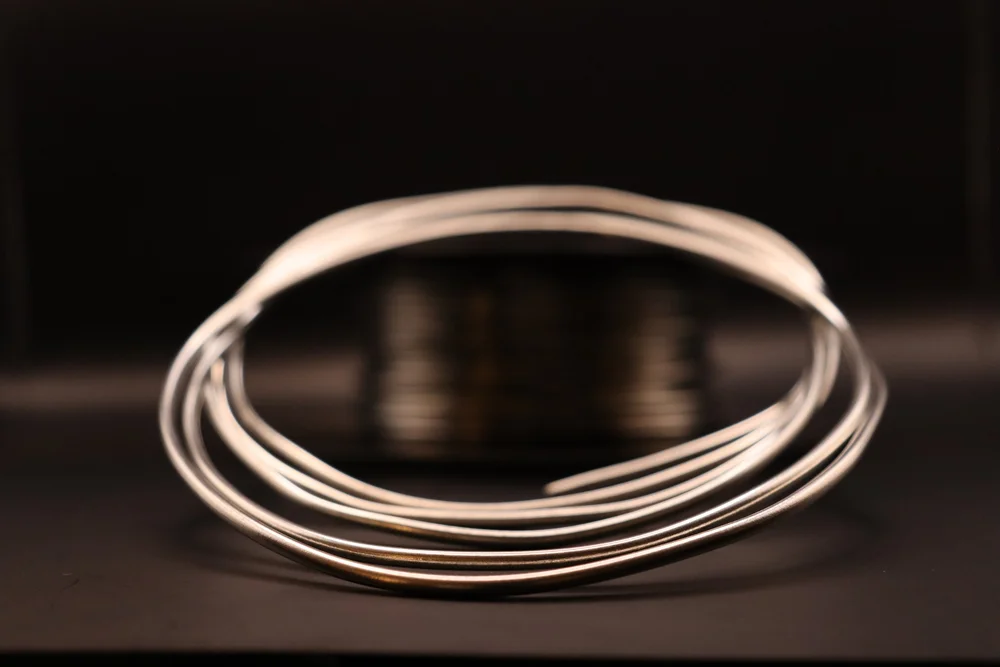
That filament was what’s now marketed by Kupros as Cu29, a copper-based material designed for users to produce electronics prototypes on Fused Deposition Modeling (FDM) printers.
“As part of the program, we had to do a customer discovery market analysis and a competitive analysis. One of the things we found out was that, since the filaments used for 3D printed electronics applications are typically all-polymer, they’re not very conductive. That limits electronics 3D printing to a small number of niche applications.”

The next step for Ramsdell and his Foundry team was to run a conductivity test on Cu29:
“We discovered that Cu29 was 48,000% more conductive than the most conductive polymer film used on the market for FDM printers,” Ramsdell told me. “Now, the other option for 3D printed electronics is to use machines made by Optomec, Nano Dimension, nScrypt, etc. The issue there, of course, is that the machines can cost over a million dollars in some cases, and you need an experienced engineer to operate them because they’re so complex.”

That background revealed the path forward for Ramsdell, which was to thread the needle between the ineffective low-cost options on the market and the proven options that are prohibitively expensive for most users:
“We were very intentional with our first pilot production run,” the CEO continued. “First off, we wanted to validate the material on the most inexpensive FDM printers we could get our hands on, to prove you don’t need hundreds of thousands of dollars to get your 3D printed circuit board prototype up-and-running.
“Secondly, and related to that, we were betting that if we could validate the material on these very inexpensive machines, then once customers transitioned to high-end, industrial machines, with more sophisticated sensors and all their other features, processing Cu29 shouldn’t be a problem. We were very fortunate to find out that we were right about that: one of our customers validated the material on an nScrypt machine using an FDM printhead.”
That’s a major selling point to what Kupros is attempting to do. Cu29 is disruptive; however, it’s also complementary. A company like nScrypt could see a company like Kupros as a threat, but in fact, nScrypt is a Kupros customer, and Ramsdell only views the two companies’ respective offerings as synergistic.
“It currently takes DoW 28 to 36 weeks to get a prototype printed circuit board (PCB) produced. When that PCB comes back, there’s a high probability you’ve already redesigned portions of it in order to tailor it to whatever mission it’s destined for,” Ramsdell noted.
“On top of that, let’s say you get a run of 100 PCBs. Only 10 are actually going to function the way you’ve designed them. So you incorporate your redesigns, send the new designs back to the manufacturers, and then you have to wait another 26 to 38 weeks to get another batch of 100.”

In order to change the way things are currently being done, AME companies have to simultaneously lower the cost, speed up the iteration timeline, and improve the performance of the prototypes being delivered. This isn’t a scenario where you can succeed simply by making marginal tweaks to the underlying process.
“The way electronics are manufactured has to be reinvented,” asserted Ramsdell. “Moving beyond the planar way that electronics have always been designed is central to that. The additive electronics industry has already done a good job by opening up people’s imaginations to the very possibility that you can embed electronics on a curved surface.
“Again, the problem is that the only way to get there right now is with these machines that are out-of-reach for the vast majority of users. But now imagine if you can embed circuits in nonplanar surfaces on a $300 printer. I think that’s the sort of thing that can cause a mindset shift regarding the way electronics are designed.”
As for use-cases, Ramsdell’s imagination is, naturally, open-ended, but he sees defense, space, and healthcare as the markets that are most immediately ready for a product like Cu29.
“Traditional electronics don’t function very well in the extreme environments NASA is interested in exploring, and our material can address many of the relevant problem-sets there. For instance, you can embed a heating mechanism in the polymers directly over the electronics packaging, for components of vehicles sent into deep space. We’re also getting a lot of inquiries electromagnetic (EMI) shielding for drone applications, and of course all the various interest based on embedded electronics involving DoW-specific exotic materials.”
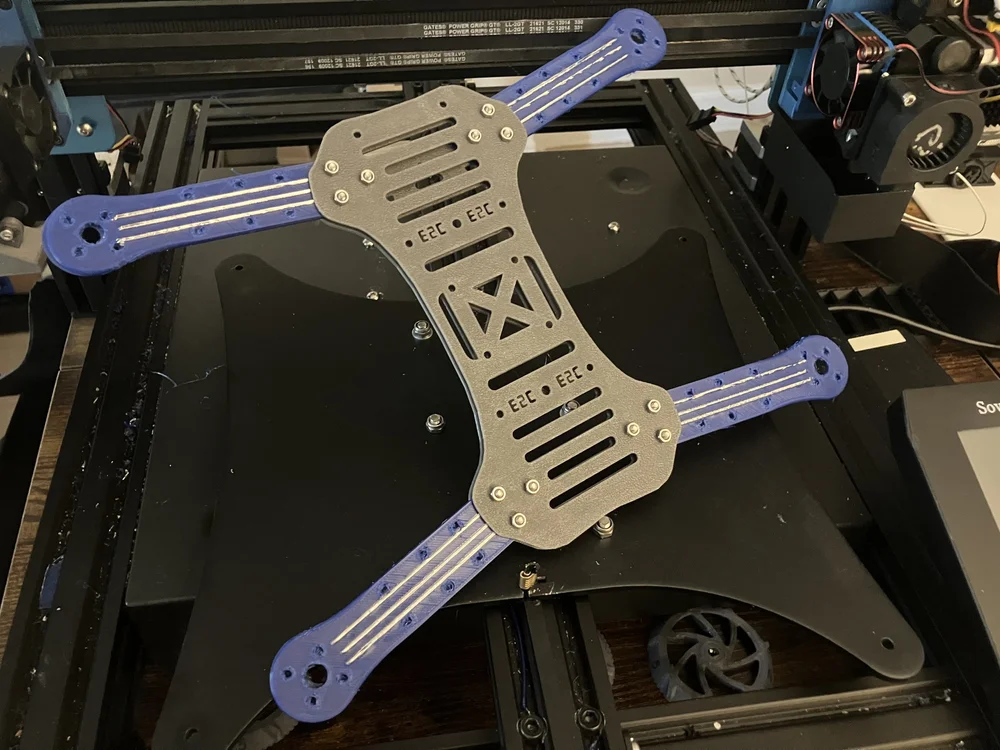
In light of how much the U.S. military (above all, the U.S. Army) has been doing with frontline drone manufacturing, ruggedized 3D printing should be a ripe area of development for Kupros. One of the limitations to 3D printing drones in forward operating conditions is that you can’t produce the electronics components. Cu29 could change that reality:
“We’re trying to leverage the fact that, owing to all our testing, we’re the only subject-matter experts for our material,” said Ramsdell. “A couple of years ago, a bunch of U.S. drone companies tried to field drone tech in Ukraine, and I think Ukraine ended up turning down every single company.
“They were already iterating too quickly, already 3D printing drones, and that’s where I see the most value right now in terms of rapid production. Virtually overnight, you could create a drone body that has embedded wire harnessing built into the structure.
“You could embed a Faraday cage into the lower drone housing that would enable you to protect your craft from electronic warfare. The best part of what we do, for me, is that by opening up the design possibilities, we’re ultimately opening up the design imagination of the end-users, as well.”
The opportunity to play a part in the development of the next generation of critical applications is clearly what has the most hold over Ramsdell’s attention:
“I could sit there and just build a filament shop, and fire all my engineer staff except for a QA engineer, and just watch spools of film move past me. But that doesn’t sound like the best use of what I’m capable of. I want to make sure we leverage this new capability as an enabling technology for the entire AM industry, for our customers in both the defense and civilian worlds.”
Images courtesy of Kupros, Inc.
🏷️ p3d_feed