3D Printing News Briefs, December 20, 2025: Gas Turbine Hardware, Build Settings, & More
⚓ p3d 📅 2025-12-20 👤 surdeus 👁️ 26

We’re starting this weekend’s 3D Printing News Briefs with news from Mears Machine and Exentis Group about large orders they’ve delivered and received. Then, a student at Kennesaw State University is researching how small design choices can affect the strength of 3D printed parts. Finally, Nugae used its ultra-light, large-format 3D printing for stage scenery. Read on for all the details!
Mears Machine Delivers 3D Printed Gas Turbine Hardware
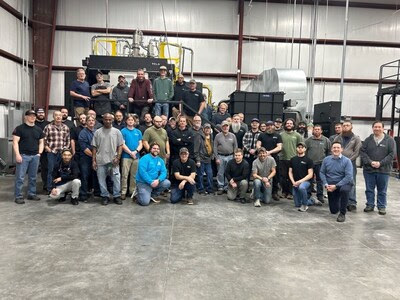
Mears Machine Team
Indianapolis-based Mears Machine Corporation recently announced that it had successfully delivered a complete set of gas turbine hardware to a new aerospace customer. With 100 employees, over 100 machining centers, and four Velo3D Sapphire XC metal LPBF 3D printing systems, Mears specializes in manufacturing components for missile defense, rocket launches, gas turbines, orbital vehicles, and advanced propulsion systems. The propulsion system hardware for its new customer order includes two Haynes 282 3D printed components, several precision machined components, and some Inconel 718 3D printed hardware. The 3D printed parts underwent a combined Hot Isostatic Press (HIP) and heat treatment cycle in order to improve their properties for high-speed rotating hardware; these parts were also polished by a specialist for improved performance.
“Our team is incredibly proud of this achievement. This is a significant milestone for Mears Machine and our customer,” said James Lloyd, the CEO of Mears Machine Corporation. “The product is a fantastic feat of engineering, which has been realized by our world-class equipment and skilled employees. We wish our customer success with their testing and are excited by the growth prospects which appear to significantly exceed our existing print capacity. We also greatly appreciate the support of Velo3D, who since the purchase of our Haynes 282 machine back in April have provided fantastic support for both the machine and this product.”
Exentis Gets Order for 10 Industrial AM Systems in Asia
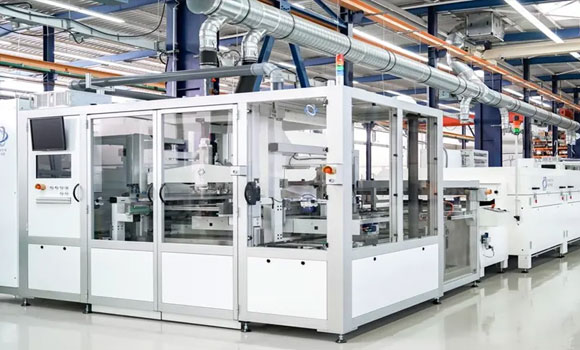
One of several Exentis production systems sold for large-scale manufacturing of industrial applications (Image courtesy Exentis Group)
Around this time last year, Swiss company Exentis Group AG, known for its unique 3D Additive Screen-Printing technology, secured a major foothold in the U.S. market, with the sale of 9 additive systems totaling about $22.4 million. Now, the company is taking on a different part of the world, with the announcement that it has received another major order, this time for 10 of its large-scale industrial systems in Asia. The company’s additive screen-printing is a cold process, operating at room temperature and able to process a range of materials, including metallic and ceramic ones. Exentis says its technology can deliver surface roughness levels of 2 μm, channel widths from 125 μm, and wall thicknesses from 75 μm. The printing step is followed by a sintering stage, but doesn’t require depowdering or machining, which speeds things up immensely. This AM method works for applications including ultra-fine structures, industrial parts, new energy, and more. To match with the customer’s expansion of its Asian production facilities, these 10 printers will be delivered progressively, with the first delivery planned for Q1 of 2026.
“We are very pleased about the order for ten production systems from our long-standing Asian partner,” stated Dr Rolf Bachmann, CEO of Exentis Group AG. “This is yet another confirmation of the strong demand for our unique and innovative technology platform for truly industrialised additive large-scale manufacturing, and a clear sign of the confidence international customers place in Exentis.”
Researchers Explore how Internal Structures Influence Print Performance
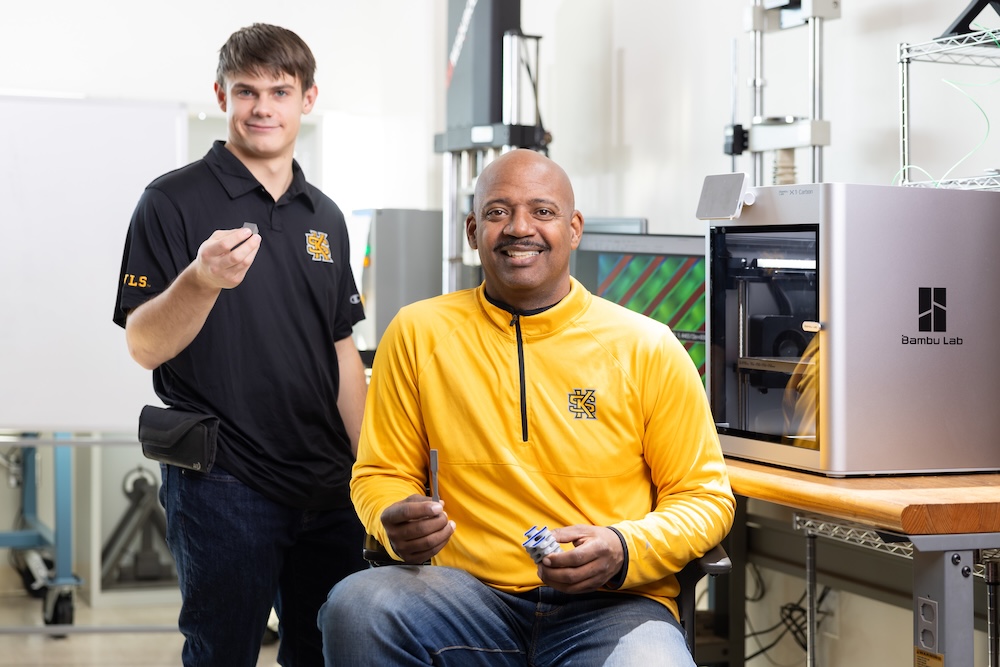
Eric Miller and Aaron Adams
The internal structure of a 3D printed part is just as important as the outside, and if it’s not strong enough, the part’s strength and reliability can be limited. Eric Miller, a mechatronics engineering student at Kennesaw State University and member of KSU’s START Lab within the Southern Polytechnic College of Engineering and Engineering Technology, is investigating how internal structures can influence performance in critical industries like nuclear energy. Under the guidance of Department of Engineering Technology Assistant Chair Aaron Adams, Miller’s research is centered around improving part performance by adjusting the print settings, making small design choices to make the components much stronger. As part of their research, he is designing models, preparing simulations, and using finite element analysis (FEA) to test different combinations of lattice densities and angles, as lattice structures and internal channels can provide material with room to expand, which improves safety and efficiency. Miller will present their findings at an upcoming American Society of Mechanical Engineers (ASME) conference, and Adams believes their work could help solve challenges with nuclear fuel efficiency.
“Right now, the fuel is in the form of a pellet about the size of a penny, and the pellets are stacked together like a roll of coins,” Adams explained.
“These fuel pellets are then placed inside a fuel rod. When the nuclear reaction begins, they heat up, expand, and come into contact with the rod wall. Because they have no room to expand, they must be removed before the fuel is completely depleted, limiting how much of the fuel can be used. Ultimately, we hope to achieve a 15 percent increase in fuel utilization using complex geometries.”
Nugae’s CoreLight3D Takes Center Stage at Garibaldi Urban Orchestra
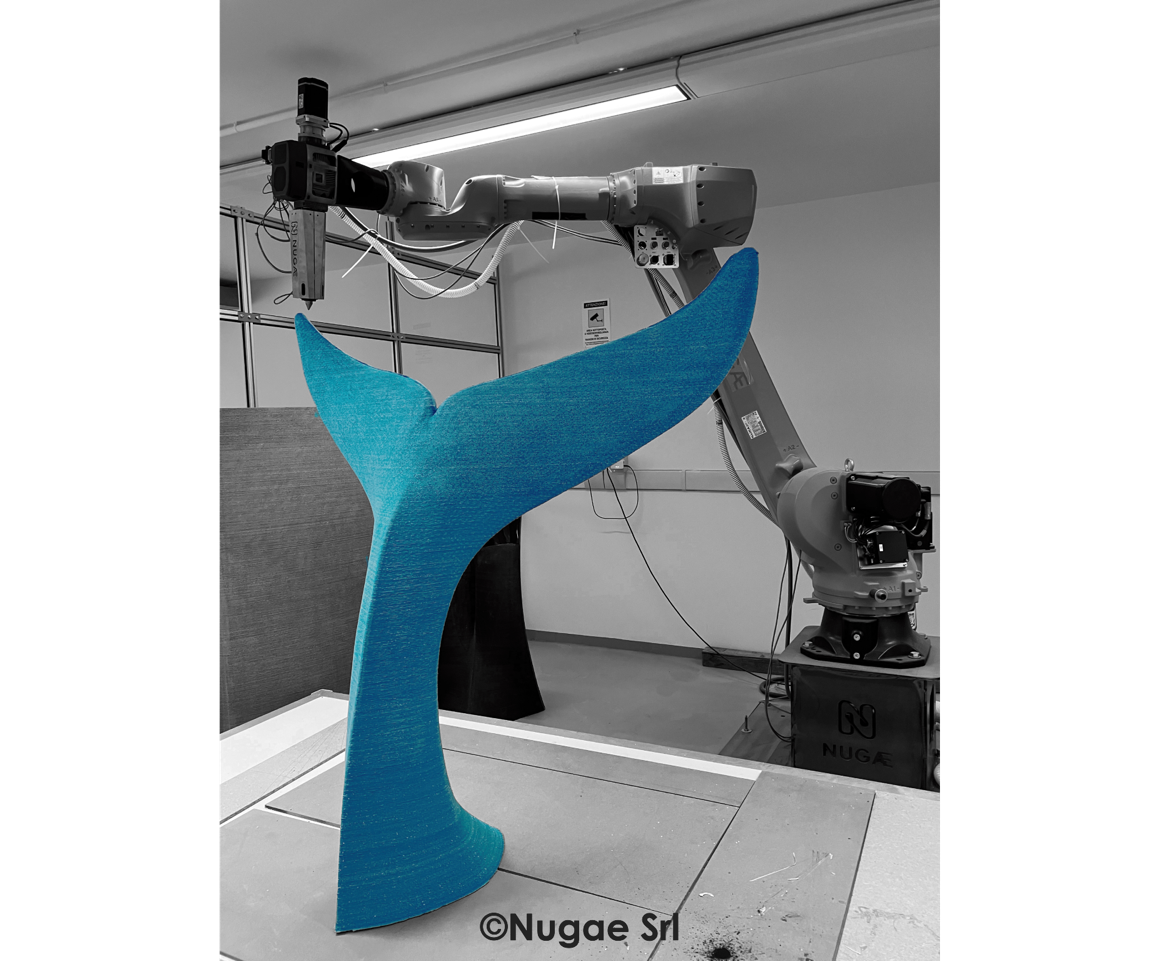
Italian firm Nugae recently used its robotic large-format additive manufacturing (LFAM) technology to create ultra-lightweight structures out of recycled plastics for the Garibaldi Urban Orchestra in Naples, a project by Pessoa Luna Park, with support from and participation by EstraMoenia within the Bella Piazza Project. Nugae’s proprietary CoreLight3D—a recycled, expanded thermoplastic core—is at the center of the project, and features a patented extruder, robotic kinematics for speeds up to 300 mm/s, and a dedicated slicer to enable stable deposition and walls that, while described as ultra-thin, won’t collapse thanks to intelligent stiffening and internal lattice structures. LFAM typically means heavy objects and thick walls, but CoreLight3D turns the concept on its head, printing extremely lightweight architectures used for an artistic, urban installation. Not only does this significantly reduce Nugae’s material usage, but it also enabled the company to print 8 colorful, large-scale scenic elements that only weight 3-4 kg. Plus, because the surfaces of these 3D printed sea monsters are so thin, they vibrate and amplify sound, acting as acoustic instruments in the performance.
🏷️ p3d_feed“We developed this material, which we define as UL-LFAM, ultra-light LFAM, to build lighter boats, but we have long been committed to themes of urban regeneration and social impact,” explained Francesco Belvisi, the founder of Nugae. “We have been collaborating with Pessoa Luna Park for some time and now, with Garibaldi Urban Orchestra, they have created the ideal place to kick off this new revolution, which we would have no hesitation in calling ‘monstrous’, especially when compared to the current state of other LFAM technologies.”