Skuld Brings Additive-Enabled Casting Closer to Production Reality
⚓ p3d 📅 2026-01-07 👤 surdeus 👁️ 18

Over the past decade, much of the U.S. Department of Defense’s (DoD) additive manufacturing (AM) strategy has focused on proving that advanced manufacturing could work inside legacy casting environments. Today, that focus has shifted. The priority is no longer experimentation, but scale.
Across the Defense Industrial Base, the challenge is now about speed, repeatability, and deployment. How fast can parts be made? How easily can those capabilities be placed closer to where they’re needed? And how can domestic supply chains be strengthened without rebuilding everything from the ground up?
One company trying to answer those questions is Skuld, a manufacturing technology firm developing hybrid workflows that combine AM with evaporative casting. The result is a process designed not to replace foundries, but to modernize them.
A Hybrid Path Between Casting and AM
Instead of fully printing metal parts, Skuld uses a hybrid process called additive-enabled evaporative casting (AMEC). First, the company 3D prints a polymer or foam pattern of the part. That pattern is then placed in a mold and disappears during casting, leaving behind a metal part with the same shape.
This approach sits between traditional casting methods. It is faster than lost-wax casting and more precise than sand casting. In many cases, the final part also needs little to no machining after it is cast.
“We’re striking a balance by using lost-foam casting in a new way,” said Sarah Jordan, Skuld’s CEO. She also noted the approach allows Skuld to move faster than traditional methods while still delivering the precision required for functional metal parts.
For defense and industrial users dealing with long lead times or outdated tooling, that balance is important. It means complex parts can be made without rebuilding production lines or waiting months for outside suppliers.
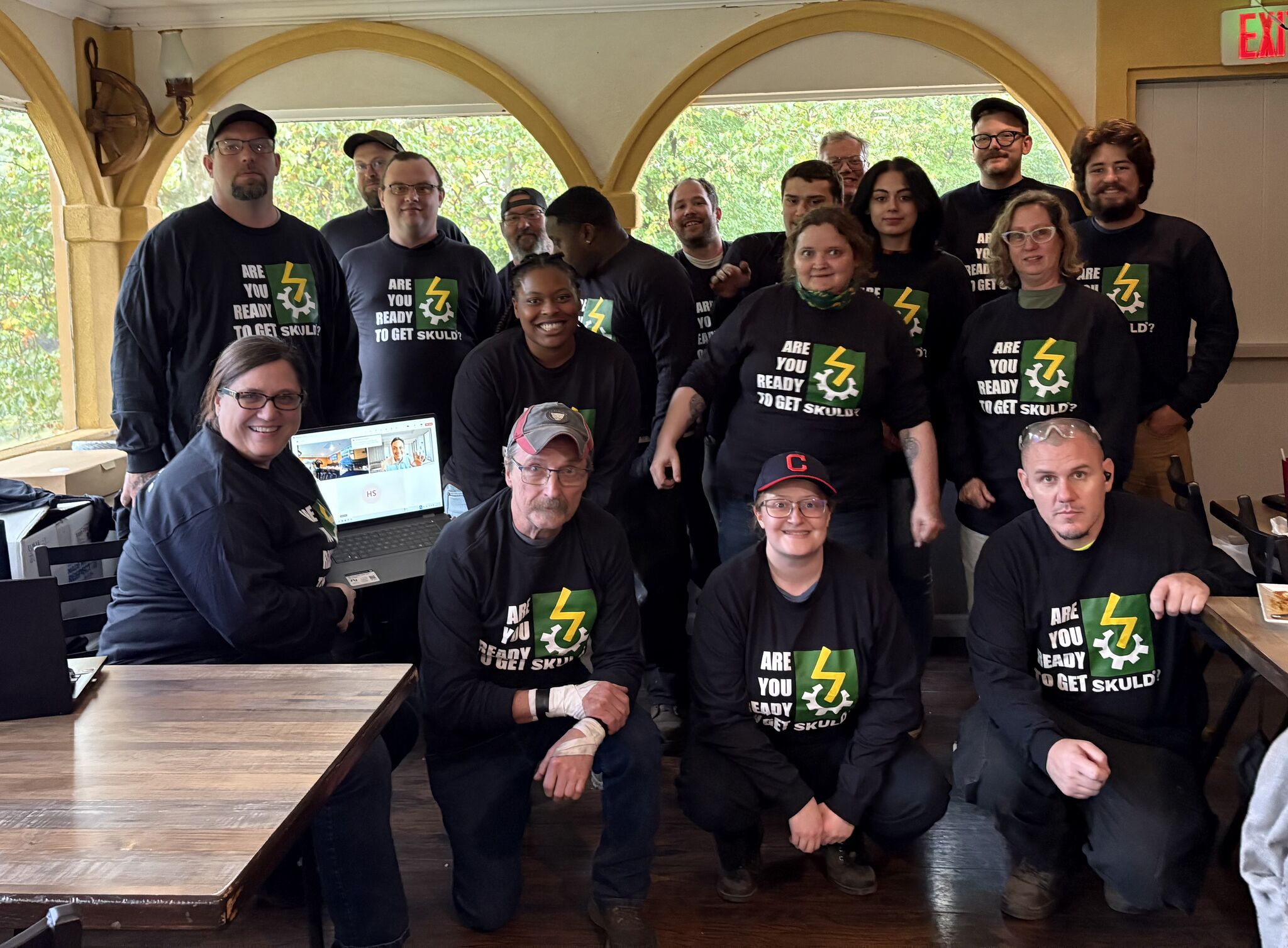
The team. Image courtesy of Skuld.
Modular Foundries Built for Deployment
Based in Piqua, Ohio, Skuld has developed several deployment-ready systems around its AMEC workflow. These include its Lightning Metal (LM16) micro-foundry, designs for existing foundries, and a containerized Conex system that integrates printing and casting into a compact footprint.
The goal is flexibility. These systems can be deployed at universities, service bureaus, defense depots, or commercial sites to enable localized production of replacement parts, tooling, or prototypes.
That capability is especially important for defense users dealing with legacy platforms and aging supply chains. Instead of relying on distant vendors, facilities can reverse-engineer parts and produce cast components on-site, greatly reducing downtime.
Strengthening the Defense Industrial Base Through Speed
Although Skuld is an early-stage company, its technology is already being applied within the defense ecosystem. Through a Small Business Innovation Research (SBIR) contract, Skuld is working with the Tinker Air Force Base Reverse Engineering and Critical Tooling (REACT) Lab to integrate AMEC into an existing foundry environment.
The project focuses on aerospace-grade aluminum components and directly addresses a long-standing challenge for the military: repairing or replacing legacy parts that are no longer supported by traditional suppliers.
“We’ve significantly reduced production times by going from reverse engineering to casting large, complex parts in as little as two days, showcasing the effectiveness of our hybrid approach for in-house manufacturing capabilities at DoD facilities,” indicated Jordan. “What took years now takes days and inches us closer to achieving our goal of broad commercialization.”
Validating AMEC Through America Makes
To move from promise to production, Skuld has focused on validation and repeatability, which are two key requirements for scaling any manufacturing process.
Through its partnership with America Makes, Skuld participated in the Improvements in Manufacturing Productivity via Capabilities and Techno-Economic Analysis (IMPACT 2.0) initiative, a program funded by the Office of the Secretary of Defense Manufacturing Technology Program (OSD ManTech). The project is designed to reduce lead times and improve productivity in casting and forging operations across the Defense Industrial Base.
As part of IMPACT 2.0, Skuld led a two-phase effort titled Speed with Evaporative Casting for AISI 4340 Steel. The work demonstrated rapid production of a 400-pound steel component, followed by a repeatability test on a challenge casting.
The results were important. The team showed that large, complex metal parts could be reverse-engineered and cast in as little as two days, a timeline that changes how in-house manufacturing can work at DoD facilities.
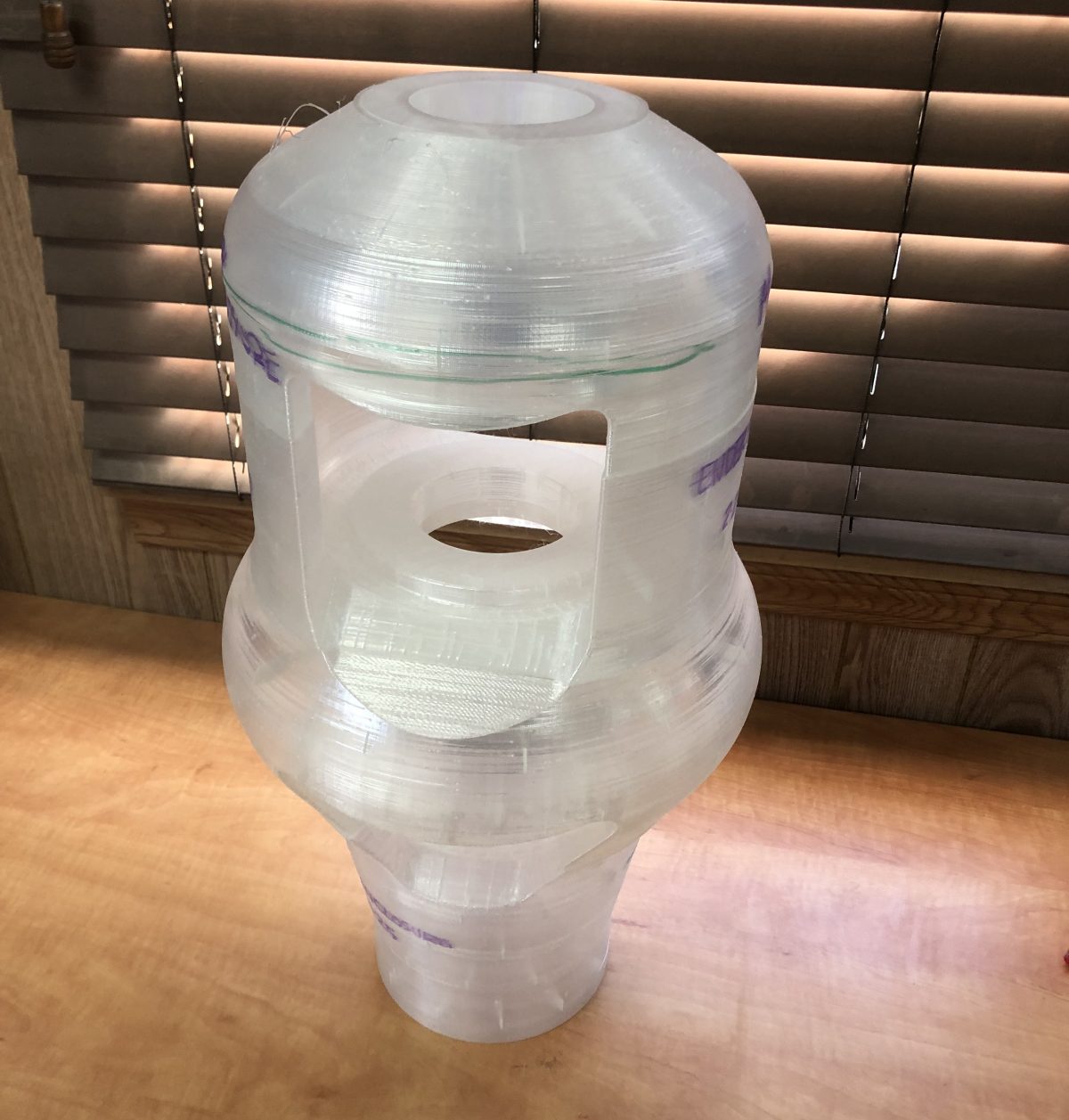
A WW II German Tiger tank muzzle brake was reverse-engineered and cast as part of the IMPACT 2.0 project. Image courtesy of Skuld.
From Demonstration to Deployment
One of the more striking outcomes of the IMPACT 2.0 work involved reverse-engineering and casting a World War II–era German Tiger tank muzzle brake, showing that the technology can be used for legacy systems that are still in service today.
For Skuld, these projects are not the end goal. They show that the approach works.
The company’s longer-term vision is to see additive-enabled casting embedded directly into government and industrial facilities, enabling what Jordan describes as “organic manufacturing,” which is the ability to produce critical parts where and when they are needed.
While AMEC is still newer than many established additive technologies, it works well with existing foundry equipment, which makes it easier to adopt at scale.
“We anticipate that this process will gain widespread adoption not only by the DoD but across the entire industrial sector,” Jordan said.
As the DoD pushes for faster and more reliable domestic manufacturing, hybrid solutions like Skuld’s offer a practical way to move forward.
🏷️ p3d_feed