3D Printing Top Technologies & Trends to Watch in 2026
⚓ p3d 📅 2026-01-08 👤 surdeus 👁️ 18

What if we take a helicopter view of the additive manufacturing market? Beyond silos, technologies, and market segments, what are going to be the most interesting trends, strategies, tactics, technologies, and events? What are the things that will change the 3D printing market overall in 2026? And what if we asked a bunch of the wisest people in 3D printing what their key things to watch out for in 2026, and then synthesized them into a single sentence?
Leading binder jet and inkjet consultant Gareth Neal believes a new seriousness and industrial focus will power us forward, driven by software. He thinks that,
“Software will start to play a larger part in the overall production of metals. To be crude, rather than waving our light sabres like a broadsword, being ruthlessly dominant over all variables, rapier-like precision and control over power, shape and direction and more will be more than a possibility, a niche. It will become prevalent in those large manufacturers that have been waiting for it and are now driving it. This will drive up quality, efficiency and TCO down. Therefore, the part cost will come down, enabling more applications. That same software control will then enable newer avenues of development, such as multi-materials and material development. I have heard of as much as a 10x reduction in cost just through software. I also think that there will be a resurgence in Binderjet driven by a deeper understanding of why Binderjet has not been successful so far, Software to control it and most importantly of all, a willingness to develop materials that work to enable it.”
This jives with what the software startup crowd was preaching in the Software Predictions article, but it’s notable for being a solution for binder jetting and also an efficient way to turbocharge your efforts without having to buy a whole bunch of packing crates. 3MF’s Duann Scott,
“One of the things I am finding most interesting is the emergence of volumetric and simulation-driven toolpath optimisation to simultaneously define variable material properties from a single material for part performance, and tuning the manufacturing process for both speed and dimensional accuracy. The convergence of laser beam shaping capabilities by companies like nLIGHT, volumetric toolpathing by Materialise, Autodesk and Dyndrite along with open hardware systems like Aconity3D and EOS M4 ONYX could all be brought together using the 3MF Volumetric and Toolpath Extensions to give voxel level fine grained control in an incredibly efficient manner. What is needed next is for CAD/CAE tools to allow engineers to better define this volumetric information, with feedback from simulation, empirical testing, and maybe even a little ML augmentation to truly make 3D dimensional components, not just a 3D form with mystery bulk properties inside.”
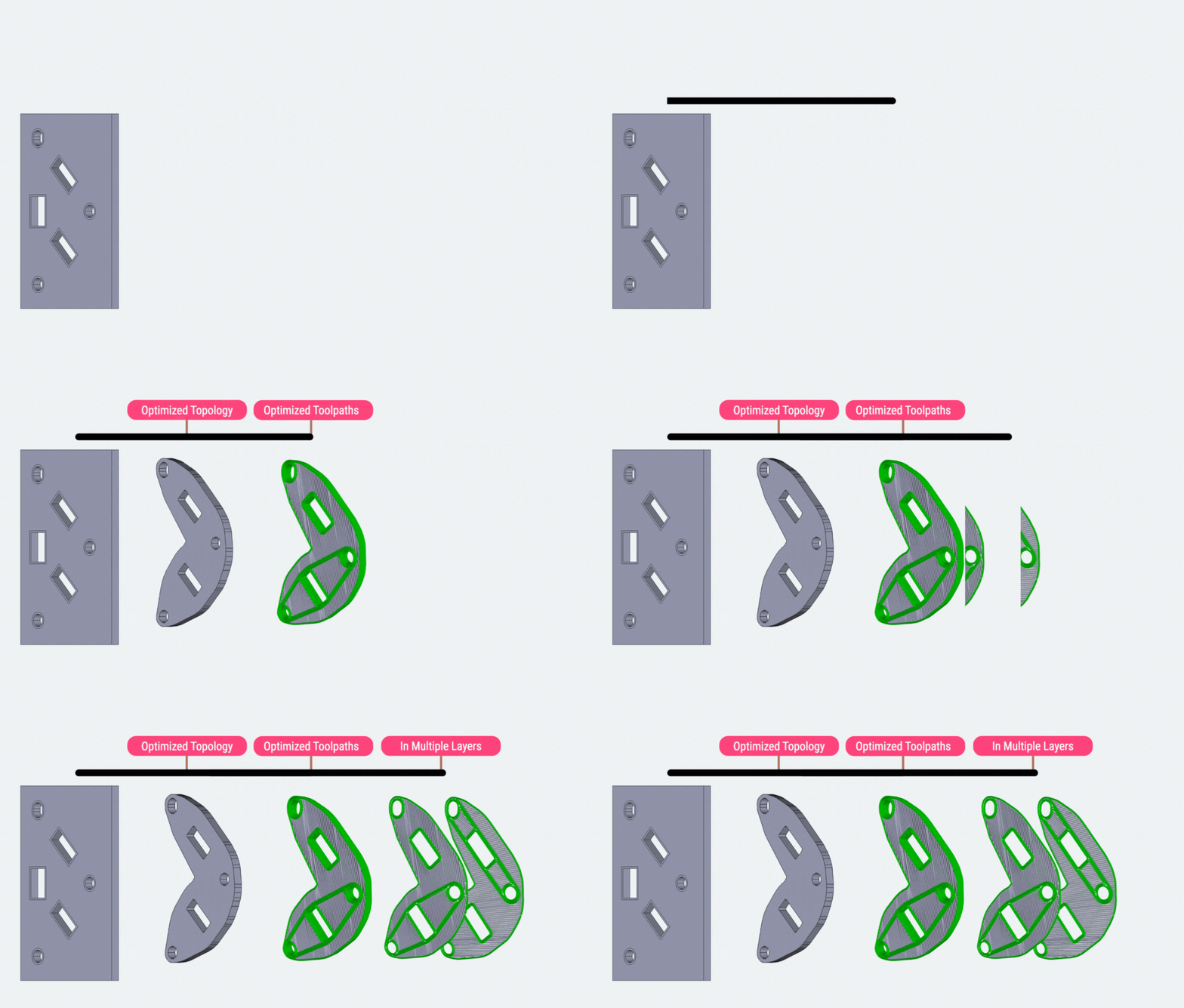
Novineer toolpathing.
Oh, what magic would this be? If we could make progress towards truly known parts at every voxel, we could make real progress in many areas. Novineer’s Ali Tamijani is working on just that for polymer and composites.
“The focus of AM software over the last decade has been mostly on metal. Over the next 12 months, the real change will be print-aware software for polymer AM that collapses the walls between modeling, mechanical simulation, and print prep. When geometry, anisotropy, and 3D-printing toolpaths are all solved in a single workflow, polymer AM becomes a more attractive option for tooling, production, and repair.”
A truly integrated solution that doesn’t require you to flit between many tools and takes all primary considerations into account would let us optimize components, assemblies, and craft in tune with properties, capabilities, and possibilities. Rather than the hazy world of possibility, we could aim for optimal success.
Another binderjet luminary, Dan Brunermer, thinks that,
“It seems like every year gets its own topic, and I believe the coming year will be the year of Automation. Though application will still be king, executing on very-high production quantity application opportunities will simply require better ways both up and down-stream of the AM machine. It’s been building for some time, and the pieces are coming together. The winners will be those who partner with other best-in-class OEMs of ancillary products and services and who can provide a true 360-degree solution.”
A total-solution view has worked wonders for the adoption of 3D printing in dentistry. More integration, more cooperation, and more solutioneering could definitely accelerate adoption and make giving us money easier and faster.
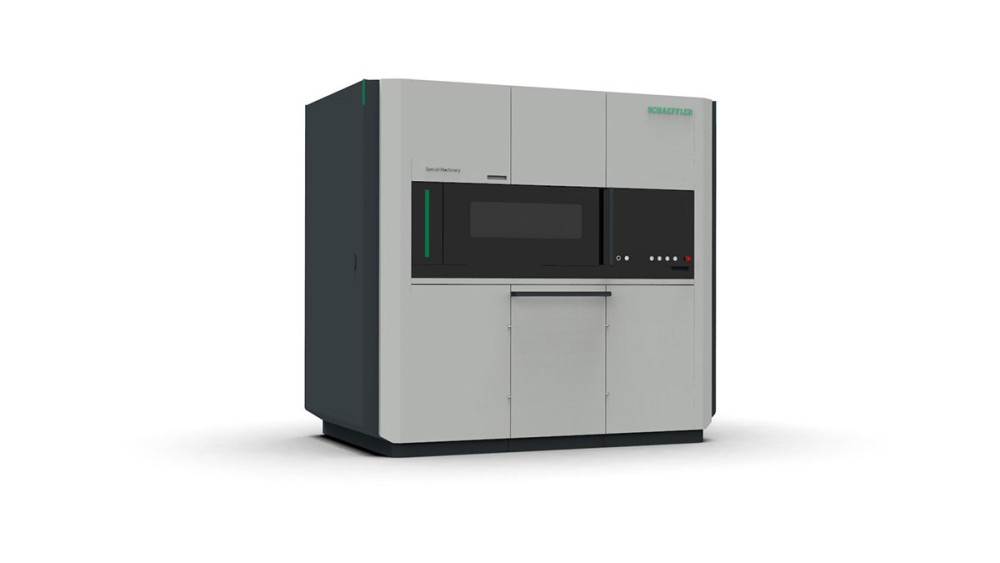
The new multi-material 3D printer from Schaeffler. Image courtesy of Schaeffler.
Andy Christensen is a true pioneer in medical 3D printing, and his work at Medical Modeling and after has done much to intertwine medicine and additive manufacturing. He concretely loves two developments in particular.
“The two most significant technology trends right now are Cold Metal Fusion and Multi-Material Metal 3D printing. Cold Metal Fusion, done by Headmade Materials and others, is a really old idea, similar to the DTM days, that is finding new life. Exciting that you can print interesting metal materials on something as simple as a Formlabs Fuse. Multi material metal printing as done by Schaeffler and Amnovis. This has cool industrial and medical implant uses. For medical, the first step is CP Ti combined with Ti64.”
Totally agree with Andy here; and it helps that he has more than a tendency to be right. I think that both these technologies could fundamentally change the industry on their own. For certain part families, Cold Metal Fusion could lead to the facile production of low-cost parts at scale using existing, now-cheap equipment. And I can’t even get my head around the new implant families and technologies that AMnovis could create using Scheaffler’s multi-material technology. Several leading implant families could come from this work, which literally has billions of dollars in impact. Another person with a deep impact in the medical space is consultant Dale Swarts, who did pioneering technical work that made titanium implants possible.
“LPBF machines are getting bigger with more lasers and more powerful lasers, and the resolution to produce small parts in metal and polymer is getting higher and higher. I see all of that impacting the cost, design, and breadth of printed medical implants. If you can print 60 to 120 acetabular cups at once instead of only 9 to 20 you will have lower costs. If you can print those acetabular cups in less time because you are melting thicker layers, you will have lower costs. The ability to produce custom implants will be impacted. True personalized and even mass customized implants with short just-in-time delivery will offer a huge benefit to orthopedic, spine, and trauma patients. No longer will a doctor have to try to find the “best fit” of an implant to match a patient’s anatomy. Implants with porous bone in-growth surfaces will continue to be the vast majority of what is printed for the medical market but single use instruments in metal and polymer and smaller and smaller implants such as stents and instrument components such as endoscopic tools will become more commonly printed.”
I’ve been very sceptical of personalized implants due to the risks, but if Dale thinks it’s likely now, then I’ll sit up and take notice. I’ve never thought about the drivers and developments that have made smaller implants possible, or about the impact of this development, which could indeed greatly expand the market.
Amnovis’ Ruben Wauthle will probably be very happy with the above predictions. Additionally, he thinks that,
“I believe 2026 will be the year of large-scale 3D printed applications. Apple’s recent adoption of LPBF for watch cases, the largest metal AM application to date, validates metal LPBF as a true production technology. We will see more of these high-volume applications emerging across industries. Concepts such as deformable implants, enabling patient-specific solutions at the cost of standardized components are an example of this. Additionally, multi-metal AM will gain traction. With academia and research institutes increasingly exploring multi-metal AM, expect this breakthrough technology to make headlines in 2026.”
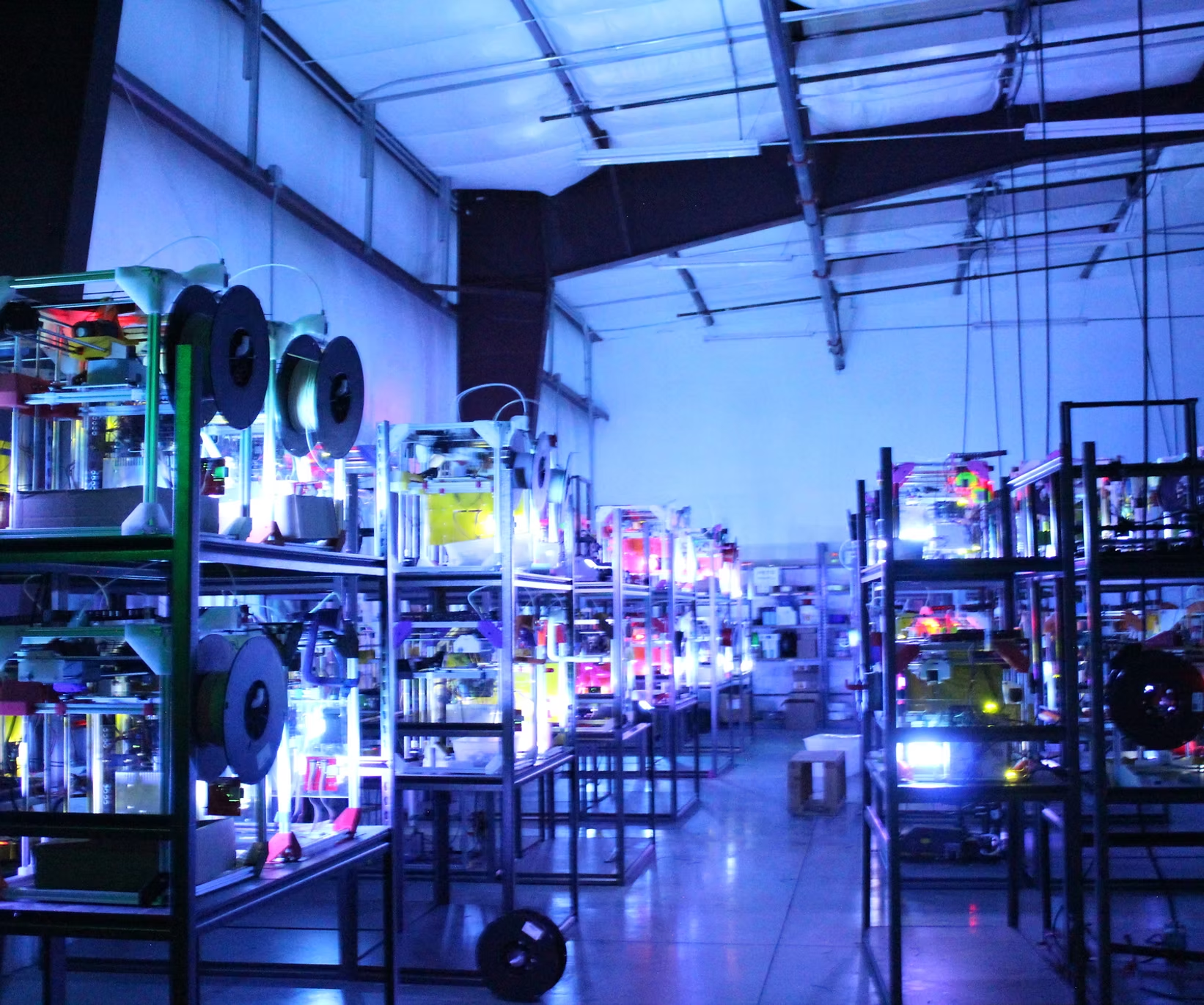
Operator of one of the largest print farms, Slant3D, Gabe Bentz,
“3D Printing is Getting a Second Wind. There is a real money coming back into the space. And the valuable companies are no longer machine makers but the companies that are using the technology to create a product that was never possible before. Fidget toys are a simple example. They cannot be manufactured any other way they additive. And with no other additive technology than Material Extrusion. This enabled even more by free access to giant prints farms and the creation of 3D models with AI. It will be a Cambrian moment of product creation.”
Easier file creation and lower cost farms may very well push us past a barrier which will see accelerating adoption. But if YouTube, other farms and successful entrepreneurs inspire many more people to create we can see a further acceleration stemming from this development. I agree with Gabe here that farms and design accessibility can be a huge force multiplier for us. Top notch designer and engineer Jonathan Klodner thinks,
“Most of the industry to this point has been, ‘would you like to buy this box that lets you make things this new way?’ The problem has been that compared to an equivalently priced machining center, injection molding line, or any other traditional manufacturing investment, the economic output has been laughable. For anything that can be made by traditional means, it has always made more economic sense to do so. Also, AM materials and the corresponding end product could not approach the quality of finished goods that traditional manufacturing processes can offer (…) but that’s changing. Within the last ~2 years or so, there’s been a subtle but critical shift in material quality and cost that is changing the math in certain finished components.“AM is currently having a “disintermediating impact” on manufacturing, the way that the internet disintermediated commerce. It’s way easier to do a Direct to Consumer company now than at any point in history, and the capex to get off the ground for a manufactured good (rather than just media, art, entertainment, etc.) is coming significantly down due to the quality of 3D printing coming way up.“This will bring about millions of niche things that no big company would ever invest in developing or supporting, but hundreds of thousands of designers and engineers will make because they care about something. And the world will be marginally better for that optionality existing. Another approach will see outsized gains accrue to those who command applications mastery through vertically integrated delivery of substantial performance benefits in areas like fluid handling components, shock absorption, certain electric motors, thermal exchange and more.”
I really believe in this dual path to sucess. On the one hand you can make on the fly, quickly, for everyone or start a simpel company fast. But, there is another way, that of outcompeting at a critical voxel in time with knowledge transformed into geometry that gives you an unfair advantage to help manage a particular flow of energy matchlessly. If you’re a person with a laptop, the first path could be extremely lucrative for you but for a venture or corporate the mint of future riches and mine for the future is to be had through the second path. Unless of course you capture the collective energies of the crowd with some tool or market.
AM Power‘s Matthias Schmidt-Lehr told us that,
“In 2026, Additive Manufacturing will undergo further consolidation, with weaker players exiting and stronger ones merging or being acquired. This market rationalization will improve overall profitability and help attract the fresh investment needed to accelerate industrial adoption. Technologically, accessibility will improve as industrial-grade AM solutions become easier to deploy and less dependent on internal R&D. Beyond continued growth in aerospace and defense, we will see meaningful expansion in consumer applications. Consolidation will also reshape niche technology segments. Solutions that cannot demonstrate profitable, scalable applications will fade, while those delivering clear value will advance.”
If we were to sum up a lot of what is said then we would come up with a single idea: high volume and niche 3D printing applications growth will accelerate through automation, cooperation, precision, application mastery and single workflow voxel level control manufacturing optimal products that were never possible before in Binder Jet, (multi-material) LPBF, material extrusion and Cold Metal Fusion. What do you think? Did we miss anything?