Boston’s Additive Edge at Autodesk: Re:3D and the Power of Printing from Waste
⚓ p3d 📅 2026-01-09 👤 surdeus 👁️ 16

This article is part of the “Boston’s Additive Edge at Autodesk” series, highlighting projects and research taking shape inside the Autodesk Technology Center in Boston.
At the Autodesk Technology Center in Boston, innovation comes in many forms. Teams from universities, startups, and labs share space with some of the world’s most advanced fabrication tools. It’s a place where ideas move quickly from concept to full-scale prototype, including bridges, turbines, furniture, and even experimental building materials.
Among the resident teams is re:3D, a company that uses its large-format Gigabot printers to explore how recycled plastic flakes and pellets can be transformed into functional parts for real-world use. From their base at Autodesk, they’re refining the process, sharing open data, and collaborating with other residents on new ways to make 3D printing more sustainable.
The Texas-based company, known for its mission to turn waste plastic into usable products, is helping Autodesk teams in the residency program explore what’s possible when 3D printing meets circular manufacturing. I spoke with Patrick Ferrell, one of re:3D’s senior engineers, and Michael Rivera, who leads operations at their GigaLab in Puerto Rico, about how they’re testing new ways to print directly from recycled materials and sharing open data on what works and what doesn’t.
Printing from Plastic Waste
“The vision has always been about accessibility,” Ferrell told me. “We started 13 years ago to make large-format 3D printing available to everyone — and to make it sustainable.”
Unlike most printers that rely on filament, re:3D’s systems can print directly from shredded plastic flakes, the kind that would typically end up in a landfill. Their flagship machine, the Gigabot X, feeds those recycled pellets into an extruder and prints full-sized parts, furniture, or molds without ever touching virgin material.
When I spoke earlier this year with co-founder Samantha Snabes, she described the company’s mission as “turning trash into opportunity.” That same spirit is what drives re:3D’s work at Autodesk today, proving that waste can be raw material for the next generation of makers.
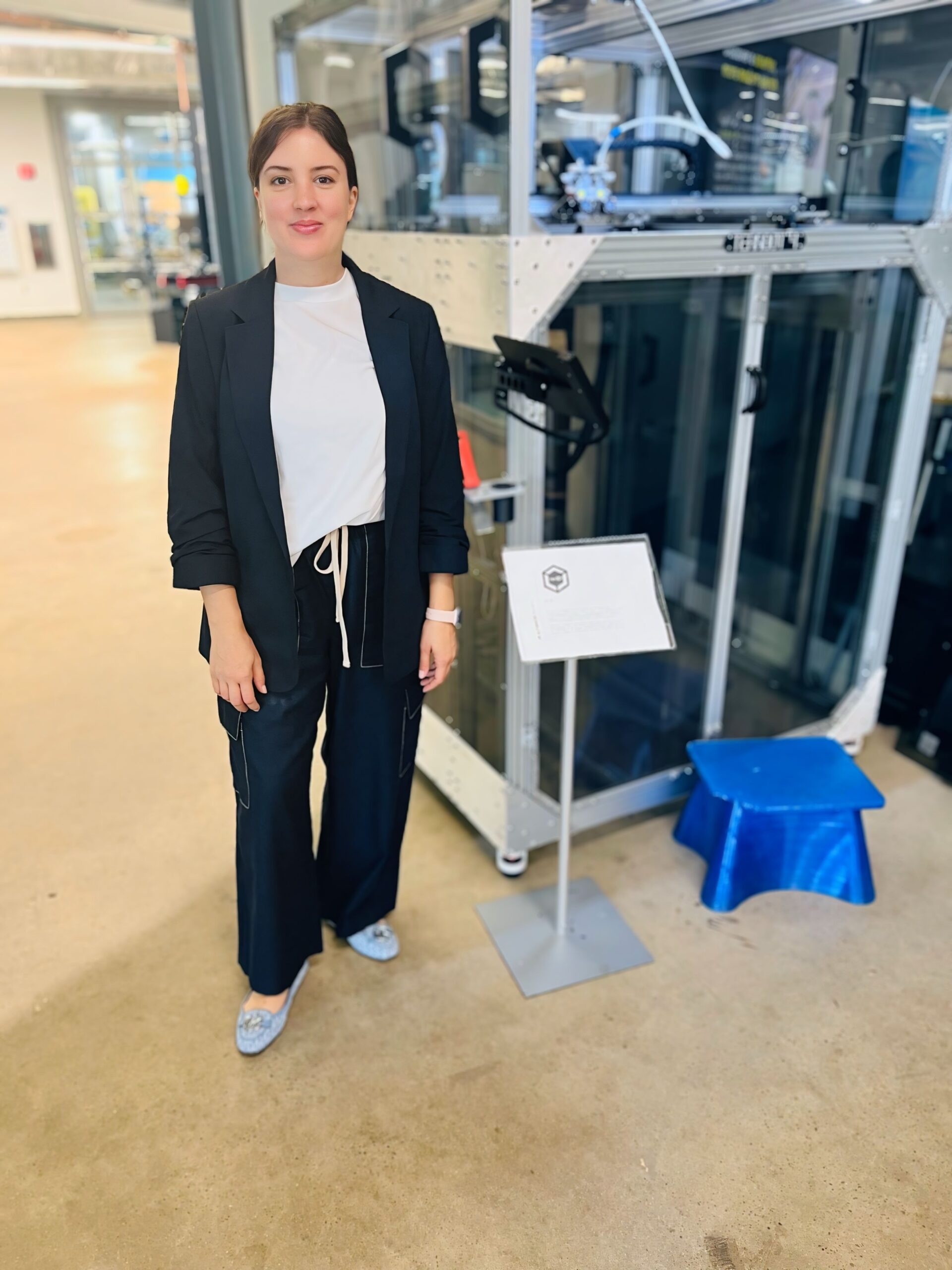
Vanesa Listek next to re:3D’s printer at the Autodesk Technology Center in Boston. Image courtesy of 3DPrint.com.
“It’s not easy,” Ferrell admitted. “Plastic waste is unpredictable. Every batch has its own quirks, different flow rates, and different additives. You need to treat it almost like a living material.”
At Autodesk, re:3D’s technology gives residents and students the chance to work hands-on with recycled polymers, running experiments that blend sustainability with real design challenges.
“We see people using the printer for hydroponic walls, molds, even furniture,” said Rivera. “It’s great to see what comes out of that curiosity.”
An Open Approach to Innovation
Ferrell pointed out that re:3D’s approach is open-source by design, from hardware schematics to the data they collect.
“We believe in open science and open hardware,” he said. “If someone improves our design, we want them to share it. That’s how the whole field moves forward.”
In fact, each month, they host an open user group on fused granular fabrication (FGF), where anyone, from a hobbyist to a researcher, can present findings or learn about recycling techniques. That openness has helped re:3D build a community that reaches far beyond the Technology Center’s walls.
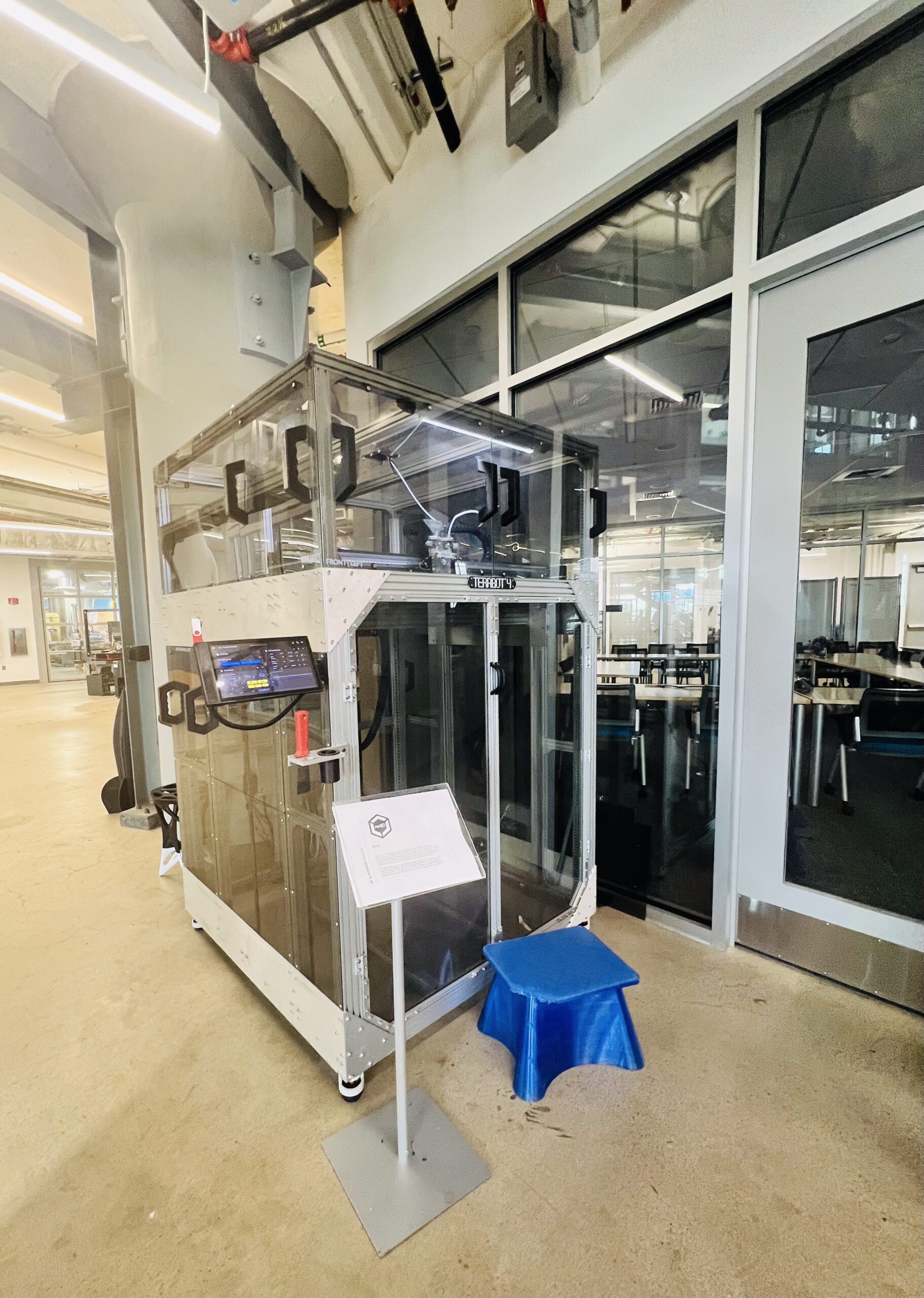
re:3D’s printer at the Autodesk Technology Center in Boston. Image courtesy of 3DPrint.com.
Rivera works out of Bayamón, Puerto Rico, home to one of re:3D’s two GigaLabs. It’s right next to city hall, he noted: “Sometimes even the mayor walks over and asks if we can help with a project.”
The lab’s focus is local and practical: turning waste into community benefit. “We print furniture, hydroponic systems, even prosthetic leg covers. We’ve done projects with drones for emergency deliveries during earthquake simulations. It’s all about solving problems close to home, using the materials that people throw away,” Rivera explained.
The Puerto Rico Science and Trust Fund and the NSF helped launch the first GigaLab, and it has since become a model for community-based circular manufacturing.
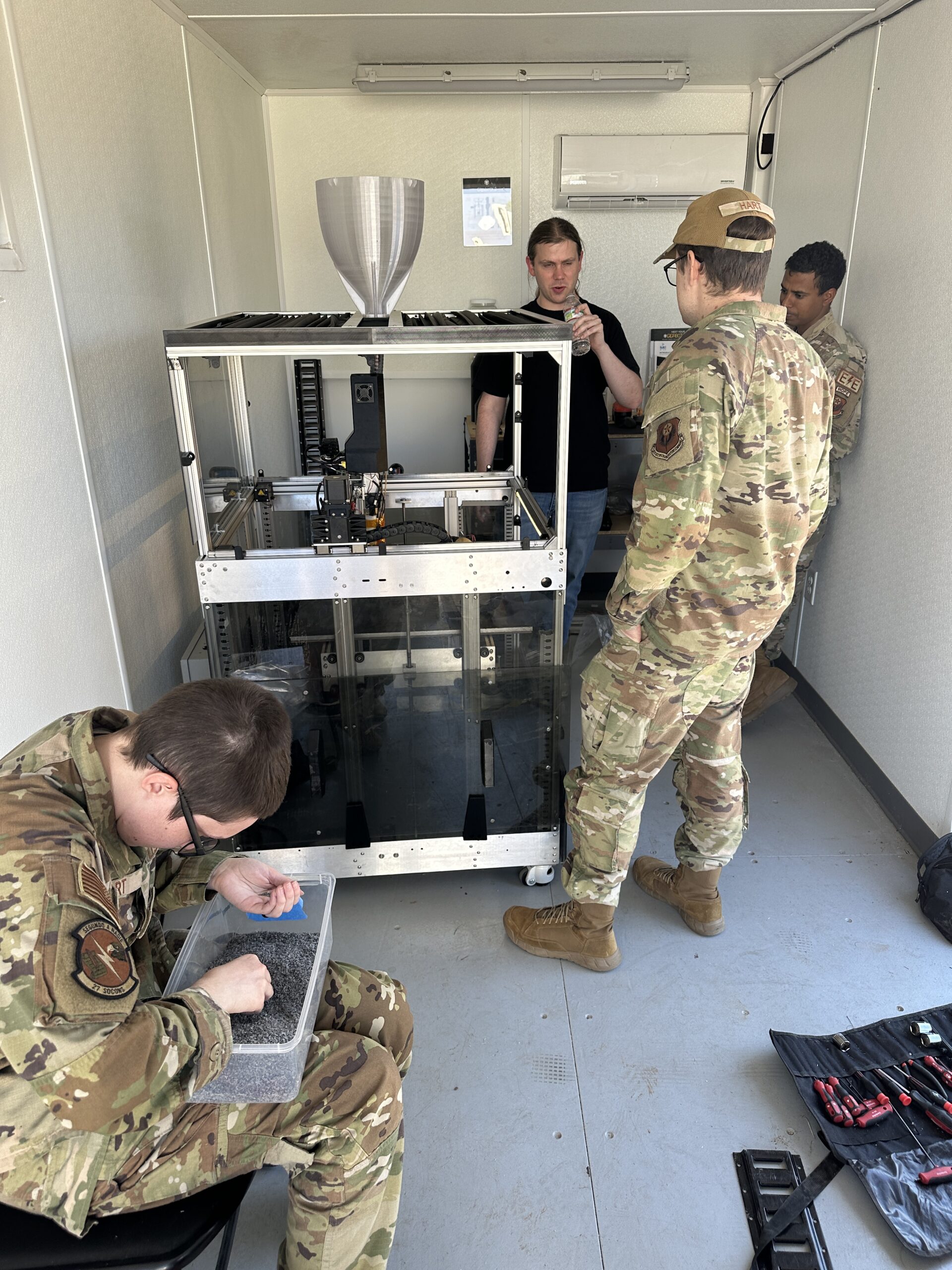
Airmen preparing shredded plastic for use in the Gigabot printer. Image courtesy of re:3D.
Re:3D’s connection to Autodesk goes back several years. Their Gigabot X and Terabot printers are part of Autodesk Research’s residency ecosystem, where startups, researchers, and companies test new fabrication methods in a shared space. Through this residency, re:3D collaborates with Autodesk engineers and visiting teams to refine large-format printing processes, experiment with recycled materials, and explore how open-source design can scale to industrial applications.
Ferrell described: “It’s made everything easier. The residency program gives us access to machines and people we’d never have otherwise. We use their CFD software to test heated chamber designs, collaborate with residents working on materials, and learn from everyone around us. It’s that mix of hardware and community that makes it so special.”
Toward a Circular Future
From NASA contracts to Department of War (DoW) projects, re:3D’s focus is on one principle: “embrace the waste.” Ferrell said it’s like a company motto, but it’s also their philosophy. “Whether it’s printing in space or on the ground, the idea is the same: use what’s available, where you are.”
Making recycling 3D printing mainstream, however, will take more work.
“The challenge is usability,” Ferrell said. “People want to just toss in mixed waste and press print. Right now, you still need to be a bit of a material scientist. But we’ll get there. The goal is a clean, simple experience — set it and forget it.”
At the Technology Center, every project pushes a boundary. It’s also a reminder that innovation doesn’t always mean inventing something new, but seeing potential in what others discard. For re:3D, that means turning waste into possibility. re:3D’s printer brings something different to Autodesk’s lineup, showing that sustainable ideas can succeed at an industrial scale. For anyone lucky enough to work inside the Technology Center, this is where great ideas get their chance to become real.
All images courtesy of 3DPrint.com, unless otherwise noted
🏷️ p3d_feed