3D Printing News Briefs, January 17, 2026: Titanium Scrap, Autopsy Analysis, & More
⚓ p3d 📅 2026-01-17 👤 surdeus 👁️ 26

In this weekend’s 3D Printing News Briefs, we’ll start with government funding news from IperionX. Then, a German contract manufacturer has acquired its 6th and 7th Lithoz ceramic 3D printers. We’ll end with 3D printed weapon replicas for autopsy analysis. Read on for all the details!
IperionX Gets Final $4.6M in DoW Funding & Titanium Scrap from U.S. Government
IperionX site in the United States. Image courtesy of IperionX.
About a year ago, American titanium metal and critical materials company IperionX received a contract worth up to $47.1 million from the U.S. Department of Defense (now Department of War) to provide titanium to the U.S. defense industrial base (DIB). After receiving tranches of $12.5 million and another $25 million over the last several months, IperionX announced that it has received the last $4.6 million of the DoW contract. This final amount was obligated through the DoW’s Industrial Base Analysis and Sustainment (IBAS) program. All of the funding will be applied to scaling up capacity for titanium production and advance manufacturing at IperionX’s Titanium Manufacturing Campus in Virginia. The end goal is to enable output of up to 1,400 metric tons per year (tpa) of titanium at this site, and the funding will help with this.
The IBAS program is meant to reinforce U.S. defense supply chains by helping with a low-cost, resilient titanium platform, which will lower our reliance on imported critical materials like the ones IperionX offers. In addition to the final IBAS funding, the U.S. government has transferred, free of charge, roughly 290 metric tons of high-quality titanium scrap material to IperionX. This surplus is worth about 1.5 years of titanium feedstock at the company’s current full operating capacity of 200 metric tons a year. With the fulfillment of the DoW contract, and the provision of the titanium scrap, it’s clear how important it is to the government that a resilient, integrated, low-cost titanium supply chain be established for the U.S. DIB.
Steinbach Expands Serial Production Capacity with More CeraFab S65 Printers
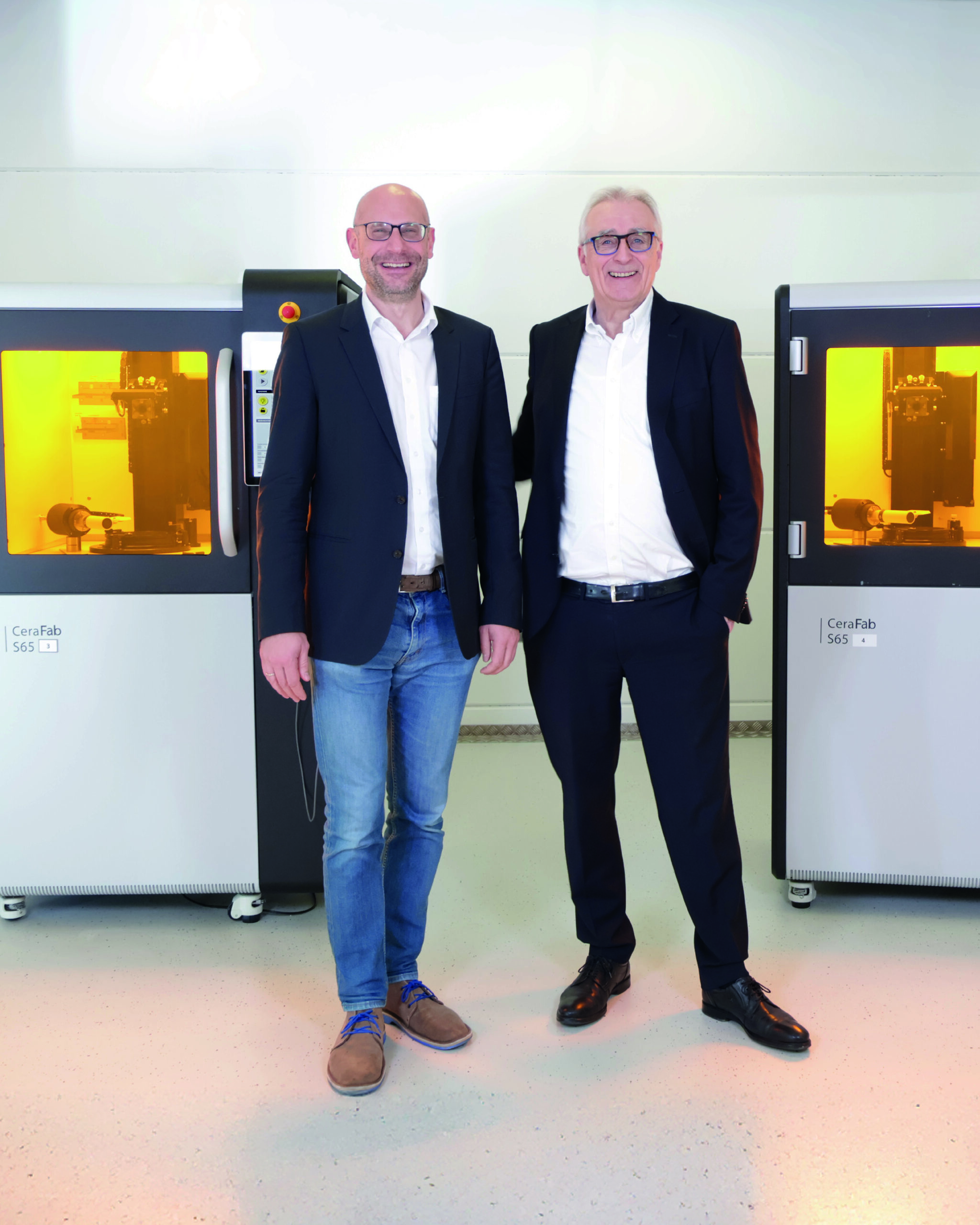
Lithoz CEO Dr. Johannes Homa (left) and Steinbach CEO Volker Steinbach (right)
German contract manufacturer Steinbach AG, which specializes in technical ceramic AM, is a partner of Austrian ceramics 3D printing leader Lithoz, and a member of its Ceramic 3D Factory: a global network of contract manufacturers and other partners. The company has just acquired two more CeraFab S65 printers, bringing the total in its Lithography-based Ceramic Manufacturing (LCM) printer fleet up to seven. Steinbach’s goal is to further grow its capacity of serial production of 3D printed ceramics for industrial applications. The company is building on the momentum that’s still resulting from formnext 2025, and the strong turnout at the Lithoz booth. By scaling its LCM production with more Lithoz machines, Steinbach can meet the increased demand for 3D printed ceramic components in machine engineering, measuring, and sensor technologies.
“After many years of working with LCM technology, growing our 3D printer fleet is a natural response to increasing market demand. Coming from various industries such as machine engineering, measuring and sensor technologies, and MedTech, our customers rely on consistent quality, reliability, and long-term production continuity,” said Volker Steinbach, CEO of Steinbach.
“Besides, we have strengthened our post-processing capabilities to 13 furnaces, enabling us to reduce delivery times for prototypes to three to four weeks. By expanding Steinbach AG’s LCM-based machine park, we have scaled our rigorous quality standards to meet customer expectations at mass production level, further reinforcing our position as a trusted manufacturing partner for high-performance ceramic components.”
Research into 3D Printed Gun Replicas for Autopsy Analysis

AI-generated photo of a Glock weapon. Image courtesy of 3DPrint.com
There are many examples of 3D printing being used to help with criminal investigations and autopsies. Now, researchers from the University of Pécs Medical School in Hungary have published a study on their work using 3D printed replicas of homicide weapons during autopsies, specifically by giving forensic pathologists a detailed, tangible replica of weapons used in crimes. Autopsy teams have to examine wounds, and the tools that inflicted them, in great detail to determine the cause of death, and try to reconstruct what led to it. But handling real weapons can be unsafe, and forensic practitioners have long been looking for a better method. To create exact replicas of murder weapons, the researchers use scanning technology to capture the details and dimensions of the original weapon, and then create a digital model optimized for 3D printing. By carefully controlling print resolution and material properties, they’re even able to add more subtle features of forensic significance, like rifling marks on a firearm barrel. Their study provides examples of several case applications where their 3D printed replicas were successfully used during autopsies, offering better visualization without compromising safety or damaging the original. These replicas could even be used in the courtroom for demonstration purposes. However, the researchers also emphasize the need for rigid calibration and validation protocols to ensure that the 3D printed weapon replicas meet forensic admissibility criteria.
🏷️ p3d_feed“A large percentage of homicides involve sharp or blunt weapons. Analyzing injuries and their mechanisms in such cases should include comparing the weapon with the injuries and evaluating the direction of impact(s). This is done typically through macroscopic observations, measurements, tool mark analysis or imaging techniques. Using replicas of weapons created via three-dimensional (3D) printing during autopsy can implement the application of these methods. Scaled photographs of weapons, routinely made during crime scene investigation, provide a perfect basis for 3D modelling. Three-dimensional objects such as hammers or axes, can be modeled with computer-aided design (CAD) software or 3D scanning methods like photogrammetry. Five case reports of homicides involving sharp or blunt weapons are presented to illustrate the routine application of 3D-printed replicas. The case reports illustrate how this technique can help demonstrate the mechanism, especially if combined with 3D reconstruction methods,” the researchers wrote in the abstract of their study.