The AM Adoption Problem No One Models
⚓ p3d 📅 2026-01-20 👤 surdeus 👁️ 31

Through its short history, Additive Manufacturing has been presented to the investment community as a classic high growth technology story. Manufacturing is a multi-trillion-dollar market. Even a small percentage looks enormous. AM promises lighter parts, more efficient designs, faster iteration, customization, and localized production. The logic appears straightforward.
If the technology is superior and the market is vast, then growth should follow.
Yet growth is much slower than the models predict. Despite continuous technical progress, repeated waves of innovation, and rising awareness across industries, the commercial penetration of AM into true production remains uneven, and resistant to acceleration.
Investors see this pattern repeatedly. Companies generate excitement, pilots are launched, prototypes are printed, and announcements are made. Then momentum slows. Sales cycles stretch, forecasts slip, and capital needs increase. What first looks like a fast-scaling platform begins to resemble a long and capital-intensive infrastructure build.
The problem is not that investors are careless.
It is that they are using tools built for a different kind of change. Traditional metrics such as Total Addressable Market, Serviceable Market, and modeled return on investment work best when adoption is mainly a purchasing decision. A customer becomes aware of a solution, evaluates it, buys it, and deploys it with limited disruption. This logic works in software, automation, traditional manufacturing, and most consumer technologies. It doesn’t hold in AM production.
The crux of the matter is adoption rates in AM are very slow.
In production, AM is not a tool replacement. It is a system change. Adopting it means rethinking how parts are designed, how materials are qualified, how processes are validated, how quality is assured, how post processing is handled, how inspection is performed, and how compliance is documented. It requires new skills, new assumptions, and new forms of risk management. None of this is visible on a market size slide or a revenue forecast.
This is why adoption rarely moves directly from interest to deployment. It moves in stages.

Parts produced with Axtra3D’s Loctite 3D IND3380 for the SLA Lumia X1. Image courtesy of Axtra3D.
Companies start with curiosity and experimentation, then limited prototyping, then controlled pilots, often through service bureaus to avoid internal disruption. Only later does in-house production make sense technically, economically, and organizationally. This slow progression is not hesitation. It is rational risk control inside environments where failure can mean recalls, regulatory action, safety incidents, or brand damage. This slows down printer purchases for AM OEMS.
Manufacturing organizations are designed to prioritize reliability and predictability over novelty. In that environment, proven processes consistently beat unfamiliar ones, even if the unfamiliar ones promise higher long-term value. And jobs of individuals making these decisions are at stake.
This creates a powerful gravitational pull toward the status quo.
For an AM OEM, the largest competitor is rarely another AM system. It is the incumbent process. Injection molding, machining, casting, stamping, and forming are amortized, certified, staffed, documented, and trusted. They are deeply embedded in corporate culture, supply chains, and regulatory frameworks. To displace them, it is not enough for the AM technology itself to be better, but the entire new ecosystem must be better enough to justify disrupting a mature and stable ecosystem.
That threshold is extremely high and varies widely by application. Printing a dental model is not the same as printing a flight critical aerospace component. The technical demands differ. The regulatory burden differs. The tolerance for failure differs. The organizational concerns associated with failure differs. The same technology can therefore experience varied adoption rates, not because the machines change, but because the environment around them does.
This is the central insight for investors – Market size does not determine opportunity, but the speed at which the market can change does.
Adoption rate governs everything that matters financially. It shapes how long sales cycles last, how quickly reference customers emerge, how fast standards form, how much capital is required before breakeven, and how fragile or durable revenue becomes. A large market with a twenty-year adoption curve behaves like an infrastructure project, not a growth venture. It demands patience, sustained capital, and realistic expectations about return timing.
This explains why so many AM companies feel early forever. They are not early in technology. They are early in organizational transformation. They are waiting for institutions, incentives, and behaviors to realign.
Once this is understood, the question shifts from how big the opportunity is to how hard the transition will be. It becomes a question about qualification timelines, internal politics, workflow disruption, regulatory inertia, and risk perception. It becomes a question about who inside the customer organization absorbs the pain of switching, and whether the economic benefit is incremental or truly transformative.
This reframing also changes how companies should be evaluated. The most resilient AM businesses embed themselves deeply into specific workflows, understand the change process, and help customers redesign systems rather than simply sell equipment. They invest in applications, validation, integration, and change management, not only in hardware performance.
It also changes how capital should be structured. Long adoption ramps mean longer periods of cash burn, slower revenue realization, and higher sensitivity to macroeconomic cycles. Valuations must reflect that reality. Capital strategies must assume patience. Exit expectations must align with industrial timelines rather than software timelines.
AM is not slow because it is weak. It is slow because manufacturing is conservative by design. Risk is high, consequences are severe, and trust is earned over long periods. Technology moves faster than institutions, and institutions move faster than cultures. All three must shift for production adoption to occur.
At Axtra3D, we explicitly model adoption rates into our qualification, and forecasting. To help customers move faster and more confidently into production AM deployment, we developed Axtra Workflow – one key piece of the adoption acceleration puzzle. It is a fully connected, validated production system integrating printing, post processing, inspection, and traceability, reducing adoption friction and shortening ramp time.
In closing, AM is not a fast market pretending to be slow. It is a slow market pretending to be fast. Until we explicitly model realistic adoption rates and the pull of the status quo, our ROI models will continue to be mathematically precise and strategically wrong.
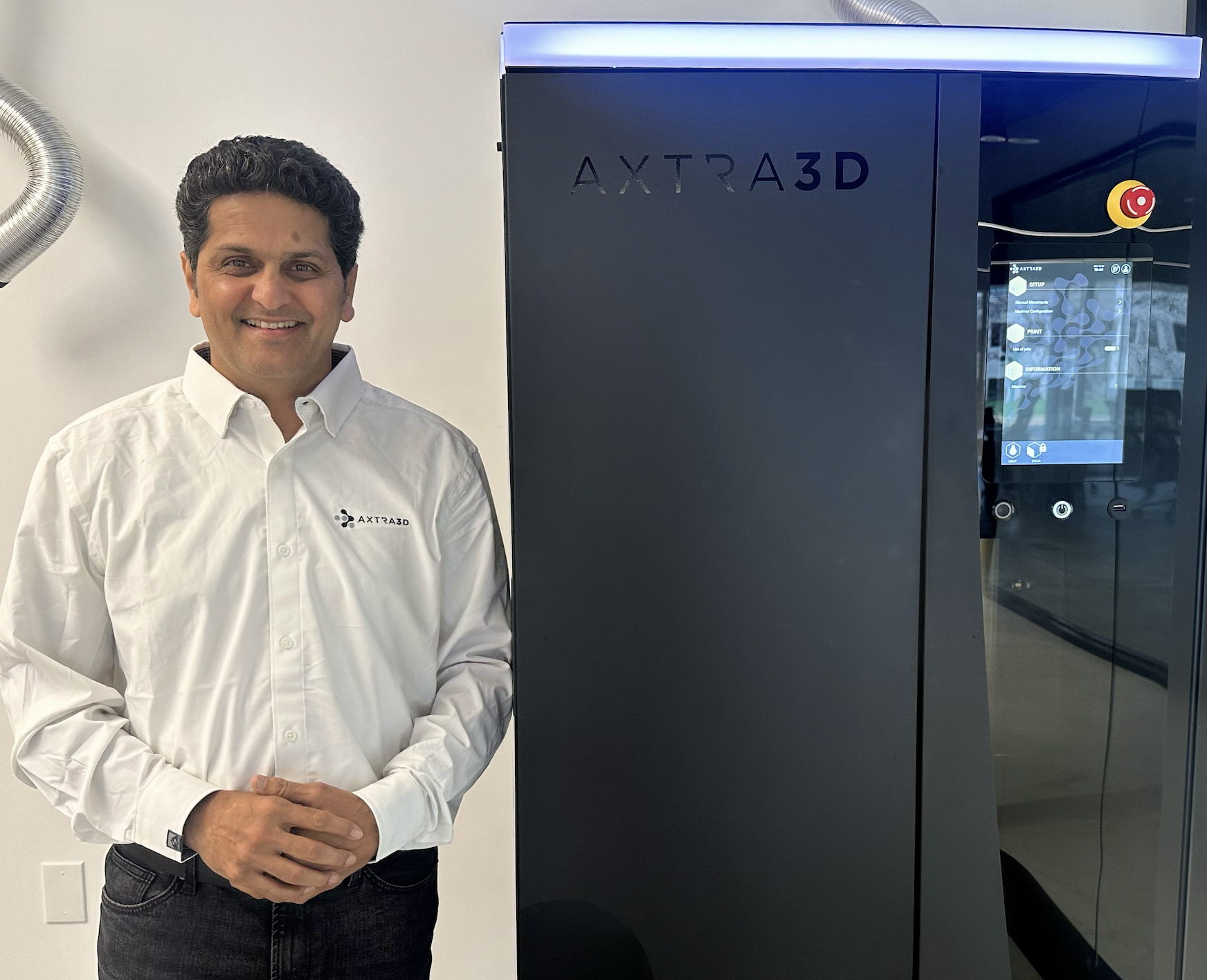
Axtra3D CSO Rajeev Kulkarni
Rajeev Kulkarni, Chief Strategy Officer for Axtra3D, will be speaking at Additive Manufacturing Strategies (AMS), a three-day industry event taking place February 24–26 in New York City. Kulkarni will participate in the panel “M&A and Capital Markets” on February 24. Registration for the event is open via the AMS website.
🏷️ p3d_feed