How Metal Additive Manufacturing Is Reshaping the Future of Aerospace and Defense Engineering
⚓ p3d 📅 2026-01-22 👤 surdeus 👁️ 23

By Dan Woodford, CEO, Conflux Technology
Additive manufacturing (AM) is steadily changing the way we think about producing metal parts for aircraft. Whilst aerospace and defense companies have been using metal AM for over twenty years, it was long confined to R&D, prototyping, and niche components. Today, it’s starting to be viewed as an essential tool for creating lighter, more efficient and more sophisticated components for both aerospace and defense, as widespread adoption and certification-level maturity accelerate.

Dan Woodford, Conflux Technology CEO
A new confidence in metal additive manufacturing
One of the main limitations for metal AM in flight applications has been the lack of real data. There simply was not enough statistical evidence to understand how these parts would behave in flight, especially over long periods of service.
Today this situation is starting to change. Over recent years, a growing body of research and testing has given manufacturers a much better understanding of how metal additive parts perform. With this new knowledge, we see a clear shift from very cautious and small steps to a growing confidence in applying additive manufacturing to aircraft design.
This verification is opening the door to a new freedom in design. Additive manufacturing makes it possible to combine multiple pieces into a single component while also reducing weight. Both benefits are extremely valuable in aircraft engineering, where every gram saved contributes to greater efficiency and lower operating costs.
Why metal AM matters
Metal additive manufacturing is not only about replacing existing parts but about rethinking how those parts can function. For example, in heat exchangers, which are our main area of focus at Conflux, AM technology allows the creation of highly efficient, lightweight and conformal structures. These parts can follow the natural curves of a fuselage or an engine manifold, using space in a smarter way while also improving thermal performance.
Before these components can be used in flight, however, they must pass through a very demanding certification process. To prove that a part can operate safely, engineers define what are called ‘allowables’, which are statistical limits that describe how a material behaves. Traditionally, this has required producing and testing thousands of small samples over many years, often at the cost of millions of dollars.
For metal additive parts, this process is even more complex, because each machine and set of machine parameters may create different material properties, and a single component can include both thick sections and very fine internal walls. Proving the reliability of such geometries requires new testing methods and deeper statistical understanding.
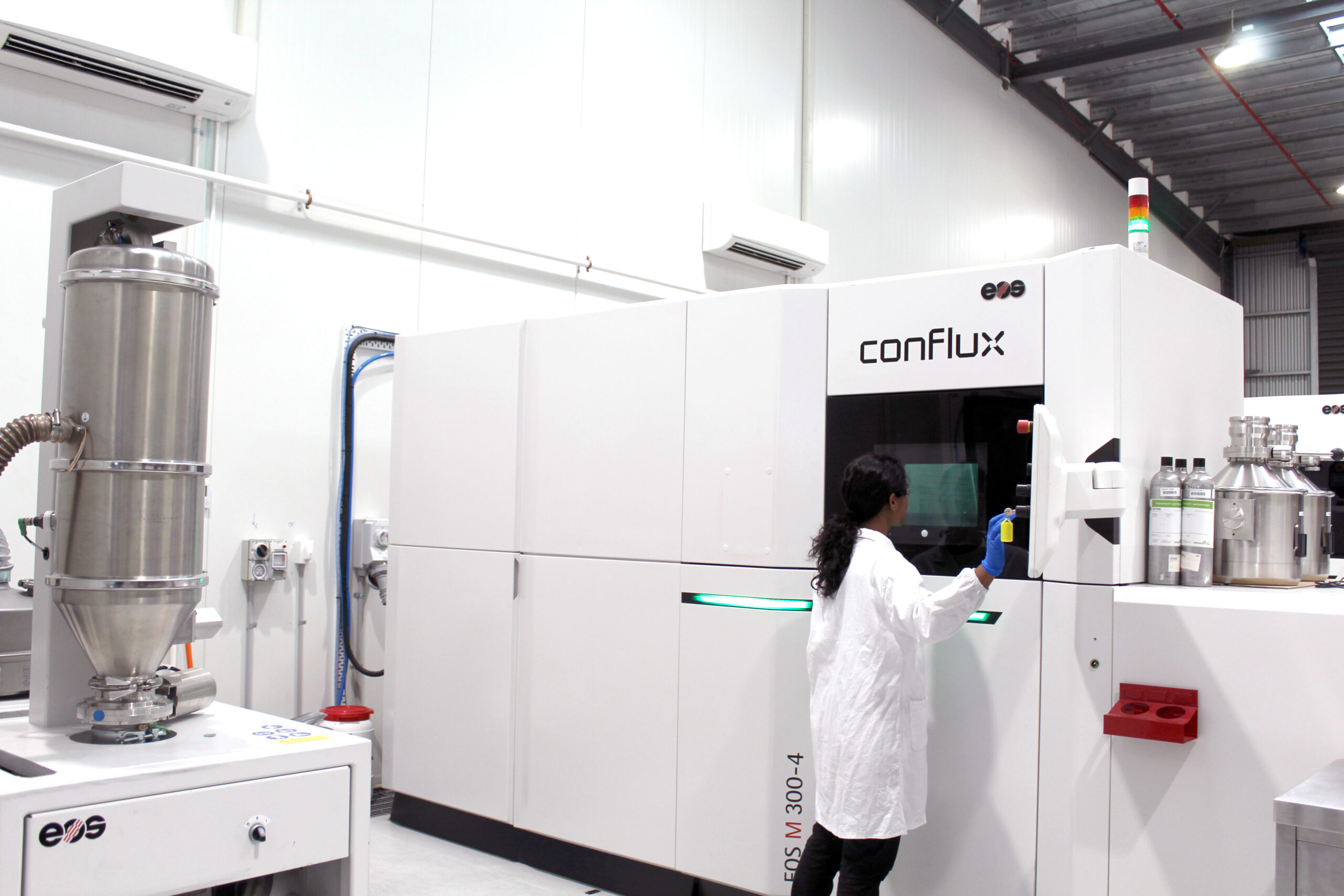
Fortunately, inspection technology is improving. Engineers can now use CT scanning and other advanced techniques to look inside printed parts and understand their behavior in detail. At Conflux, our collaboration with the Australian Synchrotron provides access to world‑class beamline facilities, enabling us to examine our metal heat exchangers at the microscopic level. This capability delivers the detailed material and structural data essential for developing reliable statistical allowables—helping accelerate the certification of complex additive components for use in critical aerospace and defense applications.
Faster adoption in defense, long term promise in civil aviation
Both defense and civil aviation are benefiting from these advances, though at different speeds. Defense programs usually have tighter development timelines and accept a higher level of technical risk when the performance benefits are clear. This makes them natural early adopters of new manufacturing methods, and they have, in fact, been using metal AM for some time, with real military applications emerging since the 2010s.
Civil aviation faces longer qualification cycles and stricter safety requirements, but the long-term potential is enormous. Lighter and more efficient engines and airframes could greatly reduce emissions and fuel consumption. There is also a very practical side to consider. Many aircraft in service today are decades old, and replacement parts for them can be extremely difficult to find. Additive manufacturing makes it possible to produce these low volume replacement parts without the need to restart entire production lines.
Looking ahead: collaboration is essential
It is becoming increasingly clear that no company can advance this technology alone. The qualification and certification of additive parts require strong collaboration between large manufacturers, smaller technology specialists, research institutions and governments.
At Conflux, we have also seen the value of this collaborative approach through our work with partners such as Airbus, AMSL Aero and the Honeywell-led TheMa4HERA consortium. Working together allows the whole supply chain to move faster, because once a process or part is proven, that knowledge can be shared across the industry.
Among all the areas of additive manufacturing, metal remains the most demanding. Airframes, engines and other critical systems are made of metal, and they must operate reliably for many years. Understanding and meeting the certification requirements for these parts is therefore absolutely essential.
The potential rewards, however, are extraordinary. With the design freedom that additive manufacturing offers, we can now create parts that are 30 to 40 percent smaller and lighter while maintaining or even improving performance. These conformal designs could also support entirely new aircraft architectures, with shapes and configurations that were previously impossible to build.
As the technology continues to mature, metal additive manufacturing will not only improve how we make aircraft but also transform how we design them. Lighter, faster and more efficient aircraft will define the next generation of aviation, and additive manufacturing will play a central role in making that future possible.
Conflux Technology will be speaking at Additive Manufacturing Strategies (AMS), a three-day industry event taking place February 24–26 in New York City. Founder and Executive Chairman Michael Fuller will participate in the panel “The Future of Metal Parts for Aerospace & Defense” on February 25. Registration for the event is open via the AMS website.
🏷️ p3d_feed