Scaling DLP: How Visitech Moves Production Beyond the “Printer Farm”
⚓ p3d 📅 2026-02-03 👤 surdeus 👁️ 12

With hundreds of light engines shipped in 2025, Visitech is leveraging its new Texas facility and scrolling DLP architecture to redefine industrial throughput. By achieving up to 20 times the volume of static systems, the company is helping OEMs bypass supply chain volatility and reduce machine cost-per-part by up to 80%.

Øyvind Tafjord, Visitech CEO
Visitech CEO Øyvind Tafjord will present a clear argument at Additive Manufacturing Strategies (AMS) in New York this February, in his talk dubbed “Scaling DLP printing of high-performance parts: moving from bottles to tanker trucks.” Lowering the cost per part in high-volume, high-resolution additive manufacturing requires an approach different from printer farms.
Reshoring for supply chain resilience
Visitech’s Texas facility plays a central role. Beyond increasing production capacity, the site has helped the company offset the impact of tariffs and avoid customs-related delays, ensuring that scrolling-capable LRS-MCx subsystems reach machine builders without prolonged international logistics. Furthermore, the site serves as a global hub for spare parts and service, significantly enhancing machine availability for customers in the field.

Image courtesy of 3DPrint.com
High-resolution DLP has long delivered image quality – but scaling it for production has relied on the “printer farm” model — if demand increases, more machines are added. Capacity grows, but so do floor space requirements, energy consumption, operational complexity, and the cost of ownership. According to Tafjord, that linear scaling model does not meet the efficiency needed for high-volume production of high-resolution parts.
Shifting focus from machine count to machine throughput
Visitech argues that an alternative approach is gaining traction: increasing throughput by improving utilization with fewer systems. That argument is reflected in recent shipment volumes. In 2025, Visitech shipped hundreds of DLP light engines from its Texas facility, which manufactures scrolling-capable subsystems for machine builders.
Shipment numbers alone don’t define industrialization, Tafjord acknowledges, but he sees them as a signal that OEMs are increasingly focused on throughput rather than printer count.
Scrolling DLP: Expanding the exposure area
The underlying technology driving this shift is scrolling DLP. With 15 years of experience with UV lithography in the PCB industry, this technology is well proven. Instead of exposing a static image, a scrolling light engine moves continuously across the resin vat, enabling a much larger effective exposure area per layer without sacrificing resolution.
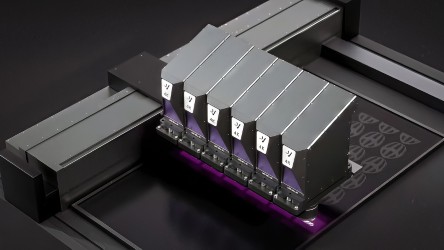
LRS-MCx 4K DLP projectors in a scrolling configuration.
“What matters is not how many printers you have,” Tafjord says, “but how much area you can expose per unit of time.”
The economics of scrolling DLP
According to Tafjord, the significance lies in what scrolling enables at the system level. A single scrolling projector can produce between 10 and 20 times the volume of high-resolution parts compared with a static system, he says. Based on Visitech’s internal modeling, that increase in effective exposure can reduce machine cost-per-part to as low as 20% of what would be required using a large park of static projectors.
The multi-projector advantage
As scrolling systems scale from single-projector systems to multi-projector configurations, throughput can increase faster than system cost, shifting how machine depreciation is distributed across produced parts.
At higher production volumes, even basic assumptions shift. “At a certain resin volume, your frame of reference changes,” Tafjord says. “You stop thinking in bottles and start thinking in tanker trucks.”

Øyvind Tafjord, Visitech CEO
That shift in thinking — from capacity to utilization — will be the focus of Tafjord’s AMS presentation as the industry continues to test what industrial-scale DLP production really looks like.
Visitech is a Platinum Sponsor of Additive Manufacturing Strategies (AMS) 2026 (AMS 2026), which will take place in New York City from February 24–26. The event will bring together leaders from across the additive manufacturing industry to discuss technology, strategy, and real-world adoption. Learn more and register for AMS 2026.
🏷️ p3d_feed