3D Printing News Briefs, February 7, 2026: Generative AI, USVs, Microgravity, & More
⚓ p3d 📅 2026-02-07 👤 surdeus 👁️ 11

Today’s 3D Printing News Briefs is a bit of a mixed bag. We’re starting with generative AI tools for 3D design from MIT, and then news about USVs. Moving on, Chinese scientists successfully 3D printed a metal structure in microgravity. Finally, we’ll finish with research on quantum sensors.
CSAIL Researchers Create Generative AI Design Tool for Personalized 3D Printing
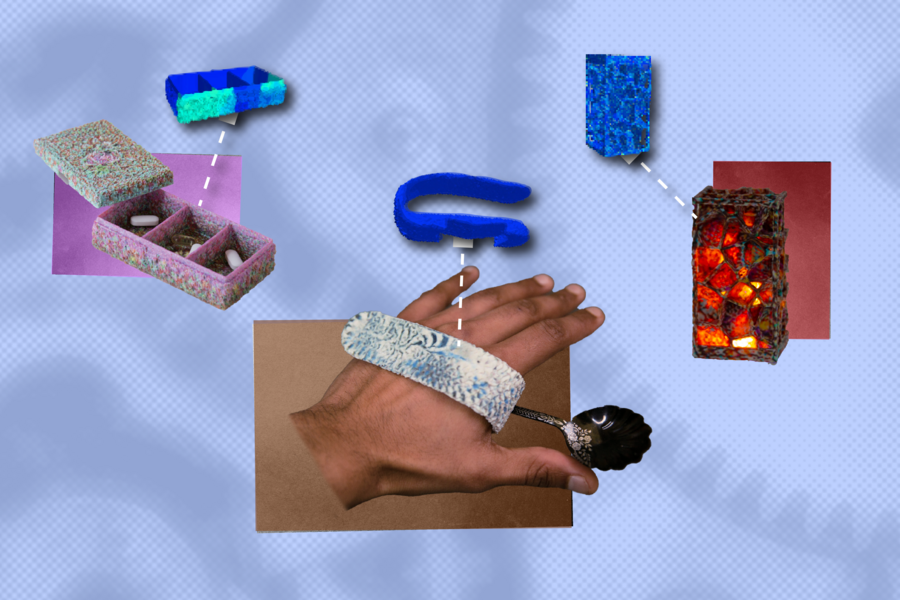
Artificial intelligence (AI) can be used to come up with personalized 3D models that you can later print, but the model’s physical properties are often not taken into account. Faraz Faruqi, a PhD student at the MIT Department of Electrical Engineering and Computer Science (EECS) and engineer with MIT’s Computer Science and Artificial Intelligence Laboratory (CSAIL), worked with researchers at Google, Stability AI, and Northeastern University to develop MechStyle, a generative AI design tool that enables users to personalize their 3D models, while also making sure the mechanical integrity is intact. The team used a physics simulation called finite element analysis (FEA) in their tool, which shows which parts of the model are structurally sound and which aren’t. In MechStyle, users upload a 3D model, or choose a preset asset of an item, like a hook or a vase, pick their material, then prompt the tool with text or images to create a personalized version. The 3D geometry is then modified with a generative AI model, and the tool simulates how any changes will impact the model. Once you’ve approved the AI-enhanced blueprint, you can print it out. In addition to making fun items, such as a cactus-like hook, MechStyle can also help design assistive technology, like finger splints and utensil grips.
“We want to use AI to create models that you can actually fabricate and use in the real world. So MechStyle actually simulates how GenAI-based changes will impact a structure. Our system allows you to personalize the tactile experience for your item, incorporating your personal style into it while ensuring the object can sustain everyday use,” Faruqi explained.
ASTM International Awarded NATO AIS Fund Project on USVs

ASTM International was recently awarded a new project focused on standardizing unmanned surface vehicles (USVs). The project, “Unmanned Surface Vehicles (USV) Standardization: Current Status and Future Outlook,” is under the NATO Accelerating Interoperability and Standardization (AIS) Fund, and delivered by a consortium led by Greece-based defense systems company INTRACOM DEFENSE S.A. (IDE). ASTM’s cooperation with NATO builds on an existing Memorandum of Understanding (MOU) between the two about advancing alignment and interoperability in defense technologies. For this project, ASTM will use its expertise in technical frameworks, advanced manufacturing, and “defense-focused collaboration” to support NATO and its growing need for maritime capabilities. The goal is to find gaps and opportunities related to USV standardization, as well as any associated frameworks, and then offer recommendations to NATO to inform future capability development and standardization priorities, and help improve operational readiness.
“Defense readiness depends on more than standards alone—it requires trusted technical frameworks, collaboration across borders, and the ability to translate innovation into deployable capability. ASTM International’s advanced manufacturing programs team is excited to collaborate with our European partners to drive innovation and standardization for USV technology that bolsters the future capacity of the NATO alliance,” stated Dr. Mohsen Seifi, Vice President of Global Advanced Manufacturing Programs at ASTM International.
MARIN’s 3D Printed SeaRush Prototype USV Moving Towards Scalability
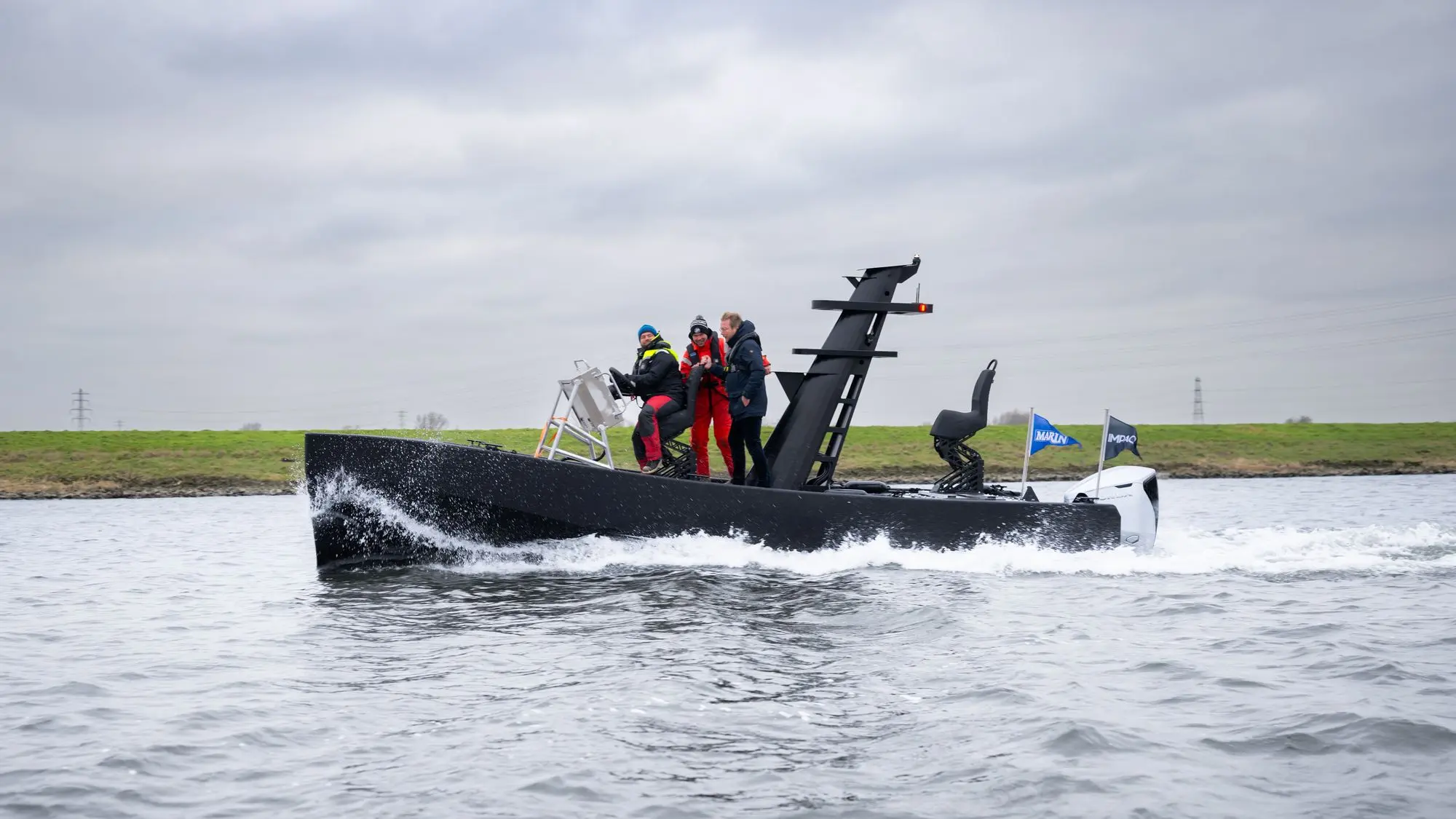
Speaking of USVs, the Maritime Research Institute Netherlands (MARIN) recently conducted the first tests on the water with a prototype of its SeaRush Uncrewed Surface Vessel, taking a big step toward scalability; it’s now a floating test platform for uncrewed maritime systems. Made with flexible material and 3D printing, SeaRush is a defense project developed by MARIN and innovation center MIND (or MINDbase), the innovation hub of the Commando Materieel en IT (COMMIT) for the Netherlands Ministry of Defence. The focus of the project is rapid development, deployment, and iterative improvement of USVs, in order to help the Royal Netherlands Navy in its eventual transition to a combined fleet of both crewed and uncrewed maritime systems. As international conflicts continue to intensify, demand for these types of uncrewed systems are growing fast, especially as the Navy doesn’t think it can bring in the necessary personnel due to labor market constraints.
IMPACD Boats took the SeaRush concept and turned it into a 3D printable design, and collaborated with CEAD on the 3D printing process. The hull was printed in less than a week at the Dutch Boat Factory in Delft, and a Honda outboard engine provides propulsion. Plus, thanks to an interface with the UltraFlex control system, it can be operated externally. The SeaRush platform also supports applications where uncrewed vessels work together with other systems, like drones. Within the KNOWONE research program, MARIN is investigating the use of software applications to ensure that small and large USVs can work with crewed systems in maritime operations without requiring extra operators. The ultimate goal of all of this work is to develop an ecosystem for scalable production of affordable USVs. Later this year, MARIN will demonstrate both the SeaRush and KNOWONE projects during the Maritime Uncrewed Sea Trials (MUST) 2026 exercise.
Chinese Scientists 3D Print Metal Structure in Microgravity
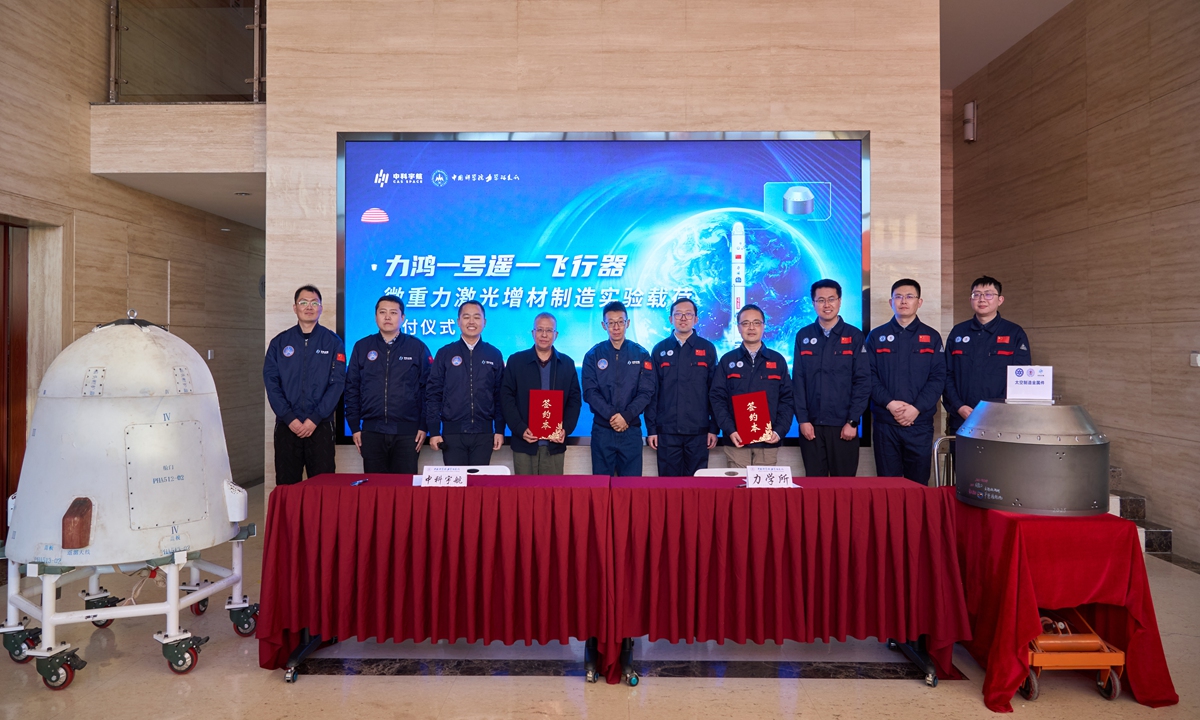
Photo: Courtesy of CAS Space
Scientists from China have successfully 3D printed a metal structure in microgravity, marking the country’s first metal 3D printing experiment in space and a big step for its in-orbit manufacturing capabilities. The team, from the Institute of Mechanics under the Chinese Academy of Sciences (CAS), developed a retrievable scientific payload, which went to space aboard the commercial Lihong-1 Y1 suborbital vehicle, developed by CAS Space. Once the vehicle crossed the boundary separating Earth’s atmosphere from outer space and reached an altitude of about 120km, metal components were autonomously 3D printed in the microgravity environment. This mission elevates China’s space-based metal AM from merely research to real “in-space engineering verification.”
It’s obviously much more difficult to 3D print with metal in microgravity environments, and the researchers had their hands full of challenges to solve, such as full-process closed-loop control, stable material transport and forming under microgravity, and reliable coordination between the launch vehicle and its payload. The payload wasn’t just carrying a metal 3D printing system, but also rose seeds for an agricultural research project. With its high flexibility and low launch costs, the CAS Space Lihong-1 Y1 vehicle is working out well as a testbed for this important research, and will be reconfigured and reused to help increase commercial space tourism possibilities and low-cost suborbital experiments. As for the metal AM in microgravity experiment, the payload capsule landed safely with the assistance of a parachute, and scientists are now combing through the important data it captured during the printing process, including characteristics of the melt pool, solidification behavior, material transport, and mechanical properties of parts 3D printed in spaces.
3D Printed Textured Surfaces Help Improve Quantum Sensors
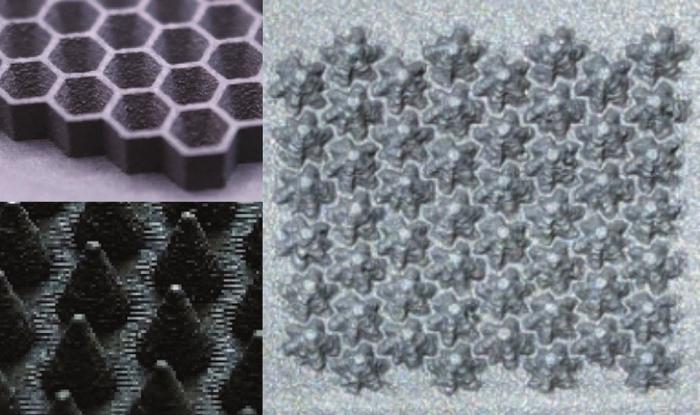
3D printed surfaces featuring intricate textures that can be used to bounce unwanted gas particles away from quantum sensors.
Quantum sensors use microscopic quantum objects to precisely measure things like gravity and magnetism, and could be very useful in scientific research, medical diagnostics, and navigation. Because they’re so sensitive, they can only work under a highly controlled vacuum, as air is dense enough that gas particles often bump into each other. But, undesirable particles sometimes still sneak in and cause problems. To combat this problem, researchers from the University of Nottingham School of Physics and Astronomy used 3D printing to create fine-scale, intricate surface textures that can actually bounce these unwanted particles away from quantum sensors, thus paving the way for useful particles like atoms to be efficiently delivered. They created a system that 3D prints titanium alloy into different patterned surfaces, like conical protrusions and hexagonal pockets. The system, which is about the size of a hockey puck, easily fits into a commercial vacuum chamber’s ports, and was designed to increase how many times an incident atom made contact with the 3D printed surface. The researchers said by applying it to a surface-based vacuum pump, the system was able to triple the rate at which it could remove nuisance particles.
🏷️ p3d_feed“What’s exciting about this work is that relatively simple surface engineering can have a surprisingly large effect,” explained PhD student Ben Hopton, a co-author on the team’s paper. “By shifting some of the burden from active pumping to passive surface-based pumping, this approach has the potential to significantly reduce, or even remove, the need for bulky pumps in some vacuum systems, allowing quantum technologies to be far more portable.”