The Real ROI of Personalized 3D Printed Medtech in Oncology
⚓ p3d 📅 2026-02-10 👤 surdeus 👁️ 11

Discover how patient-customized 3D printed devices like Stentra significantly reduce high toxicity-related treatment costs and improve workflow efficiencies to handle more cases more effectively overtime.
Introduction: The Economic Paradox in Oncology
For years, the Additive Manufacturing (AM) industry has battled a persistent myth: that customization is an expensive luxury. While this may hold true in consumer markets, the opposite is often the case for healthcare. In oncology, where precision, consistency, and efficiency directly affect outcomes, a one-size-fits-all approach can quietly cost health systems billions.
For radiation oncology, generic solutions frequently generate failure demand: the downstream clinical and operational burden of managing avoidable complications. The return on investment (ROI) of personalized 3D printing is therefore not limited to improved clinical accuracy; it represents a financial strategy that converts inefficiency, rework, and toxicity into measurable savings. By shifting from generic tools to patient-specific solutions, hospitals can improve patient experience, support clinicians, and strengthen their bottom line.
The Hidden Cost of “One-Size-Fits-All”
As an example, in Head and Neck Cancer (HNC) radiation therapy, the standard of care often involves rudimentary tools like cork and standard bite blocks. While inexpensive to purchase, these devices are costly in practice. Inconsistent immobilization and inadequate tissue displacement introduce variability between fractions, increasing unnecessary radiation exposure to healthy tissue.
The downstream consequence is financial toxicity. Patients exposed to unintended radiation frequently develop severe oral mucositis (SOM)—a painful, debilitating complication that extends far beyond discomfort. Studies show that mucositis and pharyngitis in HNC and lung cancer patients are associated with approximately $17,000 in mean additional cost per patient, driven by unplanned hospitalizations, feeding tube placement, and intensive supportive care (Elting LS et al.).
For patients, this means avoidable suffering during an already difficult journey. For clinicians and administrators, it translates into resource strain, unpredictable workflows, and escalating costs.
The Value of Custom-built AM Solutions
How can scalable customization reduce hospital costs? By preventing the complications that drive high-acuity spending.
Kallisio’s Stentra platform illustrates how patient-specific AM solutions can be integrated seamlessly into real-world clinical workflows. Using a fast, standard intraoral optical scan, patient anatomy is captured with minimal burden on staff. Design is automated, manufacturing validated, and a customized device can be delivered in as little as 72 hours.
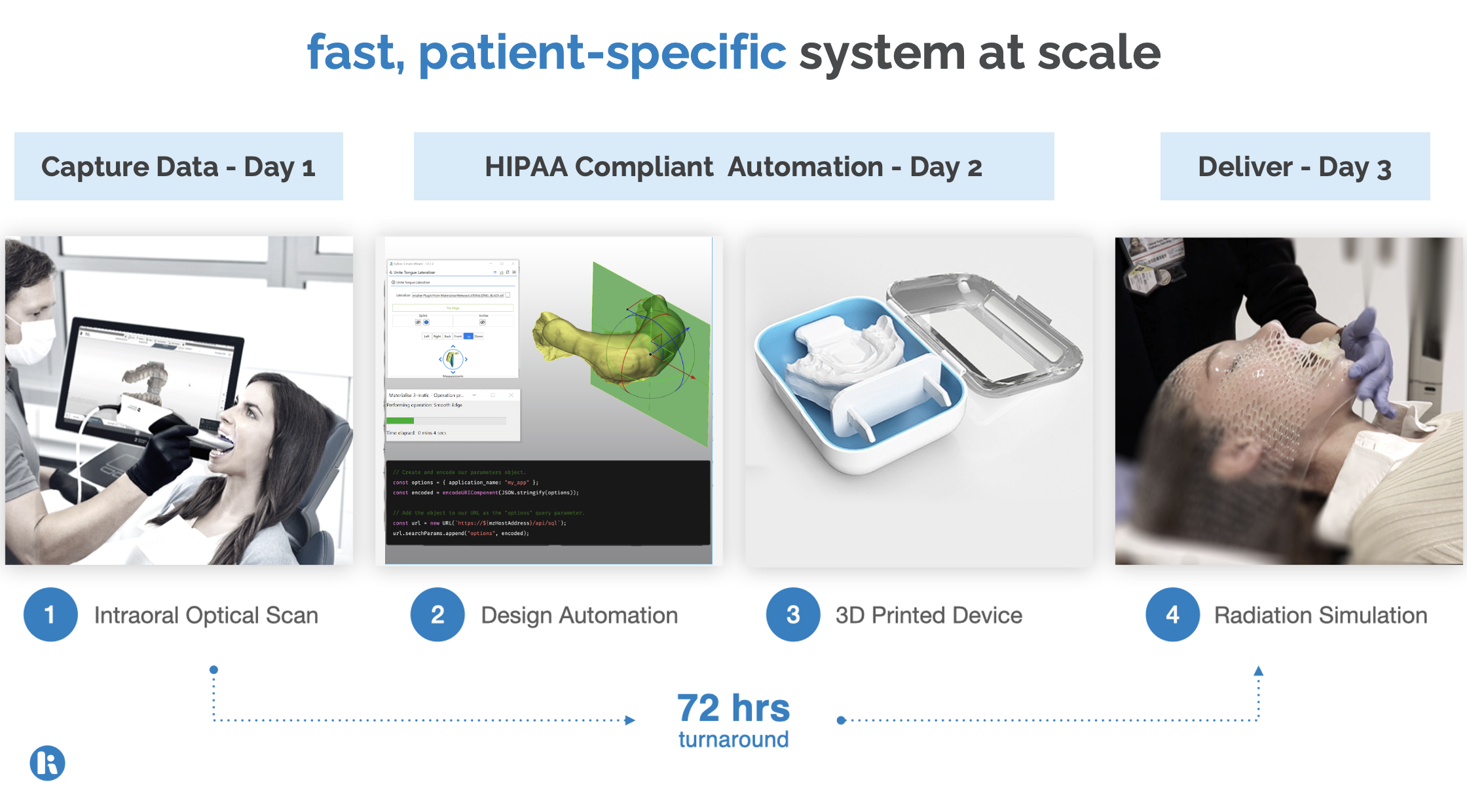
Because each device is engineered to match a patient’s unique anatomy and treatment plan, Stentra consistently immobilizes and displaces tissue across therapy sessions. Published clinical data indicates this approach can reduce the incidence of severe oral mucositis by 77.6% (Journal of Oral and Maxillofacial Surgery). Preventing these severe cases helps hospitals avoid the cascading $17,000 per-patient cost associated with toxicity management—demonstrating that modest upfront investment yields substantial downstream savings.
How can personalized devices improve operational velocity? By saving an estimated 3–4 hours of expensive machine time per patient course.
Linear accelerators (LINAC) are among the most capital-intensive assets in oncology. Every minute of delay or rework erodes throughput. Generic immobilization devices often require repeated setup adjustments and repositioning, introducing unpredictability into tightly scheduled treatment slots.
Patient-specific solutions such as Stentra fit reliably and reproducibly, reducing setup time and variability. Data shows that 3–7 minutes per fraction are saved by using Stentra [Kallisio Value Analysis]. Over a standard 30-fraction course for head and neck cancer therapy, this accumulates to 3–4 hours of LINAC time saved per patient. The resulting efficiency releases capacity to treat more patients without adding shifts or staff.
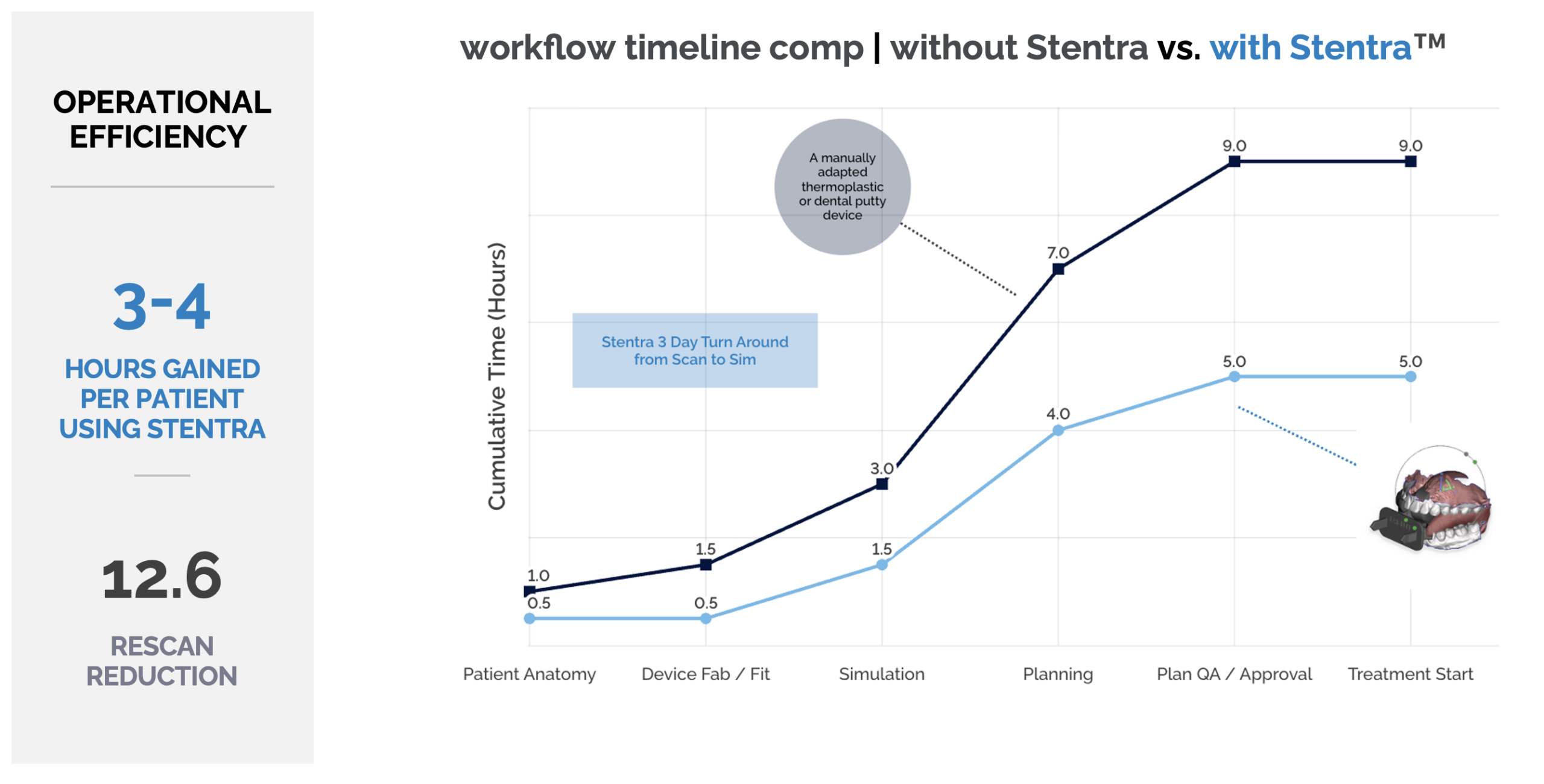
Similarly, poor fit with standard devices contributes to simulation re-scan rates approaching 10%. Custom 3D-printed solutions reduce this to <1% [Kallisio Value Analysis], minimizing delays, patient inconvenience, and unnecessary imaging costs.
Conclusion: The Business Case for Personalized 3D Printing in Oncology is Clear
- Clinical Effectiveness
-
By improving patient compliance and treatment accuracy, hospitals mitigate the risk of expensive complications like mucositis.
-
- Operational Efficiency
- Minimizing errors, interruptions, replanning and expensive treatment time allows centers to increase patient volume on existing infrastructure.
As value-based care models continue to penalize complications and reward efficiency, AM technologies like Stentra demonstrate that personalized medicine is no longer a luxury, it is the most fiscally responsible path forward.
Kallisio is a Gold Sponsor for Additive Manufacturing Strategies (AMS), a three-day industry event taking place February 24–26 in New York City. The conference brings together industry leaders, policymakers, and innovators from across the global AM ecosystem. Kallisio’s CEO Rajan Patel will also participate in a panel on “3D Printing for Oncology.” Registration is open via the AMS website.
🏷️ p3d_feed