Lockheed Martin Ventures Make Strategic Investment in Perseus Materials’ Large-Format Composite 3D Printing Vision
⚓ p3d 📅 2026-02-10 👤 surdeus 👁️ 12

The VC shift towards increased funding in geopolitical bottlenecks looks less and less like a fleeting fad and more like a tectonic shift in where global investment dollars are placing their bets for the long haul. SWISSto12’s €73 million haul at the end of January is an excellent example: as Joris Peels noted, the satellite component disruptor is attracting the sort of investor who looks at the global manufacturing order and asks themselves, “…what if you could use 3D printing as a lever to change the world? What if you can own an application and, in so doing, help nations determine their own fate?”
Another good example was Caracol’s $40 million Series B round last year, which reinforced the momentum that’s carrying a wave of large-format, robotic-arm systems to a position of higher stature within the additive manufacturing (AM) industry. We’re seeing this wave continue in 2026, and the latest proof is that Lockheed Martin Ventures has made a strategic investment in large-format robotic arm composite AM company Perseus Materials, a Knoxville-based startup that has been backed since its early stages by Roadrunner Venture Studios.
Roadrunner Venture Studios in fact epitomizes this environment in which VC is moving from “virtual,” software-driven plays to “physical,” hardware-centric investments. The studio’s co-founder, America’s Frontier Fund (AFF), ambitiously states that its mission is nothing less than “…to build the capacity needed for America to endure as the world’s best place for innovators to reach for new frontiers.”
Perseus Materials certainly fits that description, with the company’s co-founder and CEO, Daniel Lee, telling 3DPrint.com’s Vanesa Listek in a recent interview, “We’re not trying to make 3D printing a little better. We were asking why some of its core limitations exist in the first place.” Specifically, as Listek describes, Perseus leverages a principle known as ‘frontal polymerization’ to accelerate the resin’s drying process without a need for costly peripheral infrastructure like curing ovens.
Perseus Materials plans to use the Lockheed investment to begin expanding both its physical footprint and its personnel, as the startup begins to fulfill its first orders. In addition to Perseus’ focus on wind turbines, the company has also been exploring the viability of its tech for naval applications.
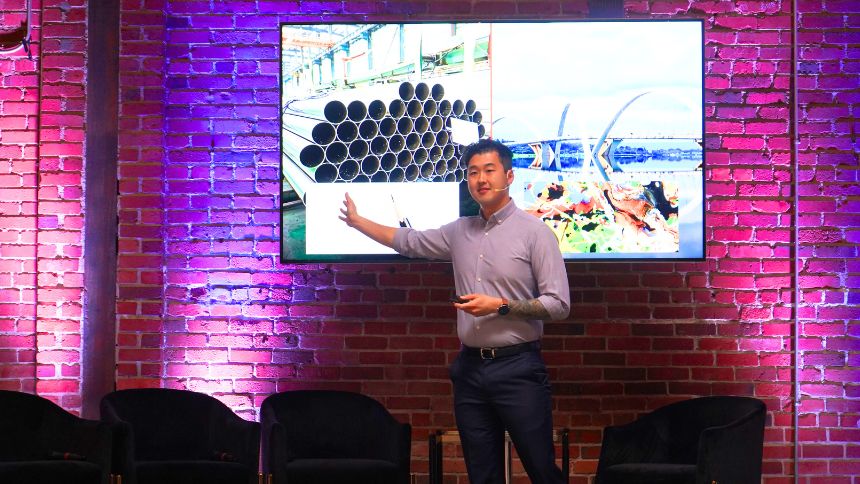
In a press release about Lockheed Martin Ventures’ strategic investment in Perseus Materials for an undisclosed amount, Lockheed Martin Ventures’ VP and general manager, Chris Moran, said, “Our work at Lockheed Martin Ventures supports promising companies that expand the U.S. industrial base and advance innovative technologies for the future of national defense. Perseus’ innovative composite production process can help accelerate design and prototype manufacturing while reducing costs and eliminating tooling, helping Lockheed Martin accelerate its ability to meet the needs of the Department of War and our nation’s warfighters.”
Adam Hammer, CEO and co-founder of Roadrunner Venture Studios, said, “Perseus is exactly the kind of company Roadrunner exists to build — a breakthrough technology born from deep science with clear implications for security and competitiveness. Dan and his team are solving a foundational manufacturing bottleneck that has held back entire industries. This is the kind of innovation that can reshape how America builds at scale.”
The most intriguing angle to Lockheed’s investment here is that there’s no need to view it as a sign that Perseus will be pivoting from wind to defense. First off, Lockheed has extensive experience in providing clean energy solutions, including offshore wind energy, which would combine both of Perseus’ key areas of interest, maritime and cleantech.
Secondly, via Lockheed’s GridStar Flow technology, the defense prime has already demonstrated an exemplar of the fact that there is increasingly no distinction between defense and energy resilience. At the end of 2024, for instance, Lockheed completed installation of a GridStar Flow system at Colorado’s Fort Carson. This aligns with the argument I made in a recent post about how AM should be utilized as an enabler of sustainability-as-security.
Thus, by focusing on grid resilience, Perseus is already leaning into the contemporary national security imperative in its truest form. If that technology can also at some point be used for structural components of U.S. naval vessels, that will be icing on the cake.
There are many companies trying to do similar things to what Perseus is doing in terms of its core tech, but there aren’t nearly as many as you’d think who are applying it to the precise areas of the economy that Perseus is targeting — and that’s what counts. If you factor in the proximity of Perseus’ headquarters to both Oak Ridge National Laboratory (ORNL) and the Institute for Advanced Composites Manufacturing Innovation (IACMI), the company is perfectly positioned to capitalize on the emerging public-private consensus surrounding the need for enhanced grid stability.
Images courtesy of Perseus Materials
🏷️ p3d_feed