3D Printed Orthopedic Device Startup Nanochon Closes $4.1M, Oversubscribed Seed Round
⚓ p3d 📅 2026-02-13 👤 surdeus 👁️ 9

Two of the biggest growth opportunity areas for the additive manufacturing (AM) industry that 3DPrint.com and AM Research have long been keeping an eye on are sports and medical devices. The Washington, D.C.-based startup Nanochon has cultivated a business model that, in large part, targets the intersection between those two markets, and the company just closed an oversubscribed seed round worth $4.1 million, bringing total capital raised to $11.3 million.
While Nanochon’s value proposition relies on definitively ‘deep-tech’ principles — using AM to create nylon-based composite “replacements” for damaged cartilage — the company’s approach is nonetheless guided by textbook, old-school business fundamentals: Nanochon found a blind spot in the market, and created a solution that directly addresses that gap. Specifically, the gap is the population of patients with damaged cartilage who aren’t yet considered candidates for cartilage surgery.
Of course, this isn’t a problem exclusively faced by athletes, but it’s worth noting that the team that will work on Nanochon’s first clinical trial, which the company announced last year, includes multiple specialists in sports medicine. Interestingly, by leveraging AM’s capacity to enable targeted treatments by filling — as Nanochon describes it — “potholes” in patients’ cartilage surfaces, the company draws on similar engineering strengths that give AM an advantage for repairing parts in industrial settings.
Perhaps the most impressive angle to the approach is that the 3D printed implants the company is producing also serve as scaffolding that the company claims encourages new tissue growth in damaged joints. Nanochon plans to start its Phase 1 clinical trial in Canada imminently, beginning with a 10-patient feasibility study, following successful initial testing on animals.
In a press release about Nanochon’s oversubscribed seed round for its 3D printed cartilage implants, the company’s CEO and co-founder, Ben Holmes, said, “We’re both honored and humbled to oversubscribe another funding round. The capital commitments from our investors speaks volumes about their confidence in the work we’re doing to shift the paradigm of cartilage restoration. Not only do we have strong financial backing, but these partners also offer us support in commercial and regulatory strategies as well.”
Meanwhile, R. Sean Churchill, MD, MBA, of cultivate(MD) Capital Funds, the leader of the round said, “Making a follow on from our initial investment in 2023 was an easy decision as we continue to watch CEO, Ben Holmes, lead Nanochon with his forward planning and executional excellence. The current round will not only support the first in human clinical trial in Canada as well as accelerate their manufacturing capabilities, but it will set the stage for a greater North American pivotal trial leading to FDA clearance. In addition to making a revolutionary product in the cartilage regeneration space, Nanochon understands the value of preoperative planning and has launched a partnership with ProVoyance to develop a full MRI based preoperative surgical planning software tool. The combination of a revolutionary product and best in class enabling software is positioning Nanochon to truly change the future for focal cartilage defects in the knee.”
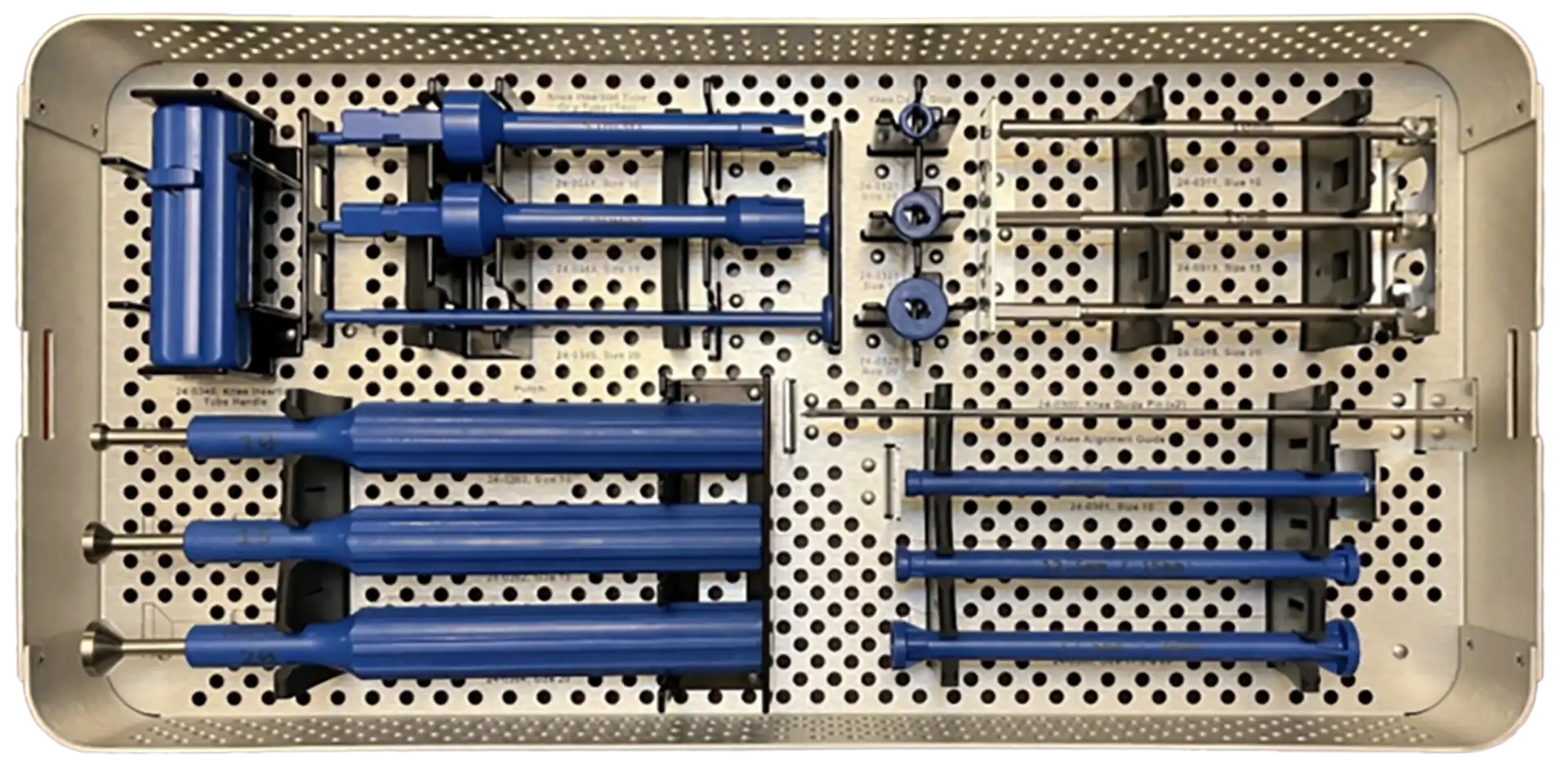
The implant is designed to fit securely into the damaged area of the knee using a simple press-fit procedure.
Again, this isn’t a product that could solely benefit athletes, but from the personnel on the company’s clinical trial, and the branding on Nanochon’s website, they clearly know that’s a priority demographic, and there’s no question that it’s a product that could be most valuable to serious athletes in the early phases of scaling. Given the success that companies like Carbon have seen with applications such as football helmets, 3D printing applications also would seem to have a better than average chance of being embraced by the sports medicine world.
And, the target demographic certainly doesn’t even need to be thought of purely in terms of professional and otherwise high-level participants in athletics. Someone who works in an office all day and wishes they could get back to their old jogging habit is an equally suitable ideal patient for what Nanochon has created.
Beyond the potential that Nanochon’s process has for improving the lives of patients who receive the treatment, I think the company could also indirectly benefit the entire population of patients with joint issues. The addition of another viable solution for treating cartilage damage to the overall medical ecosystem should free up resources that would’ve gone to patients that might otherwise have been destined for more conventional treatments.
Finally, I didn’t realize how common it is for U.S. companies to start with clinical trials in Canada, but apparently, there are plenty of advantages that come along with doing so, including a much more expeditious route to approval for early-stage research. If the U.S. can manage to stop alienating our continental neighbors, maybe stakeholders across North America could unify around the mission of accelerating AM-centered medical research.
Images courtesy of Nanochon
🏷️ p3d_feed