Velo3D Becomes First Qualified AM Vendor for US Army’s Ground Vehicles Program
⚓ p3d 📅 2026-02-17 👤 surdeus 👁️ 12

One indicator that I’ve used to help me track the additive manufacturing (AM) industry’s progress in terms of its technical maturity is the relative progress that each U.S. military branch is making in its AM capabilities when compared to the other branches. It would be difficult to quantify this with any single metric, other than perhaps the total mass of parts printed by each branch, and since we’re not really privy to that information, figuring it out is a mostly subjective analysis based on qualitative signs of technological parity.
Usually, when I bring this up, it’s when I’m writing about the U.S. Army, and the current post is no exception: Velo3D recently announced that the U.S. Army has selected the company as the first AM vendor supporting the U.S. Army’s Ground Vehicle Systems Center (GVSC) in its activities related to accelerating AM qualification. This follows Velo3D’s announcement in early January that the company had reached a Cooperative Research & Development Agreement (CRADA) with the U.S. Army DEVCOM GVSC.
That CRADA deal was the second with a U.S. military agency that Velo3D has signed in well under a year, the first being an agreement announced in Q2 2025 with the U.S. Navy to characterize materials primarily for Navy aerospace applications. Similarly, Velo3D will validate “complex parts and assemblies” for GVSC made from Aluminum CP1 and Inconel 718 on the Sapphire family of metal AM systems. The final parts, once validated, are ultimately destined for U.S. Army Tank and Automotive Command (TACOM).
According to Velo3D, the company “met all GVSC qualification criteria” in under two weeks, hinting at the extent to which the U.S. Army is prioritizing a ramp-up of its AM capacity. While there’s no word yet on what parts exactly Velo3D will be producing for GVSC, there is at least one Velo3D user that has reported using the company’s machines for automotive tooling in the past.
In a press release about the U.S. Army GVSC selecting Velo3D as its first qualified AM vendor, Brandon Peter, Associate Director for GVSC Materials Engineering, said, “Accelerating AM solutions is a critical effort for the Army and the GVSC. Velo3D has the advanced AM technology we need within industry and the robust process, quality and material data available required to support our accelerated qualification process. We are excited to replicate this process with other industrial base partners and appreciative of Velo3D’s close cooperation that enabled us to rapidly validate this concept.”
The CEO of Velo3D, Dr. Arun Jeldi, said, “Velo3D is humbly honored to support the U.S. Army and be the first of an important cohort of industrial base partners facilitating GVSC’s rapid advancement of sustainment technologies at the speed of war — soldiers should expect nothing less from a company like ours. Our Rapid Production Solution is a proven solution the Department of War and the broader national security community increasingly rely on to accelerate the delivery of critical advanced technologies.”
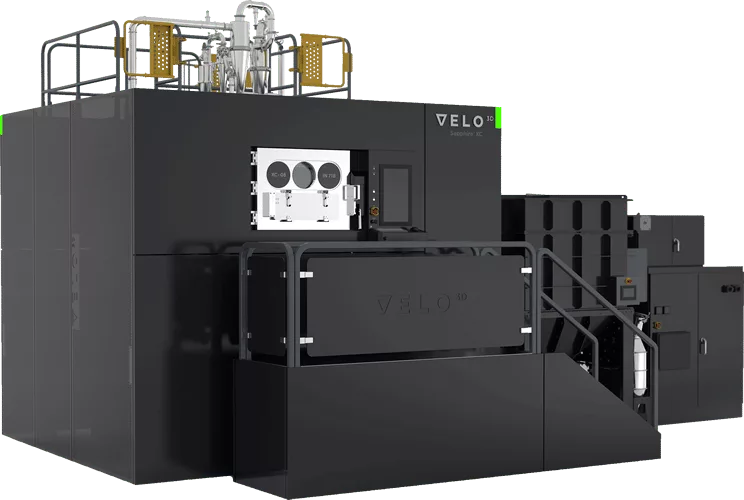
I brought up technological parity, and its relevance in an AM context to the U.S. Army, at the beginning of the post because this deal serves as a major signal that the U.S. Army — more or less the last domino in the Pentagon’s AM supply chain — is starting to approach parity with the Air Force and the Navy. This doesn’t mean that the Navy is “doing as much” in AM as the Air Force is, or that the Army is doing as much in AM as the Navy is, but that all three branches are now speaking the same language, so to speak.
That’s significant if you believe, as I do, that cross-branch AM cooperation is an all-important prerequisite that the U.S. military must fulfill in order for its AM activities to truly hit critical mass. To put it in practical terms, the Navy’s ability to print parts all over the world, even on a deployed aircraft carrier, will be most valuable once the other branches have some baseline catalog of parts qualified on the platforms that the Navy uses.
This is also why it matters that companies like Velo3D are reaching the same deals with one branch that they’ve already reached with another branch. More broadly, we can extrapolate out that same logic and apply it to the civilian sides of the dual-use spheres that the Air Force, Navy, and Army represent on the defense side.
All the context here similarly highlights the importance of organizations like the National Institute for Aviation Research (NIAR), to which the DEVCOM GVSC awarded $100 million in 2023 and Velo3D sold a Sapphire 1MZ in 2024. The more AM cross-pollination there is between strategically critical sectors, the better chance AM has to genuinely contribute to supply chain resilience.
Images courtesy of Velo3D
🏷️ p3d_feed