Takeaways From MILAM 2026: Defense’s Growing Role in Driving 3D Printing – Part II
⚓ p3d 📅 2026-02-18 👤 surdeus 👁️ 9

At the recent Military Additive Manufacturing Summit & Technology Showcase (MILAM 2026), additive manufacturing wasn’t just being discussed as a production strategy; it was being packaged for deployment. A big focus at the event was the need for additive systems that can operate in the field, not just inside traditional factories. Instead of relying only on centralized production, many companies are developing machines that can be transported, set up quickly, and used close to where parts are needed, including machines designed to fit on ships and systems meant to deploy with military units. Most of the people we talked to concur that if additive manufacturing is going to matter in defense, it has to be available where the work is happening and when parts are needed.
What’s more, that idea showed up clearly on the show floor. Phillips Corporation brought its Phillips Additive Hybrid system, a large-format hybrid machine designed for deployment. The system is meant to support repair, sustainment, and part production in defense environments, including scenarios where access to traditional manufacturing infrastructure is limited.
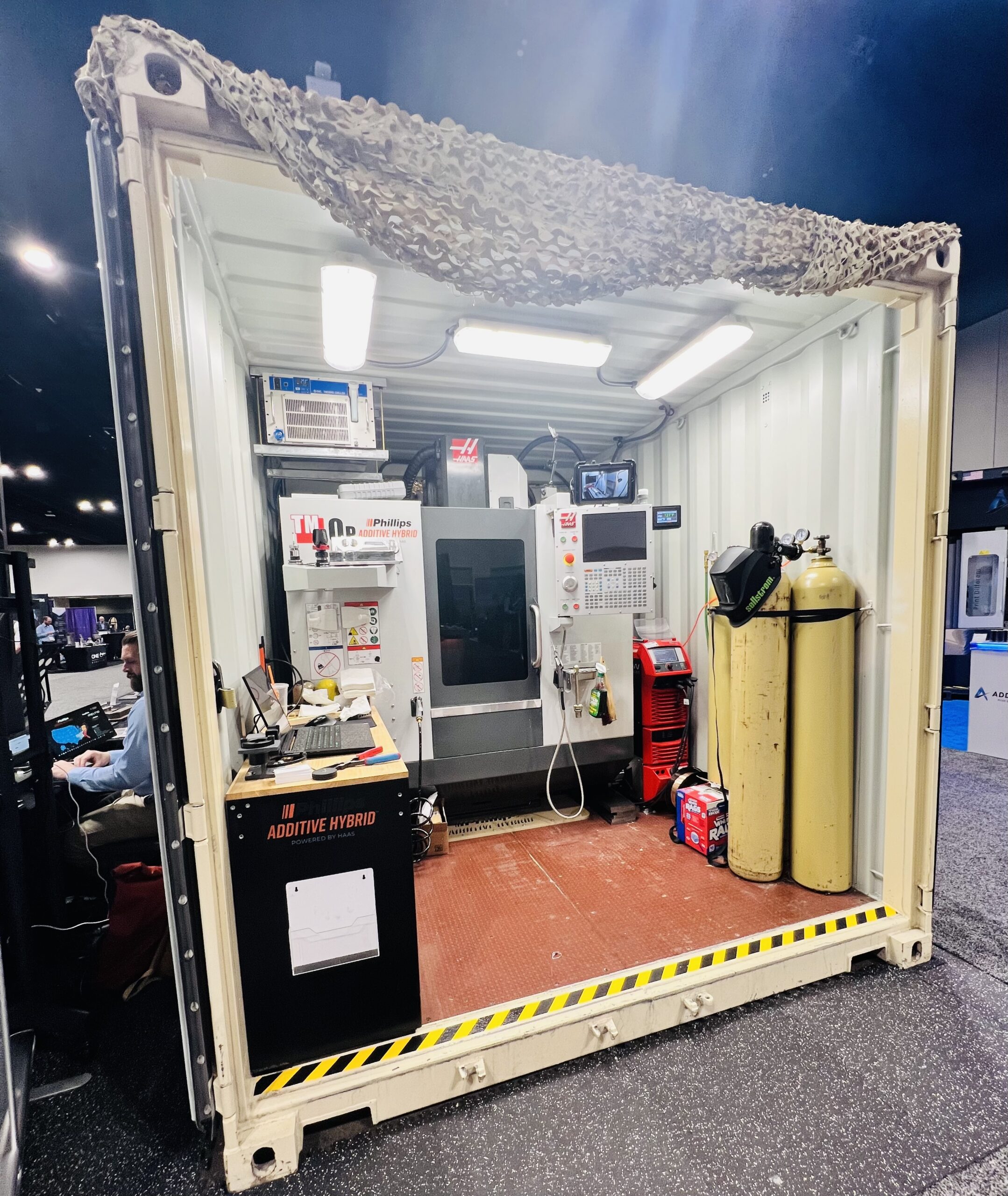
Phillips Additive Hybrid system at MILAM 2026.
Brian Kristaponis, General Manager of Phillips Corporation’s Hybrid Division, and Derek Milgate, Sr. Marketing Manager at Phillips Corporation, said the strongest demand signal they’re seeing right now is deployable technology. Speed and cost still matter, but for defense customers, the priority is being able to set these systems up quickly and use them in the field. They explained that the goal is to cut setup times dramatically, moving from hours to something closer to minutes.
Phillips already has systems operating on U.S. Navy ships, and its machines have also been deployed with military units during training exercises. In those settings, the benefit is simple: parts can be made or repaired on site, without waiting on long supply chains or outside vendors.
“For defense, additive manufacturing is very valuable when it can be moved, deployed, and used where the need exists,” noted Kristaponis.
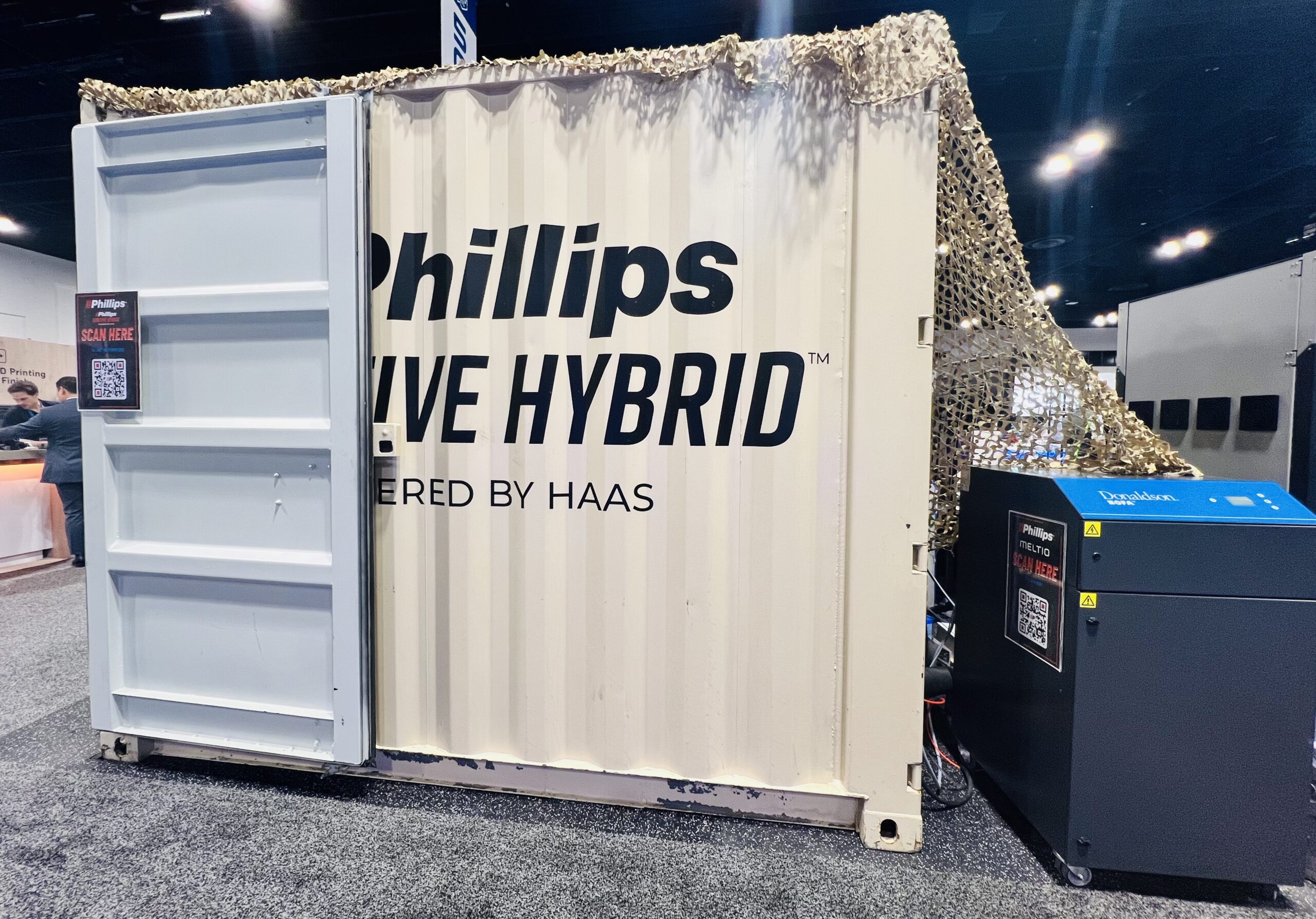
Phillips Additive Hybrid system at MILAM 2026.
Another example on the show floor came from ADDiTEC. The brand showcased its Hybrid X expeditionary unit, a self-contained system designed specifically for forward and field use. Speaking at the booth, ADDiTEC’s Electrical and Controls Engineer, Bryson Pender, explained that the system is designed for deployability and flexibility, combining additive and subtractive technologies on a single platform.
Pender said the goal is to support spare parts and hard-to-source components, especially in environments where supply chains are strained. The system has already been deployed on a Navy ship, and ADDiTEC is working toward broader use in the field. By pairing liquid metal aluminum printing with laser wire DED, the machine can produce a wide range of parts, balancing speed for larger components with higher resolution where needed.
For defense users, that flexibility is super important. As Pender described it, “systems like this are meant to go where the work is, whether on ships or in deployed settings, allowing parts to be made or repaired on site instead of waiting for replacements.”
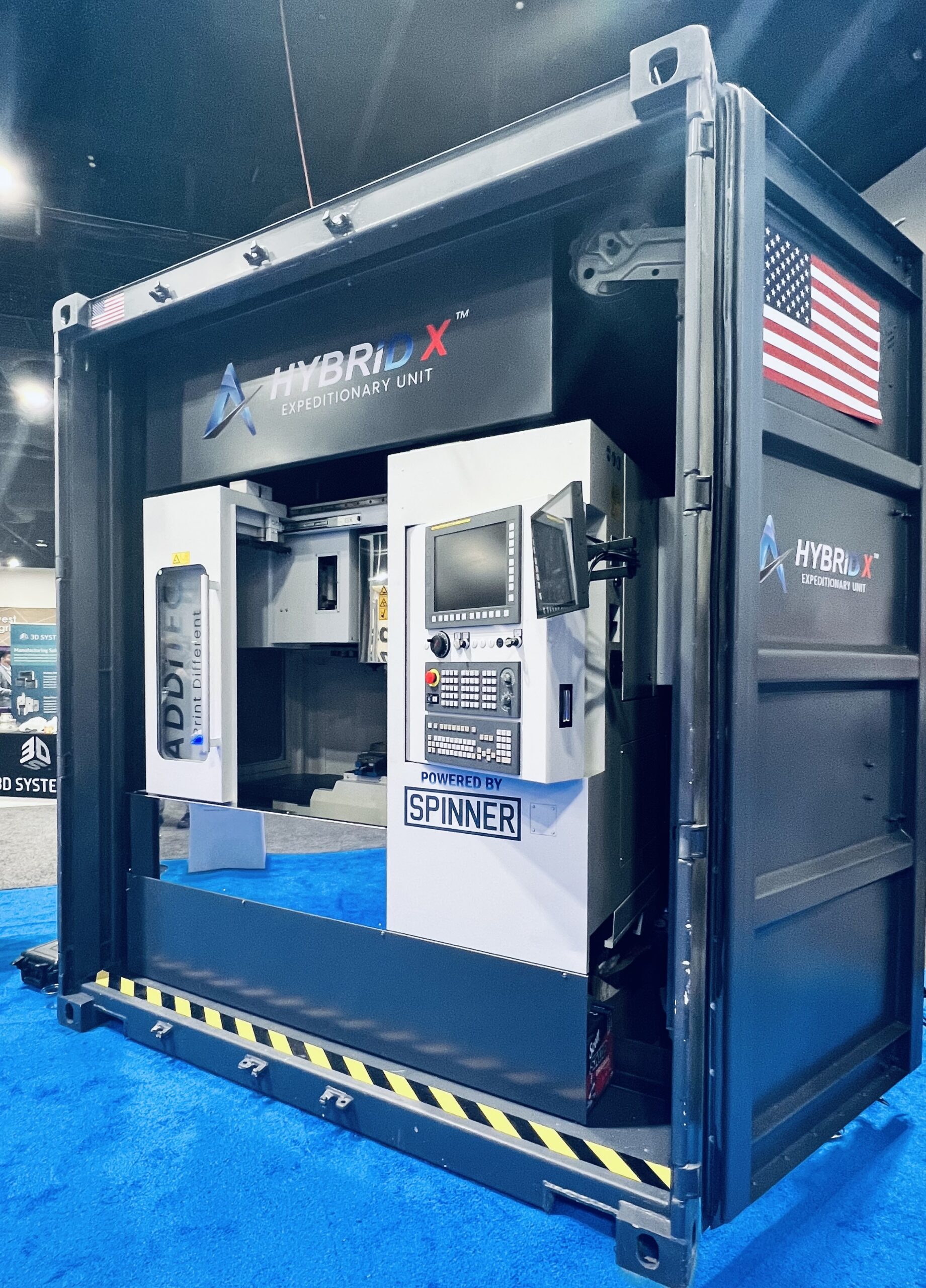
The Hybrid X expeditionary unit by ADDiTEC at MILAM 2026.
The focus on deployable systems at MILAM reflects a broader trend across defense manufacturing. In recent years, the U.S. military has tested containerized additive units, expeditionary fabrication labs, and mobile repair platforms aimed at reducing downtime and supply chain risk in remote or contested environments. The systems on display in Tampa suggest that those early experiments are now becoming more standardized and commercially supported.

Stratasys booth at MILAM 2026.
Still, at MILAM, it was clear that speed alone isn’t enough for defense. Additive manufacturing also has to meet strict qualification requirements, which can later support adoption in other industries.
Additive manufacturing is being used to reduce supply chain delays, especially for parts that are hard to source or take a long time to arrive. And making parts closer to where they are needed helps avoid long wait times and production backlogs.
Stratasys‘ Vice President of Industrial Business, Foster Ferguson, noted that one of the biggest factors still slowing wider adoption is confidence in the qualification process, which continues to limit how quickly companies can scale production.
“One of the biggest remaining bottlenecks is awareness and confidence in the qualification process, which continues to limit scalability across production applications.”
Aerospace and defense, he continued, remain the strongest drivers of demand, as additive manufacturing becomes more closely tied to readiness, sustainment, and long-term production needs.
Looking ahead, Ferguson said he expects deeper collaboration between industry and the Department of Defense to accelerate adoption.
“By next MILAM, we’ll see early areas of a modernized defense industrial base where scalable production has been unlocked through AI-enabled workflows, automation, and qualified industrial systems,” said the executive.
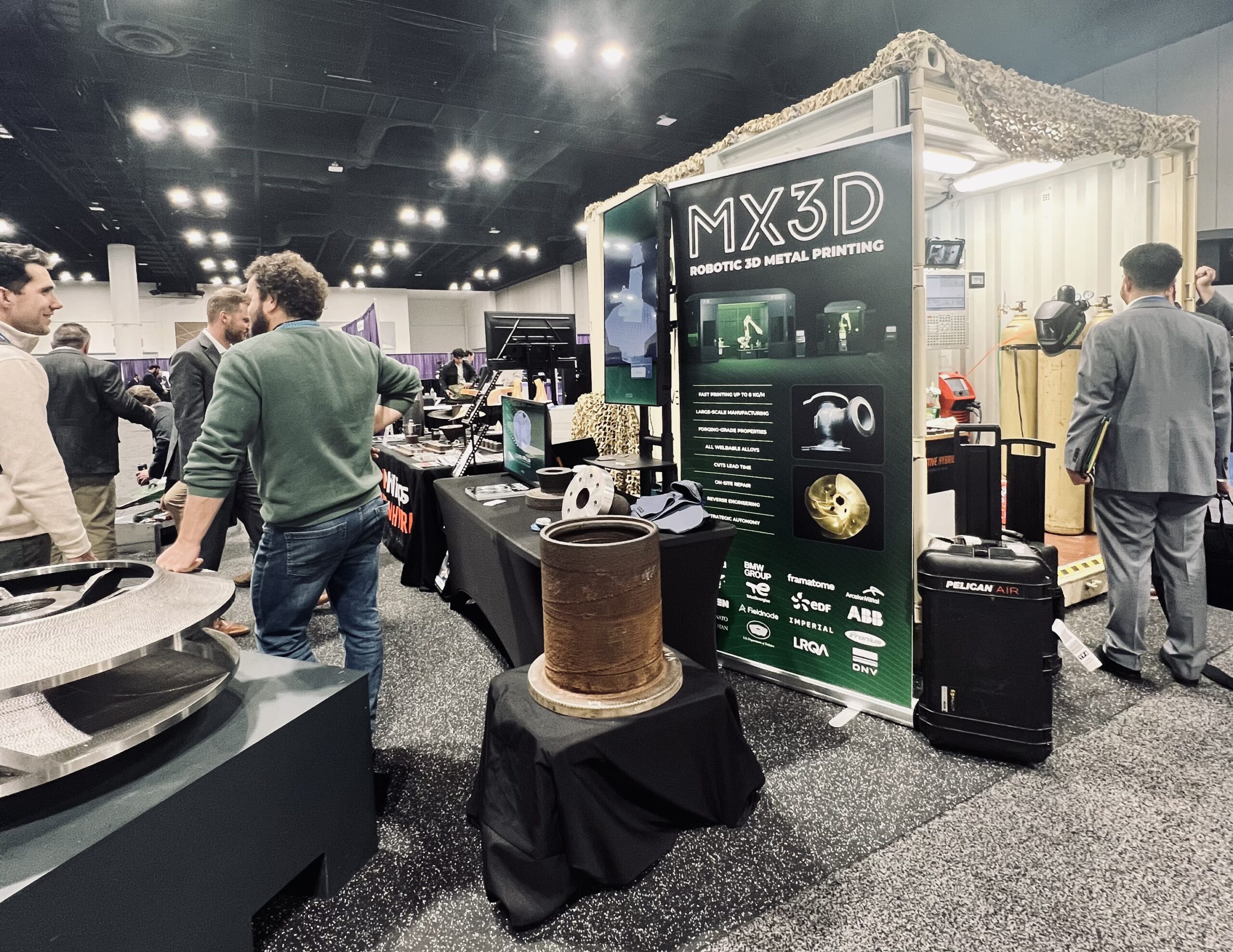
Phillips Additive Hybrid system at MILAM 2026.
MILAM 2026 showed that deployable additive manufacturing is no longer experimental. Systems are already operating on Navy ships and alongside military units, and companies are designing equipment specifically for field use. As defense pushes for faster response times and shorter supply chains, additive manufacturing is being positioned not just as a production tool, but as a capability that can move with the mission.
Images courtesy of 3DPrint.com
🏷️ p3d_feed