LPBF Woven Nitinol Opens New Possibilities for Stents and Actuators
⚓ p3d 📅 2026-02-19 👤 surdeus 👁️ 8

Nitinol is a very exciting material in and of itself. The alloy is almost a metal elastomer and is known for its strength, super elasticity, and shape memory properties. Originally discovered in Roswell, New Mexico, it may have originated from the Naval Ordinance Laboratory and Batelle, while some adhere to a much more colorful theory that it is a material found on alien spacecraft. Primarily used in stents, high-end actuation, orthodontic wires, and some eyeglasses, nitinol is an exotic alloy with distinctive properties.
Woven, braided, and tubed nitinol wire is already used in catheter tubing and heart valves. In additive, Nitinol parts have been made using LPBF, Ebeam, and several DED processes. In LPBF, researchers have shown that shape memory effects, tensile, and other properties can vary widely depending on the processing parameters. Variation in process parameters and scanning strategies can lead to very different outcomes in superplasticity and shape memory. The variable outcomes and inputs of 3D printing, therefore, can lead to programmable, tunable properties in parts.
Now, a team from IMDEA Materials and the Technical University of Madrid (UPM) has gone further in this area. They think that they’ve created new pathways to make medical devices and complex things, such as actuators, out of 3D printed woven nitinol structures.
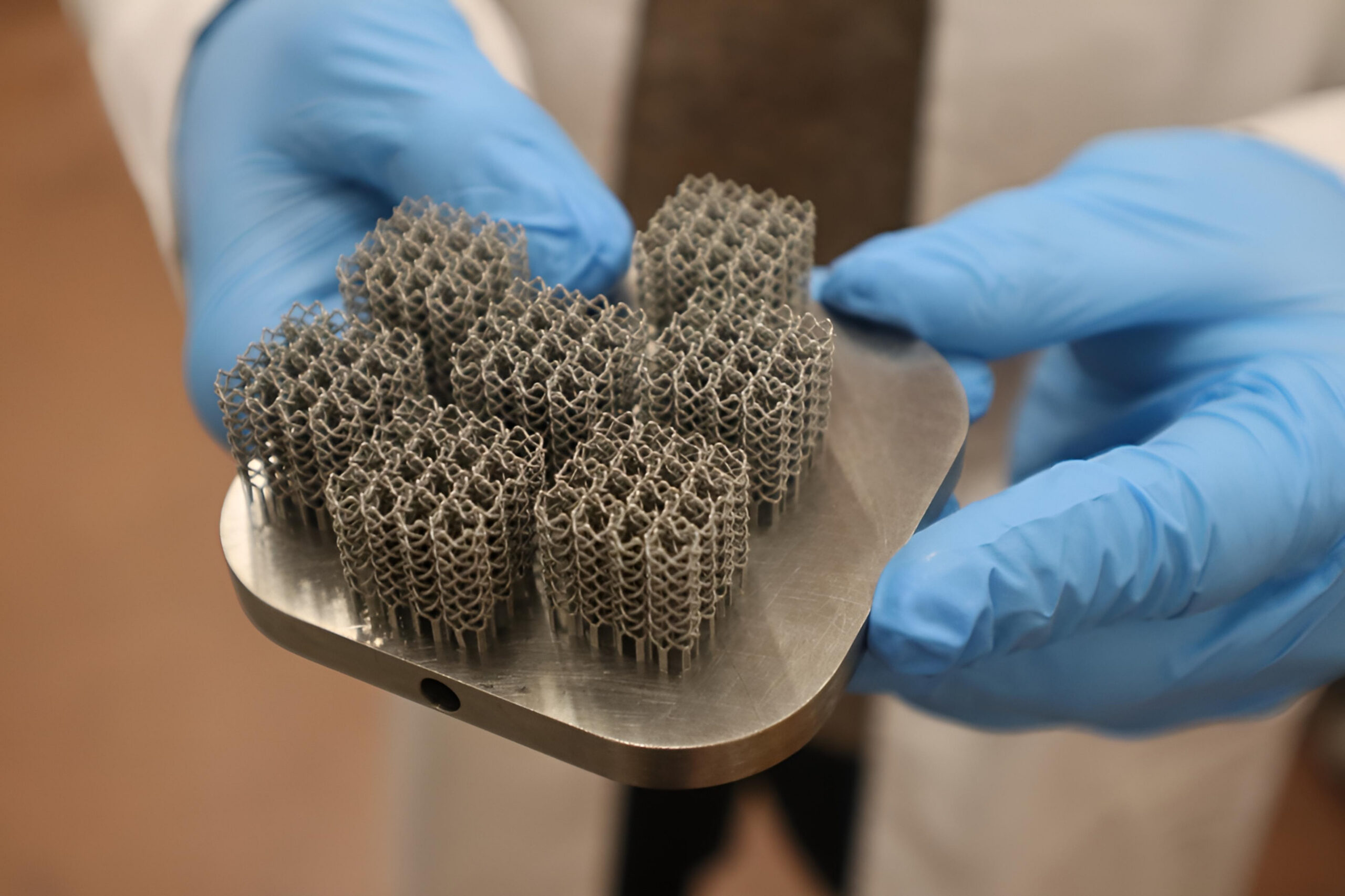
Woven nickel-titanium structures. Image courtesy of Carlos Aguilar Vega.
Published in Virtual and Physical Prototyping, the paper titled “Superelastic 3D printed nitinol lattices and wovens lead to dramatic variations of mechanical properties by design” has, I think, an excellent title. I read a lot of 3D printing papers, but this one has an intrinsic drama in the title that really makes me want to grab some popcorn and dive in. How? How dramatic exactly? Whose design? Well done.
Researcher, Carlos Aguilar Vega, said that,
“While LPBF remains the gold standard of nitinol additive manufacturing, the shape-memory and superelastic properties of these additively manufactured NiTi parts do not yet match those achieved with more conventional industrial processes,Effectively, this means that we have so far been unable to harness the enhanced control of mechanical performance by design, or the geometrical complexity offered by 3D printing techniques in the additive manufacturing of nitinol structures.This work represents the first demonstration of design-based optimisation of additively manufactured superelastic nitinol, showing that mechanical drawbacks inherent to current additive manufacturing processes can be effectively mitigated through architecture.”
Better elasticity and shape memory properties than previously possible are a great step forward. The researchers report that previously additive-manufactured parts were half as expensive as conventionally manufactured parts. The team turned to designing specific structures to improve part performance. They made woven cylinder and tubular lattice metamaterials designed to optimize superplastic nitinol parts, which “by design alone, the stiffness, load-bearing capacity, energy absorption and toughness of these structures can be modulated across several orders of magnitude.”
Professor Andrés Díaz Lantada stated that,
“These were some of the most complex-shaped woven nitinol structures ever created. Promisingly, they represent a breakthrough in the additive manufacturing of superelastic alloys and demonstrate the possibility of achieving self-supported NiTi wovens via LPBF techniques”
This is useful work. Woven nitinol structures made with additive could be used to make advanced stents, valves or other medical devices. More complex medical actuators, valves, filters, and catheters could be possible as well. This comes at a time when medical device production with 3D printing is expanding across many systems. At the same time, populations with many diseases are exploding and living much longer than before. The need and market for new treatments and devices are therefore present and expanding. Especially in heart and vascular devices, these kinds of structures could readily find an application.
We have seen a lot of similar papers emerge where researchers are looking at process parameters and design to make materials more tunable or increase part performance. Given the huge number of variables in 3D printing, there could be a lot of work to do here. There could also be some very solid IP where certain structures or designs and processes could lead to the best heart valve, for example. This means that design lead work on building better devices is something that we will see more of over the next few years.
🏷️ p3d_feed