Cisco Report Finds Cybersecurity and Networks Determine AI Growth in Manufacturing
⚓ p3d 📅 2026-03-03 👤 surdeus 👁️ 9

Additive manufacturing (AM) is a market in-itself. Still, more broadly, it can be viewed as one component of a shift in the productive economy towards interconnection by the Industrial Internet of Things (IIoT). This is the framework within which one should view the incorporation of AI into manufacturing processes, and the latest State of Industrial AI report from network equipment giant Cisco, released today, synthesizes data from over 1,000 respondents on the topic, including over 350 manufacturing sector stakeholders.
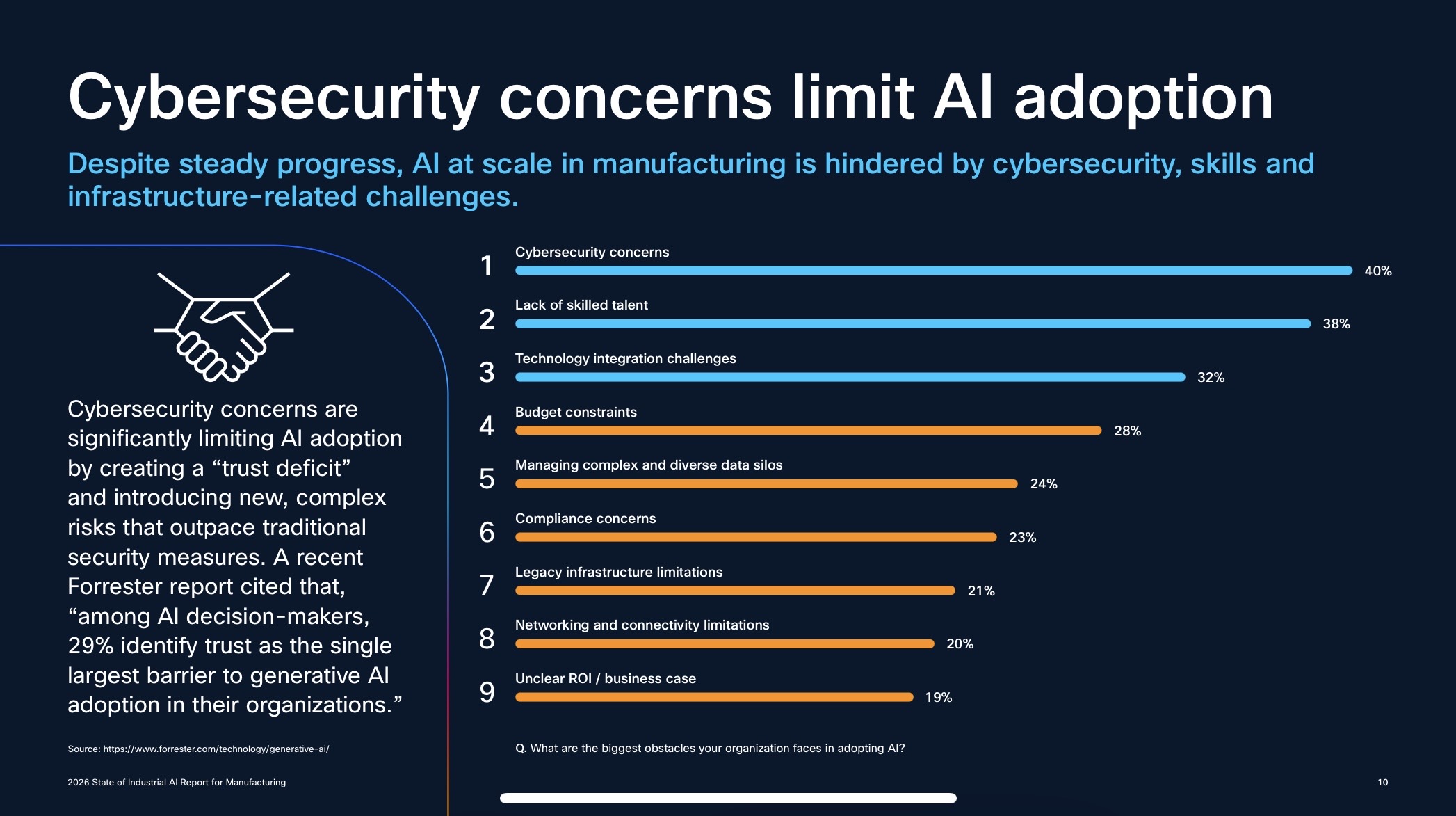
One of the most noteworthy takeaways from the report is that cybersecurity has jumped to the top of the list of limiting factors for AI adoption. When the last report was released in 2024, cybersecurity was ranked #3. Compared to the broader industry, which saw 40 percent of respondents list cybersecurity as their number one concern, an even higher percentage of respondents from the manufacturing sector — 46 percent — said cybersecurity was their top concern in 2026.
At the same time, interestingly enough, 81 percent of manufacturers also said that they ultimately expect AI to improve their cybersecurity capabilities, once it’s implemented at scale. Other important findings relate to network readiness: nearly 50 percent of manufacturers said that, to produce results, investments in AI also require greater investments in network connectivity and edge computing.
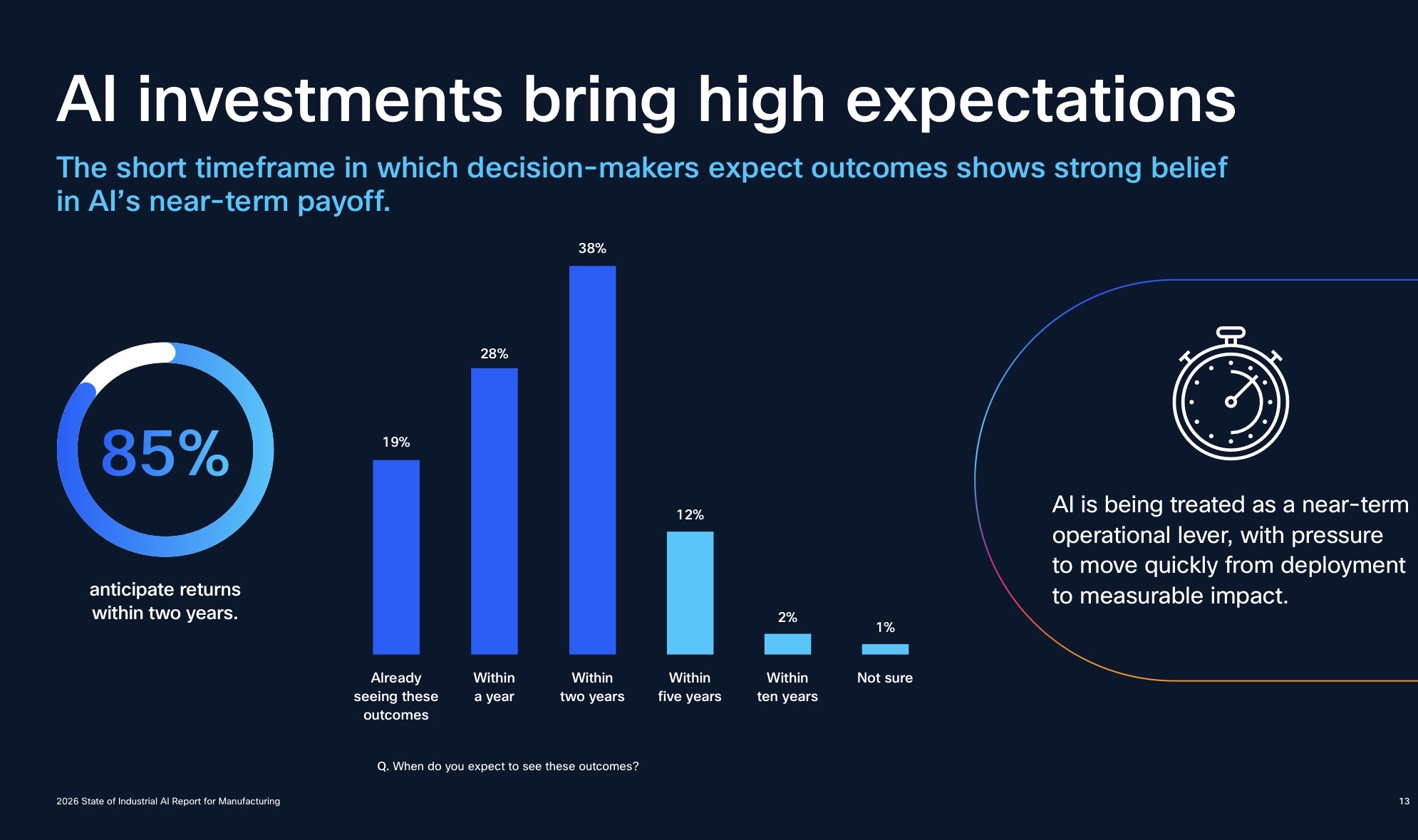
Overall, AI adoption in manufacturing may have finally hit critical mass, with just under 60 percent of the manufacturers surveyed saying they’re already “actively deploying AI at scale”, and 83 percent expect to continue to increase their AI spend. Reinforcing that acceptance of and optimism surrounding the new technological landscape, 85 percent of manufacturers said they expect to see ROI within two years.
In a press release about Cisco’s latest State of Industrial AI report, Vikas Butaney, SVP/GM of Secure Routing and Industrial IoT at Cisco, said, “Industrial AI is moving from experimentation into production, where AI systems sense, reason, and act in the real world. At this stage, success is no longer determined by models alone, but by whether networks, security, and teams are ready to support AI at the edge, in motion, and at scale. The research shows that organizations confident in scaling AI are those treating infrastructure, cybersecurity, and IT/OT collaboration as foundational, not optional.”
That concept of treating AI as foundational reminds me of an interview I did last year with Michael Corr, co-founder and CEO of PLM software firm Duro, which was later acquired by the electronics design software provider Altium. Corr explained to me how the company relaunched its entire platform with AI embedded at the core, rather than simply trying to “layer it” on top of the product that already existed:
“What’s unique about the relaunch,” Corr told me, “is the fact that AI isn’t just a bolt-on. I think we’re in an enviable position compared to our competitors because we’re still small enough to where we can do such a major refactoring compared to legacy providers. They’re too far down the road already to be able to do that.”
This suggests a significant edge that new firms could have over legacy manufacturers in the initial mass scale-up phase of the IIoT build-out, as organizational agility has turned into an operational mandate, not a “nice-to-have”. That same logic supports the idea that, in order for an enterprise to effectively contribute to objectives like supply chain resilience, AM capacity has to be a core component of an enterprise’s business model, not simply a “bonus” that has been grafted onto the company’s periphery.
Along those lines, we won’t see every manufacturing company that adopts AM and every manufacturing company that adopts AI succeed at doing so. But I would bet that the handful of manufacturing companies that have successfully built AM and AI into the foundation of their business models will be disproportionately influential to the trajectory of the rest of the productive economy.
So a company like DEFEND3D, for instance, which provides software solutions that enable print jobs via streaming as opposed to file-based transfers, stands to gain in this environment. Hadrian Additive, the new division of the massively-funded ‘Factories-as-a-Service’ startup, stands to gain in this environment, as do OEMs like Velo3D, which has made cybersecurity compliance a centerpiece of its business strategy for years, etc. It is no longer adequate (if it ever was) to consider the product you’re selling as a standalone thing: to gain traction, you have to primarily consider the total operational environment that everyone’s tech lives or dies in.
Images courtesy of Cisco
🏷️ p3d_feed