3D Printing News Briefs, March 19, 2026: 3D Printing Waste, Technical Ceramics, & More
⚓ p3d 📅 2026-03-19 👤 surdeus 👁️ 11

In today’s 3D Printing News Briefs, Meltio announced an official sales partner for Ireland and Northern Ireland, Roboze received an investment from a U.S. venture capital firm, and Future Form added 3D printing services. Ter Hoek adopted XJet’s Carmel 1400C to expand into technical ceramics 3D printing. Finally, CEAD is shredding its 3D printing waste, and investigating how to recycle it to create new materials.
Meltio Announces Official Sales Partner for Ireland & Northern Ireland

L-R: Johannes Werner and James Wall, 3D Technology Ltd.
Meltio, which specializes in wire laser metal deposition, announced that 3D Technology Ltd. is its newest official sales and services partner, and will help boost metal AM market growth for Ireland and Northern Ireland. A leading Irish provider of AM hardware, materials, and technical support, 3D Technology Ltd. has offices in Belfast, Galway, and Meath, so can certainly spread the word about Meltio’s process, which is centered around safe, affordable, and clean welding wire. The company will help build a strong and supportive ecosystem in the Irish territory for Meltio’s technology, and provide customers with local support, such as consultation, solution design, installation, maintenance, training, and application development. This partnership between Meltio and 3D Technology Ltd. will allow Irish manufacturers to achieve supply chain independence by adopting cost-effective, reliable metal AM solutions for repair, production, tooling, and hybrid manufacturing.
“We are incredibly excited to partner with Meltio and bring their world-class metal additive manufacturing technology to Ireland and Northern Ireland,” said James Wall, Managing Director at 3D Technology Ltd. “Meltio’s wire-LMD systems are transforming how companies think about metal production, repair, and hybrid manufacturing. This partnership aligns perfectly with our mission to deliver innovative, reliable, and accessible advanced manufacturing solutions to our customers. We look forward to supporting Irish industry as it embraces the next generation of metal AM.”
Roboze Gets Venture Capital Investment to Speed up Distributed Manufacturing

Roboze has been on the move as of late, holding an open house at its Houston location earlier this week and celebrating the grand opening of its Aerospace and Defence HQ in California tomorrow. The company also announced an investment from U.S. venture capital firm Rule 1 Ventures, which focuses on defense and national security technologies designed to strengthen operational readiness. The investment will support the global expansion of Roboze’s AI-driven distributed manufacturing platform, combining materials science, AM systems, software-driven process intelligence, and embedded Physical AI. The platform is focused on reliable, localized, on-demand production of complex, mission-critical parts for strategic sectors like aerospace, defense, and energy. Roboze’s funding round also included participation from some existing shareholders, like microprocessor inventor Federico Faggin, and investors experienced in the government affairs, defense, and global industrial markets, like Privcorp Ventures and Gary Ang, former Temasek operating partner and Singaporean Air Force official.
“We are proud to welcome Rule 1 Ventures and this exceptional group of investors to Roboze. Modern industrial resilience requires more than machines — it requires a complete manufacturing platform that combines hardware, materials science and intelligent software. Our mission is to build the infrastructure that allows critical industries to produce advanced components wherever they are needed,” said Roboze Founder and CEO Alessio Lorusso.
Future Form Adds 3D Printing Services for Prototyping & Low-to-Mid Volume Production
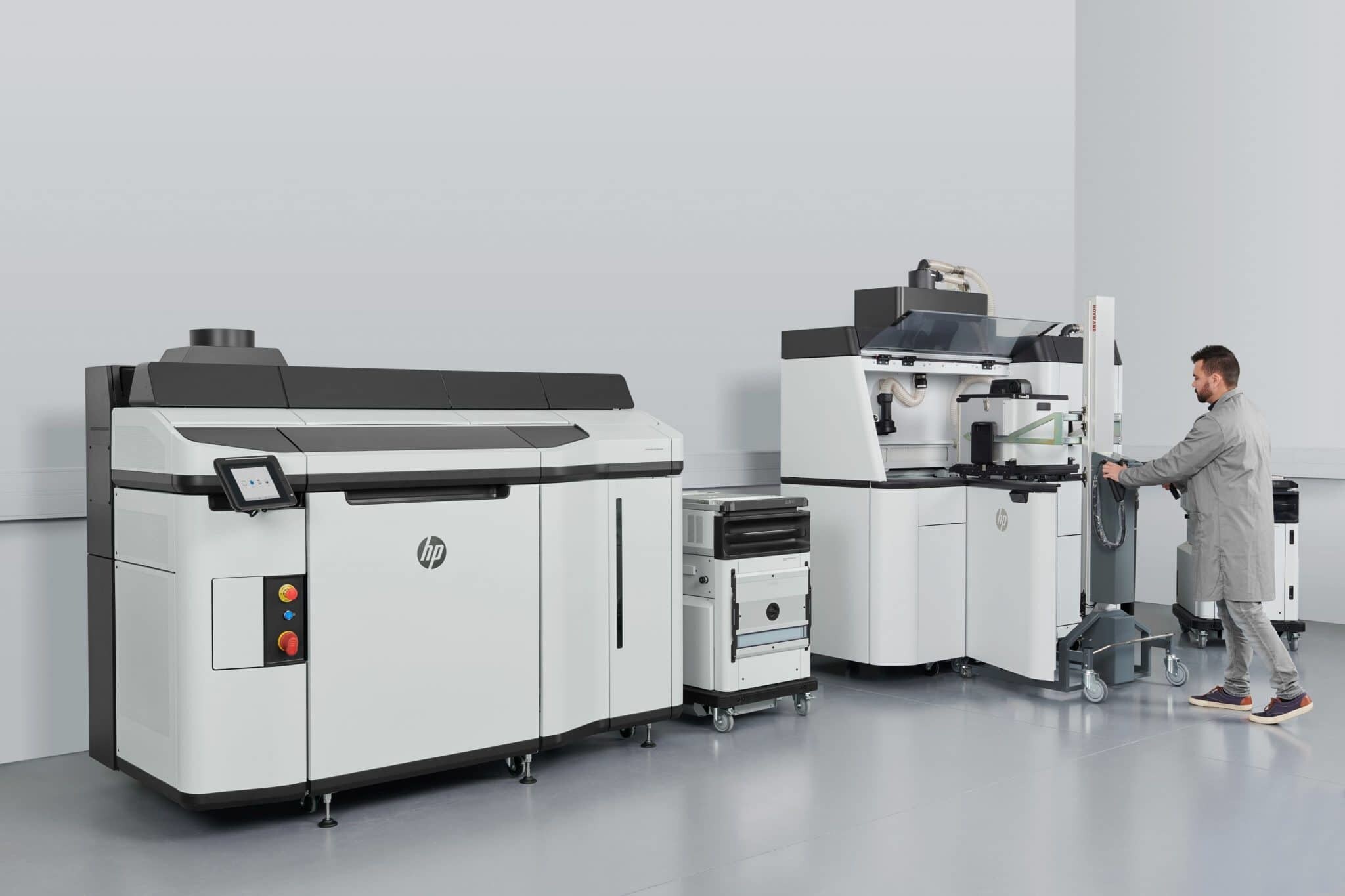
Future Form is now using this HP Multi-Jet Fusion (MJF) 3D printing system, a cutting-edge scalable platform that supports functional prototyping to final part production.
High-volume manufacturing solutions provider Future Form recently added 3D printing services to its portfolio. The company specializes in plastic AM, and its new service will use HP Multi Jet Fusion (MJF) technology to enable prototyping and low-to-mid volume part production for the aerospace, medical, and data center industries. 3D printing growth has been especially pronounced in these sectors, like for making flight-certified parts and constructing data centers. Reasons for its increased popularity include everything from supply chain resilience and the ability to deliver complex geometries to improved sustainability. With its new services, Future Form will use MJF to print functional, high-quality parts for these sectors with great surface finish and cost efficiency, and improved turnaround times. This addition to its portfolio shows that the company really has a forward-looking approach to manufacturing.
“For low- to mid-volume production and/or prototyping, plastic 3D printing is quickly becoming a smarter alternative to traditional manufacturing methods,” said Ben Thomas, CEO of Future Form.
“By adding these services, we’re ensuring we can deliver high-quality parts to our customers when they need them without costly transportation fees or exorbitant mark-ups.”
Ter Hoek Expands into Technical Ceramics with XJet’s NPJ Technology

XJet 1400C Alumina system installed at Ter Hoek facility in Rijssen, The Netherlands
Dutch precision manufacturing specialist Ter Hoek recently adopted the XJet Carmel 1400C ceramic 3D printing system, expanding its expertise from precision metal manufacturing to technical ceramics. This decision will diversify the company’s existing material portfolio, and also upgrade its production process into a digital, automated workflow. Additionally, the collaboration will bring XJet’s proprietary NanoParticle Jetting (NPJ) technology to the Netherlands—one of the most demanding precision manufacturing environments in Europe—and increase both companies’ ability to offer ceramic solutions to high-tech industries, such as semiconductor, medical, aerospace, and aviation. The Carmel 1400C system was designed to handle prototyping as well as production-scale manufacturing, which meshes well with Ter Hoek’s service model. At next week’s Ceramitec 2026 in Munich, XJet and Ter Hoek will demonstrate NPJ technology together at Booth 206, Hall A6.
“In the future of manufacturing, sustained success will hinge on continuous differentiation and innovation in an increasingly competitive landscape. With our solid expertise in precision manufacturing, we have constantly sought the next opportunity to better serve our customers. By entering the world of technical ceramics with XJet’s digital production platform, we’re not just adding a new material – we’re embracing a fundamentally new way of manufacturing that offers unprecedented design freedom, faster iteration cycles, and the ability to produce parts that were simply impossible before. This positions us at the forefront of the next generation of precision manufacturing,” said Gerrit Ter Hoek, Founder and Technical Director at Ter Hoek.
CEAD Uses WEIMA Shredding Technology to Recycle 3D Printing Waste

Large-format additive manufacturing cells at CEAD – © Weima
In another story out of the Netherlands, CEAD is combining its large-format additive manufacturing with the circular economy. The Delft-based company develops LFAM systems for the composite, construction, and marine industries. Its pellet extrusion process uses fiber-reinforced thermoplastic composites (FRP) to print full-scale components, like complex molds, prototypes, and even boats. Unfortunately, the discarded parts and prototype structures made of glass- or carbon-fiber reinforced polymers can add up fast. Plus, CEAD’s leftover prints can weigh up to several hundred kilograms, so it’s not sustainable or efficient to dispose of them. CEAD is now using a material recycling solution from German mechanical engineering company WEIMA. CEAD installed a WEIMA WLK 4 single-shaft shredder, which is able to easily convert reinforced thermoplastic waste components into uniform flakes about 10 mm in size. These flakes are a great intermediate material for reprocessing and upcycling, and CEAD is now working with several Dutch R&D companies to investigate how the shredded waste material can be re-pelletized to create new 3D printing material.
🏷️ p3d_feed“WEIMA for me is reliable, easy to operate, and a trustworthy partner. We’ve been using the shredder frequently without any breakdowns, and it performs perfectly in an industrial environment,” said Mark Muilwijk, Material and Process Specialist at CEAD.