3D Printing News Briefs, April 2, 2026: Reseller, Submarine Parts, & More
⚓ p3d 📅 2026-04-02 👤 surdeus 👁️ 1

We’re starting off today’s 3D Printing News Briefs with business from Materialise and RapidFit, and Axtra3D and MULTISTATION. Then we’ll move on to a contract for submarine components, and end with Meshy’s Multi-Color Printing and integration into MakerWorld. Read on for all the details!
Materialise Transferring RapidFit Business to Management Team
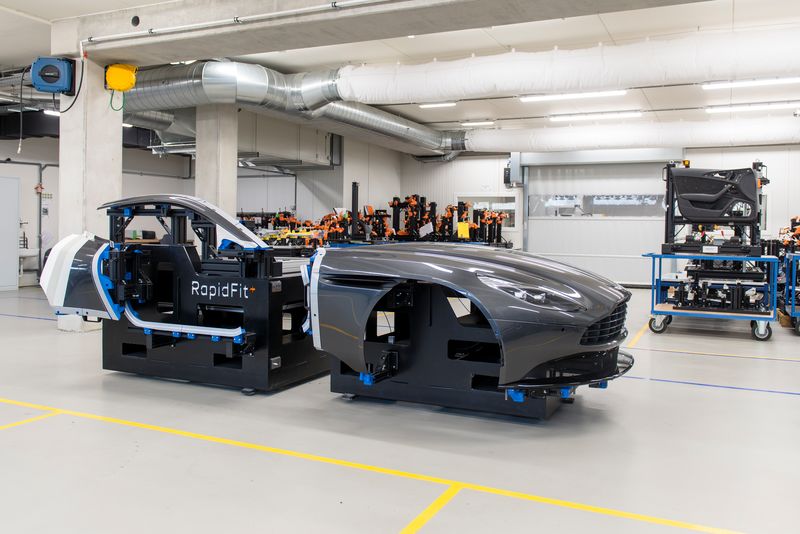
3D printed parts and a fully modular approach empower automotive brands to accelerate engineering and development processes. Image courtesy of RapidFit.
Additive manufacturing pioneer Materialise announced that it will be transferring its RapidFit business to its management team. RapidFit is a specialized subsidiary of Materialise, and delivers tooling solutions, mainly 3D printed jigs, fixtures, and quality control solutions for automotive and manufacturing applications. Its custom components help companies in these sectors reduce lead times, improve production efficiency, and support strong quality assurance processes. Materialise’s decision to transfer the business falls right in line with the company’s growth strategy of refocusing investments and resources on its business lines with the strongest potential. The transaction is expected to close on April 30, 2026, and is not expected to impact any existing customer orders or projects. RapidFit will continue to operate as an independent company under its same leadership, and this setup will in turn support its next phase of growth.
“For RapidFit, operating as an independent company provides greater focus and flexibility,” said Jurgen Laudus, the Vice President of Materialise Manufacturing. “A standalone setup allows the business to make decisions closer to its customers and markets, build on its core strengths, and pursue partnerships and investments that best support global growth.”
Newest Axtra3D Reseller Multistation to Expand Lumia.X1 to French Market
Today, Axtra3D announced that French resale provider MULTISTATION has joined its network as a professional reseller, helping to expand the reach of the company’s Hybrid PhotoSynthesis (HPS) technology and Lumia.X1 3D printer into the French market. MULTISTATION has years of experience in both AM and industrial machining, offering machines sales and consulting services in sectors including aerospace, automotive, energy, jewelry, R&D, medical, and dentistry. In fact, MULTISTATION’s CEO Yannick Loisance says the company plans to use Axtra3D’s Lumia.X1 to expand its dental applications. This new reseller partnership will bring Axtra3D’s high-performance AM solutions to French businesses for the first time, and is a testament to its commitment to build a strong reseller network around the world for its Hi-Speed SLA technology.
“We are more than pleased to welcome Multistation to the Axtra3D reseller family. As our technology proves itself in real world use cases in both industrial and dental markets, we’re excited to be expanding our reseller network further to meet increasing interest,” said Rajeev Kulkarni, Chief Strategy Officer at Axtra3D. “Partnering with Multistation to reach the French market is another step towards the goal of increasing Axtra3D’s footprint in the global AM space.”
AML3D Gets AU$2.6 Million US Navy Order for Submarine Parts

AML3D has received a 10-month, AU$2.6 million (US$1.84 million) contract to produce five large-scale 3D printed US Navy submarine parts. After the US Navy successfully completed hydrostatic testing of AML3D’s metal 3D printed parts, the order was signed with US nonprofit BlueForge Alliance, a neutral integrator that supports the sustainment of the US Navy’s Submarine Industrial Base. AML3D will use its proprietary WAM-driven ARCEMY system to print these high-demand, non-safety critical replacement components for in-service trials on US Navy submarines, as the parts are no longer made by the original manufacturer. The contract is set to commence in the fourth quarter of 2026, and the components will be printed using a US Navy-qualified Nickel-Aluminum-Bronze (NAB) alloy. This is just the latest in AML3D’s US scale-up strategy, which has already delivered over AU$30million in US defense-related contracts.
“Signing this order is a significant milestone for AML3D. It shows our advanced manufacturing technology is key to solving a wide range of critical supply chain challenges for the US Navy’s submarine program. This latest contract pertains to complex components that are no longer supported by the original manufacturer and could not be sourced in a time and cost- effective manner from the Navy’s traditional supplier base,” said AML3D’s CEO Sean Ebert.
“AML3D’s advanced industrial 3D metal printing technology is increasingly being embedded in the US Navy’s Maritime Industrial Base. This contract allows us to continue to build and deepen our long-term, strategic partnership with the US Navy and supports our investment to double capacity at our US Technology Center in Ohio. Our US Scale-up strategy continues to deliver significant growth and value to AML3D and its shareholders. While the latter strategy is being successfully delivered, we at the same time continue to progress our plans to enter into the UK market and other globally significant markets across Europe.”
Meshy & Its Multi-Color 3D Printing Live on MakerWorld
Generative AI company Meshy specializes in 3D model creation, and recently announced that it’s been fully integrated into MakerWorld’s MakerLab, the Bambu Lab ecosystem’s AI tool hub. That means users can access Meshy’s Image-to-3D tool, powered by the advanced Meshy-6 generation engine, directly in MakerLab, and quickly generate high-quality, 3D printable models from a single image. This is great news for 3D printer owners who don’t have the necessary skills to design and create their own models. But that’s not all: Meshy has also updated its Multi-Color Printing feature, which removes the need for manual coloring in slicing software. You can now export a .3MF file from Meshy and drag it into Bambu Studio, where complex textures will be automatically mapped into precise color zones that work with Bambu’s AMS. Together, these changes deliver a very seamless AI-to-print workflow for makers.
The Meshy-MakerWorld integration and Multi-Color Printing are separate but complementary capabilities. For “Image to print” in MakerWorld, you don’t need any software downloads; just open MakerLab’s Image-to-3D at makerworld.com. Then, upload an image or photo, and Meshy-6 will generate a print-ready 3D mesh within seconds. Finally, export it as either a .3MF or .STL, and send it to Bambu Studio for slicing and printing. For “Image to multi-color print” on the Meshy site, use Image-to-3D or Text-to-3D to generate a model. Then, enable Multi-Color Printing to automatically map textures to filament color zones, and export as a .3MF. You won’t need to do any manual painting in Bambu Studio, as all color-to-filament assignments are pre-configured. Finally, drag the .3MF into Bambu Studio and print; the AMS will take care of everything else.
🏷️ p3d_feed