The Additive Chicken Coop, Part III: Bananas
⚓ p3d 📅 2026-05-08 👤 surdeus 👁️ 1

A friend of mine, Ed Davis, once pointed out the level of strategic replication in additive. I wasn’t aware of it before and haven’t been able to unsee it since. We can make most everything. And this is rather overwhelming. We can make implants, hearing aids, aircraft parts, toys; the mind boggles. And this vastness of possibility overwhelms us. I previously called this the Van Gogh’s Blank Canvas Problem in 2013. Overcome by the sheer possibility of a blank canvas with infinite paths and outcomes, we freeze in place. This problem is not sufficiently taken into account, and I think that it is a risk to our industry. I think that the strategic replication follows from the Blank Canvas Problem. Coupled with the Additive Chicken Coop, where we all watch each other while drinking the same Kool Aid, it may be one of the most limiting factors in 3D printing. Maybe it’s not lasers, funding, revenue, or technology holding us back, but this.
There are perhaps over 300 and maybe a 1000 banana cultivars worldwide and over 1000 wild varieties. Bananas can be red, Blue Java bananas, reportedly taste like ice cream, while others have pink flowers. Most bananas are grown in India, followed by China, Indonesia, Brazil, and Ecuador. Tropical countries around the world grow bananas. The first domestication and first cultivars probably occurred in New Guinea. Somewhere between 8,000 and 5,000 BCE, humans began cultivating bananas.
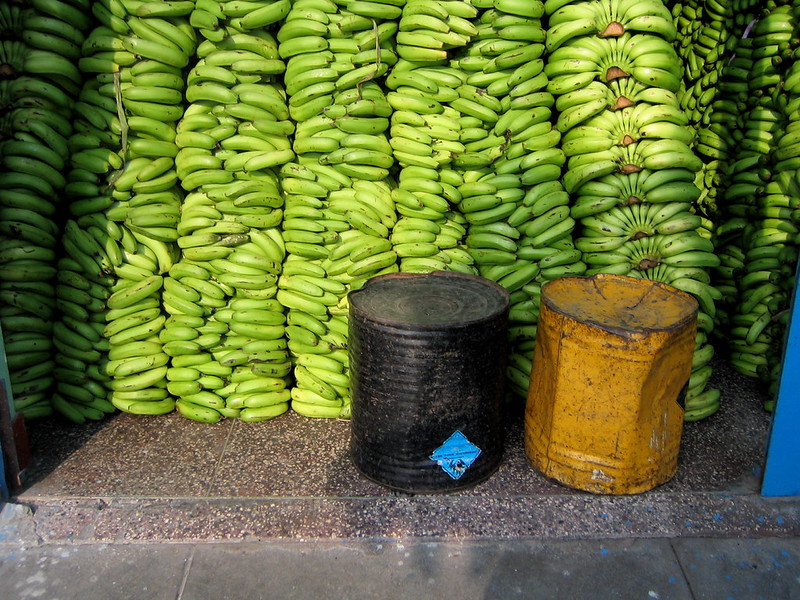
According to this source,
“From New Guinea and the Philippines, bananas dispersed far and wide across the tropics, in all directions. It is probable that bananas arrived in India, Indonesia, Australia, and Malaysia, within the first two millennia after domestication. Plantains may have been grown in eastern Africa as early as 3000 BCE, and in Madagascar by 1000 BCE. The plantain had certainly reached the African continent between 500 BCE and 500 CE. Buddhist literature notes the existence of the banana in 600 BCE, and when Alexander the Great’s expeditions led him to India in 327 BCE, he stumbled across the fruit. Perhaps most surprising, the banana may have arrived in South America well ahead of Europeans, as early as 200 BCE, carried by sailors of Southeast Asian origin. By the 3rd century CE, plantains were being cultivated on plantations in China….By the 1200s, the banana had reached into North Africa and in Moorish-controlled Spain. It is also likely that Islamists carried the banana from eastern to western Africa.”
This is a completely insane development by the way. The spread, so early and so wide, of the banana, along with humans, has made it an important companion throughout much of human history. Plantains, meanwhile, are in the same genus but have a different taste, are used in cooking rather than raw, and are spread worldwide through different paths. Since the Neanderthals and Denisovans populated the earth together with Homo sapiens, this fruit has been an important food source. Today, from a rich country’s healthy snack to an African and South American staple, it’s intertwined with our lives. Today, the banana is the single best-selling item in the supermarket in many countries. The industry has revenues of over $180 billion.

But their importance goes deeper than that.
“The most traded variety is the Cavendish banana, which accounts for just under half of global production and has an estimated annual production volume of 50 million tonnes. Bananas are particularly significant in some of the least-developed, low-income, food-deficit countries, where they can contribute not only to household food security as a staple but also to income generation as a cash crop.”
Banana production will grow and is expanding across the world, but there are production shortages caused by adverse weather conditions in several other supplying countries. Losses and additional costs stemming from the spread of plant diseases, importantly, the Banana Fusarium Wilt Tropical Race 4. This disease, also known as Panama Disease, may actually wipe out most banana production worldwide.
How exactly can one disease have so much impact? Especially considering that there are 300 cultivars, 1000 wild species, and the distribution of the banana is so widespread? The immense genetic variation of the banana and its incredible ability to morph and survive in different forms have been negated because over half of the world’s production is in one variant, the Cavendish. The Cavendish is even more important than the 50% statistic suggests because it is the Chiquita banana, the one that is traded worldwide and so provides income for poor people and developing nations. The Cavendish can not reproduce; the banana is a clone.
This, of course, is handy if you’re a large fruit company looking to control the market, but it is now a threat to millions of livelihoods. The Cavendish is also a banana that works well with the current banana system. The Cavendish holds up well in reefers and container transport and can ripen during the journey. With planning, it can be cultivated in several countries simultaneously, supplying homes worldwide with identical bananas year-round. So this one perfect banana that works well for the market right now is under threat because its genetic diversity is limited.
This sounds kind of stupid for a $140 to 180 billion industry to do. But it’s even more stupid than you think because this has happened before. In the 1950s, a single clone of a single cultivar, the Gros Michel, almost went extinct due to Panama disease. The Gros Michel was perfect for trading on slower ships at the time and dominated the banana industry worldwide. Across 10 years, the variety was almost wiped out by Panama disease. The banana industry almost collapsed, but big, well-capitalized firms (now in a stronger position due to the malaise affecting undercapitalized small farmers) were able to pivot towards another clone, the Cavendish. For 30 years, the Tr4 variant of Panama disease has spread worldwide to all major growing regions. The industry is doing very little to harness the globally available biodiversity or to develop any solution that may work. In my mind, large companies are waiting for the industry to collapse so they can muscle in more, raise prices against powerful supermarkets, and then introduce their own patented, genetically modified products. A banana crisis, therefore, would in one fell swoop improve the process economics of the large fruit companies forever. This is the only logical explanation for their complacency.
Now, why did you just read a long article about bananas? Well, because we are essentially in the banana industry. We too have few customers, few markets, are locked into prices, and are stuck. We, too, could look successful before you consider the risks that strategic replication entails.
Images courtesy of Creative Commons. Attribution: Keepon I, Jeff Warren, and Dan Zen.
🏷️ p3d_feed