DMG Mori Joins $10M Defense 3D Printing Program
⚓ p3d 📅 2026-05-12 👤 surdeus 👁️ 2

To look at the Biden administration and the Trump administration that succeeded it and find areas of policy overlap is obviously a bit of a challenge. But such areas certainly do exist, and one of the clearest objectives shared by both administrations is an aggressive reemphasis on leveraging US federal power to shape national industrial policy.
That’s one of the primary reasons for the growing significance of additive manufacturing (AM) in the government procurement landscape, especially relevant, of course, to defense matters. This has led companies with exposure to the AM market and global presences to prioritize investing in and expanding their domestic US operations to bolster their relationships with the Department of Defense (DoD). One company that has lately been making notable progress in this regard is Japan’s DMG Mori, through its US-based DMG Mori Federal Services (DMFS) division.
DMFS just announced its biggest step forward to date in terms of entry into the US AM for the defense market, with its selection to participate in the Joint Additive Manufacturing Acceptability (JAMA) IV Pilot Parts Program, an Indefinite Delivery, Indefinite Quantity (IDIQ) contract administered by the Defense Logistics Agency (DLA). The five-year program, announced last year, represents total funding of $10 million, and “aims to establish a supplier base for [AM] parts” for the US military.
The companies participating in JAMA IV will place competitive bids to sell 3D printed components to DLA, with the group of enterprises also including the likes of Nikon AM Synergy. DMFS’s own work in the program will be run by Fred Carter, the company’s Head of R&D, who is also overseeing work that the company is doing on a Department of Energy (DOE)-backed project announced earlier this year. All of the company’s work with the US federal government will be supported by the new DMG Mori Advanced Manufacturing and Innovation Center in Chicago, which is funded by $40 million from the State of Illinois.
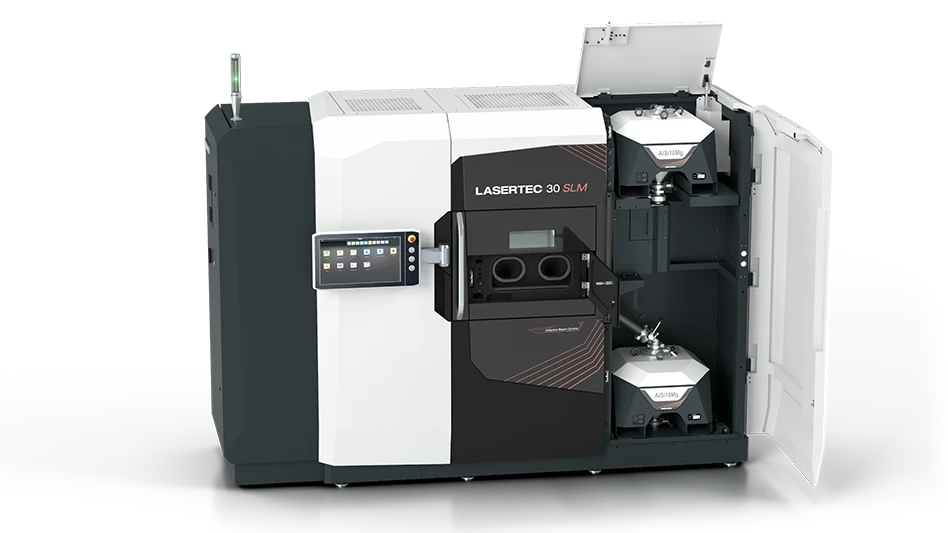
DMG Mori Lasertec 30. Image courtesy of DMG Mori.
In a press release about DMG Mori Federal Services’ selection to participate in JAMA IV, the company’s chairman, James V. Nudo, said “Being selected for the JAMA IV Pilot Parts Program reflects the strength of our team and our continued investment in advanced manufacturing technologies. [AM] is a critical component of the future defense industrial base, and DMFS is proud to support efforts to improve supply chain resilience and readiness.”
When I wrote about DMFS’s grant award for the DOE’s High-Performance Computing for Manufacturing (HPC4Mfg) program, I noted that it could ultimately create a good opportunity for the US and Japan to work more closely to build their respective supply chains for data center hardware. There’s always the possibility that this kind of take is a reach, if only because of the complex nature of the industrial policy environment, particularly when more than one nation is involved.
On the other hand, when we now take into consideration DMG Mori’s selection to the JAMA IV group, which also, as I noted, includes the US division of another Japanese multinational, Nikon AM Synergy, it does seem to raise the likelihood that there’s at least some coordination between the ground-level activities represented by individual funding grants from US agencies, and the strategic objectives of the highest policy circles aligning US and Japanese interests. For instance, Japan just announced a record defense budget, and this is central to Prime Minister Takaichi’s ongoing dialogue with President Trump.
All of this context is the sort of background information that has become the requirement for a baseline understanding concerning the true value of advanced manufacturing in global geopolitics. It’s a value that can no longer be adequately defined in terms of traditional markers like the market caps of the industry’s largest publicly traded companies.
There are many reasons why that’s the case, but one of the simplest reasons is that world leaders seem to be operating under the assumption that whatever the current nominal monetary value of industries, including the AM industry, is, it pales in comparison to what that value will amount to in the 2030s and beyond. To be sure, world leaders are wrong far more often than they’re right, and this case could be no exception. But at the very least, there seems to be no slowdown in the momentum behind advanced manufacturing, which has pushed it near the top of the global policy agenda.
🏷️ p3d_feed