i3D Manufacturing Expands Metal 3D Printing Capacity with Burloak Technologies Acquisition
⚓ p3d 📅 2026-05-15 👤 surdeus 👁️ 1

The Canadian economy may be one of the most difficult to forecast right now. This is largely the result of the fact that the nation is attempting to thread a needle between sharing a border with a country led by Donald Trump, while simultaneously cultivating a trade relationship with China in hopes of carving out a place in the global economy that is truly its own.
One would imagine that with such a rare combination of natural resource wealth and technological sophistication, Canada will be just fine, if you can ignore all the noise; but, there is indeed a great deal of noise. Nonetheless, no matter the specifics for Canada’s economic fate, considering the nation’s mix of a sparsely distributed population, world class education system, and heavy exposure to strategically critical sectors, it seems like a safe bet that advanced manufacturing will play an increasingly prominent role in the Canadian future. i3D Manufacturing, a metal additive manufacturing (AM) specialist based in Oregon, is making that bet, having just acquired Burloak Technologies of Ontario.
Burloak Technologies has extensive metal AM capabilities as well, although the company also works with polymer AM, along with a variety of other manufacturing technologies including CNC machining and Hot Isostatic Pressing (HIP). A parallel between i3D and Burloak that makes the acquisition a particularly good fit is their shared familiarity with EOS systems: Burloak operates both polymer and metal EOS machines, while i3D runs a fleet of 30 EOS metal printers, including a single purchase of a dozen in 2024, which President of EOS North America Glynn Fletcher referred to at the time as “one of the single largest metal AM investments ever in North America.”
Previously, Burloak was a subsidiary of Samuel, Son & Co., a leading Canadian supplier of metal components, while i3D is itself a part of Illinois-based advanced manufacturing network BTX Precision. Private equity firm NewCap Partners, where Danny Piper, host of the Printing Money podcast, is a managing partner, represented Samuel in the deal.
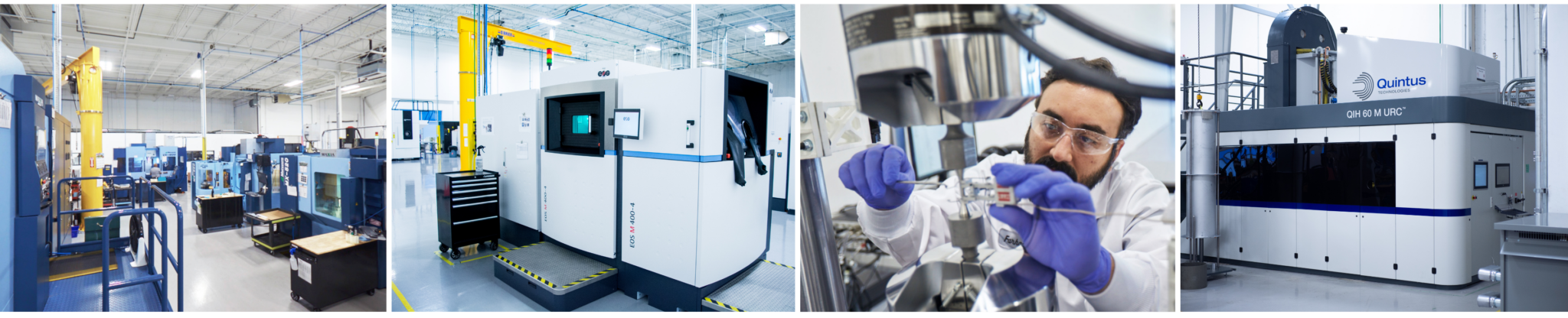
In a press release about i3D Manufacturing’s acquisition of Burloak Technologies, Erin Mastroni, the President of i3D Manufacturing, said,“Burloak has built a world-class reputation in metal additive manufacturing and materials science. Bringing Burloak into i3D expands our technical depth and gives us additional resources to better support customers developing next-generation, high-performance components.”
Jason Ball, VP and General Manager of Burloak, said,“Burloak’s team, technology, and expertise make this a natural fit. We will continue operating as the organization our customers trust today, now with greater support and investment to accelerate growth and innovation.”
In the present global business environment, an interesting angle regarding i3D is that it’s a supplier of Ursa Major, the high-growth defense/space startup that’s closely linked to EOS. Joris Peels noted in his 2024 post on i3D’s acquisition of 12 EOS printers that “…[Ursa Major’s] success alone could have prompted this purchase.”
With the US military now in need of an accelerated ramp-up of missile production from its suppliers, it’s conceivable that the same thing could be said about i3D’s acquisition of Burloak. It’s also worth noting here that Canada is well ahead of schedule on achieving its goal of raising defense spending to meet the 2% of GDP threshold targeted by NATO members.
In any case, defense is far from the only Canadian sector in need of additional domestic manufacturing capacity, and almost certainly isn’t even the one with the greatest such need. For instance, despite the fact that Canadian oil producers have said they’re not going to jump right into new capex spending even in light of the windfall profits from the Iran-induced price premium, the industry’s long-term growth depends on new capex spending.
Above all, Canada needs new pipeline infrastructure to support increased fossil fuel exports. Conventional manufacturing will be required for the bulk of that work, but there are also countless small components like valves, gaskets, etc. AM could be an indispensable tool for addressing supply gaps for those sorts of parts.
Along those lines, if the oil & gas industry in Canada can credibly position itself as a stimulus for building up low-carbon manufacturing capacity, that could serve as an olive branch between the Canadian federal government and the Alberta-based drillers with whom Ottawa has such a contentious relationship.
Images courtesy of i3D & Burloak Technologies
🏷️ p3d_feed