Inside nScrypt’s “Factory in a Tool”: Space, Defense, and the Future of Additive Electronics
⚓ p3d 📅 2026-05-28 👤 surdeus 👁️ 2

This article is Part 2 of a three-part series based on 3DPrint.com’s visit to nScrypt’s Orlando headquarters and conversations with Ken Church.
Walking through nScrypt’s facility in Orlando last summer, what stands out isn’t just the machines — it’s the people running them. Engineers move between screens and systems, adjusting toolpaths, watching material deposit in real time, and fine-tuning processes. It feels less like a typical 3D printing lab and more like a place where electronics are being built, tested, and fixed all at once.
The company is based at Central Florida Research Park, a large technology hub next to the University of Central Florida. The area brings together defense contractors, aerospace firms, and research-driven companies, making it truly an innovation hub. You see that mix inside as well; the facility blends research, engineering, and production in a way that makes it clear this isn’t just about printing parts.
And while these are, at their core, 3D printers, the way they’re used here goes far beyond typical additive manufacturing. nScrypt’s systems are designed to do far more than deposit material layer by layer. They combine multiple manufacturing processes into a single platform, actually turning what would normally be a production line into a single, integrated system.
“That’s why we call it ‘factory in a tool,’” nScrypt CEO Ken Church told me. “A single machine can handle additive deposition, subtractive correction, pick-and-place operations, inspection, and electronics integration. This combination is not just about flexibility; it is about solving one of the most difficult problems in electronics manufacturing: reliability. If you have a defect in electronics, it is not going to work.”
Electronics are different. Unlike structural parts, where you can sometimes get away with small imperfections, even a tiny defect, a short, an open, a misplaced line, can mean the whole thing doesn’t work. That’s why, as Church put it, the goal is simply 100% yield.
And to approach that goal, the company has built inspection directly into the manufacturing process. Each layer is evaluated as it is created, allowing issues to be identified and addressed immediately rather than after the print is done. If something is wrong, the system can intervene in real time. This is where the hybrid nature of the platform becomes critical.
This ability to both build and correct within the same system is a powerful departure from traditional manufacturing workflows. It also generates a large amount of data, which opens the door to more advanced forms of process control.
“That’s the beautiful part of machine learning,” Church said. “It likes data. As a matter of fact, it thrives on data. By collecting and analyzing layer-by-layer information, we hope to improve consistency and move closer to fully reliable additive electronics. The process is not complete, but it is progressing. We are knocking on the doorstep. We’re not quite there, but we’re knocking.”
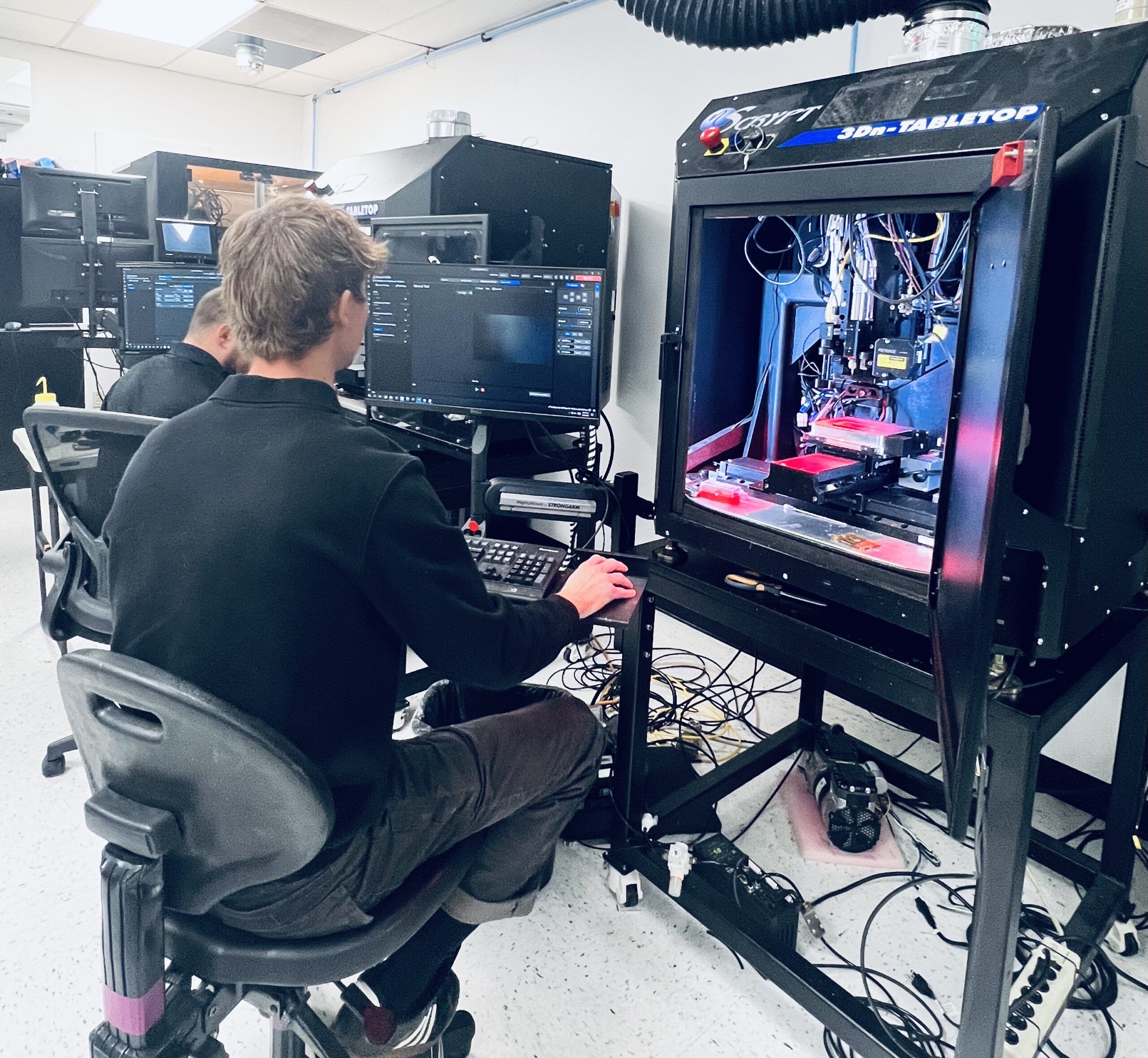
nScrypt headquarters. Image courtesy of 3DPrint.com.
While much of the conversation around additive manufacturing focuses on new production, one of the most immediate and practical applications for nScrypt’s technology is repair. This is particularly relevant in defense and remote environments, where supply chains can be slow and unpredictable.
The company’s “nRugged” system, which is designed for deployment in harsh or remote conditions, was actually on site during my visit. Seeing it up close makes the idea much more real; the same platform has already been used in locations around the world.
“nRugged is fantastic. It’s been to Djibouti, Norway, Hawaii, and it’s going to Japan. The goal is to enable users to fix electronic systems on-site rather than waiting for replacements. In many cases, that difference can be measured in weeks or months. In well under an hour, you’ll fix that circuit. Which would’ve taken months to get a replacement.”
In military operations, that capability can directly impact readiness. Systems that would otherwise be offline for extended periods can be returned to service quickly, reducing downtime and improving resilience.
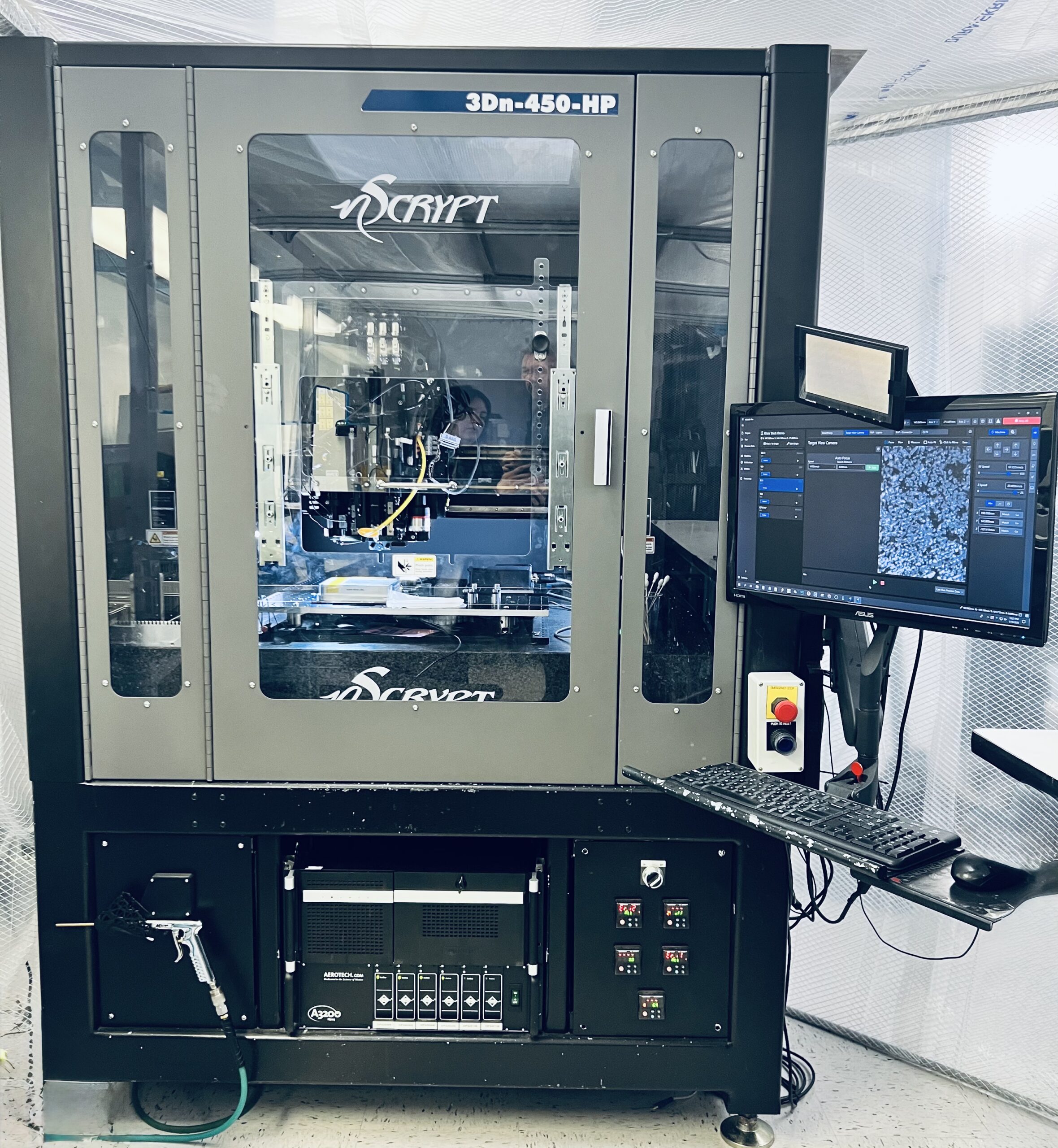
An nScrypt 3Dn-450-HP system, a “Factory in a Tool” (FiT) 3D manufacturing system designed for multi-material, high-speed, and high-resolution production. Image courtesy of 3DPrint.com.
Despite how much of the technology is already in use, not all of it is easy to point to. Much of nScrypt’s work takes place in aerospace and defense environments, where details are often kept confidential.
Even so, Church is clear that the industry is still in its early stages. After decades of development, the shift from experimentation to real demand is only just beginning.
“We’ve been pushing for 20 years,” he said. “And we’re just now on the very front end of this pull.”
That shift, from pushing the technology into the market to responding to actual demand, may define what comes next for additive electronics. For companies like nScrypt, it marks a turning point, where years of incremental progress are starting to come together into something more real.
🏷️ p3d_feed