The Stories nScrypt Can’t Tell; and Why That Matters
⚓ p3d 📅 2026-06-04 👤 surdeus 👁️ 1

This article is Part 3 of a three-part series based on 3DPrint.com’s visit to nScrypt’s Orlando headquarters and conversations with Ken Church.
There’s an interesting dynamic inside nScrypt’s Orlando headquarters. The company is clearly working on advanced electronics systems for aerospace, defense, and other high-performance industries, but some of the most interesting work happening there is also the hardest to discuss publicly. There is simply too much that can’t be said.
During 3DPrint.com’s visit to the facility, CEO Ken Church walked through the company’s technology, its history in additive electronics, and the challenge of talking publicly about work that often happens behind NDAs.
“We have some customers out there — some really big names,” Church said. “The more relevant electronic things that we’ve done, we don’t get to talk about.”
That level of secrecy is not uncommon in the industry. But in a field where so much attention is built around case studies, demonstrations, and public announcements, it can make it harder to see where the technology is actually gaining traction. Still, when advanced manufacturing methods provide a strategic advantage, the details often stay behind closed doors. Church explained that many of nScrypt’s customers operate in industries where even small manufacturing advantages matter. In some cases, simply revealing how a system is built, repaired, or integrated could expose capabilities that competitors are not supposed to see yet.
“Our best stories, we don’t get to talk about,” Church said.
A Different Kind of Visibility Problem
One question keeps coming up around additive manufacturing: if the technology is moving forward so quickly, why does so much of it still feel hidden? Why do some areas still seem stuck in early adoption?
At least in nScrypt’s case, part of the answer is that the work is definitely happening, but a lot of it is happening behind closed doors. In fact, much of the company’s work is in aerospace, defense, and other high-performance industries, where even small manufacturing advantages can matter.
Church explained that many customers prefer to keep their use of the technology quiet, especially when it may provide an advantage over competitors. In industries like aerospace and defense, even small manufacturing or integration gains can be strategically important, making companies cautious about how much they publicly share.
So the same factors that make additive electronics valuable, such as design flexibility, integration, and speed, also make it something companies would prefer not to advertise too early.

3DPrint.com’s Vanesa Listek at nScrypt headquarters. Image courtesy of 3DPrint.com.
Printing What You Can’t Replace
Some of those projects are much bigger than small electronics. One of nScrypt’s largest systems can print electronics directly onto existing structures, Church explained.
“The largest system we sell is 8 feet by 10 feet by 12 feet and weighs about 25,000 pounds,” he said. “At that scale, you’re obviously putting something large inside it, and we’re printing electronics directly onto that structure.”
It’s a much bigger use of additive manufacturing than most people probably imagine, with electronics added directly to larger systems. But again, many of the specifics stay behind closed doors. For companies working on advanced aerospace or defense systems, even acknowledging how something is made can reveal too much.
For nScrypt, that creates a tradeoff between secrecy and visibility. The company wants to protect its customers and keep sensitive projects private, but at the same time, it also has to show people what the technology is capable of.
“We are very committed to our customers… we’re very dedicated to keeping what they want confidential. But while we’re doing that, we’re also trying to figure out how to tell our story.”
It’s not an easy balance. In industries where visibility helps drive adoption, not being able to share real-world projects can make it harder to demonstrate progress. At the same time, the fact that companies are keeping so much of this work private says a lot. It suggests that additive electronics is moving beyond experimentation and becoming more important commercially and strategically.
Where Real Demand Is Starting to Appear
Church explains that despite decades of development, additive electronics is still in the early stages of broader adoption.
“We’ve been pushing for 20 years,” he said. “We’re just now on the very front end of this pull. And that distinction [between pushing technology into the market and responding to real demand] is important. For much of its history, additive electronics has been driven by what it could do. Now, it is starting to be shaped by what customers actually need.”
Luckily, some of that demand is already visible. The work nScrypt is doing with repair systems for the U.S. Army, for example, is one clear use case. Instead of waiting weeks or months for replacement parts or electronics, systems can be repaired much closer to where they are being used. Church also pointed to areas like conformal electronics, integrated systems, and rugged, field-deployable platforms, where “additive approaches can solve problems traditional manufacturing struggles with.”
But beyond those examples, much of the company’s work remains hard to talk about publicly, especially in aerospace and defense environments where the stakes are higher. However, most major defense contractors have nScrypt equipment. And that, in itself, hints at a level of adoption that isn’t always shown in the public media.
The Problem With Being Early
Church describes the additive electronics market as something that has taken years to develop, “with long periods of limited traction followed by gradual progress.”
“We are on the very front end of this pull,” he said. “That slow build has shaped how companies like ours operate. Early on, the challenge was simply getting customers to try the technology. Now, the challenge is different; it’s managing demand while continuing to refine the systems and processes behind it.”
At the same time, the company has had to learn how to navigate industries that operate very differently from traditional manufacturing. Large customers, especially in aerospace and defense, bring their own high expectations for reliability, consistency, and performance, and Church recognized that working with those companies has pushed nScrypt to continuously improve its systems.
“Those interactions,” he explained, “have helped shape the company’s technology into something better suited for high-consequence applications, where even small failures are not acceptable.”
If there is one area Church seems especially focused on, it is advanced electronics packaging, particularly involving glass. The topic connects closely to the growing demands of AI and high-performance computing, where more processing power also means more heat, density, and complexity.
“We are in the glass business here,” Church said. “We want people to know that, but right now we’re having a hard time telling that story.”
Even this, though, is still only being discussed in broad terms. But, Church hinted that more may become visible soon.
“2026 is going to be a glass-telling story,” he said.
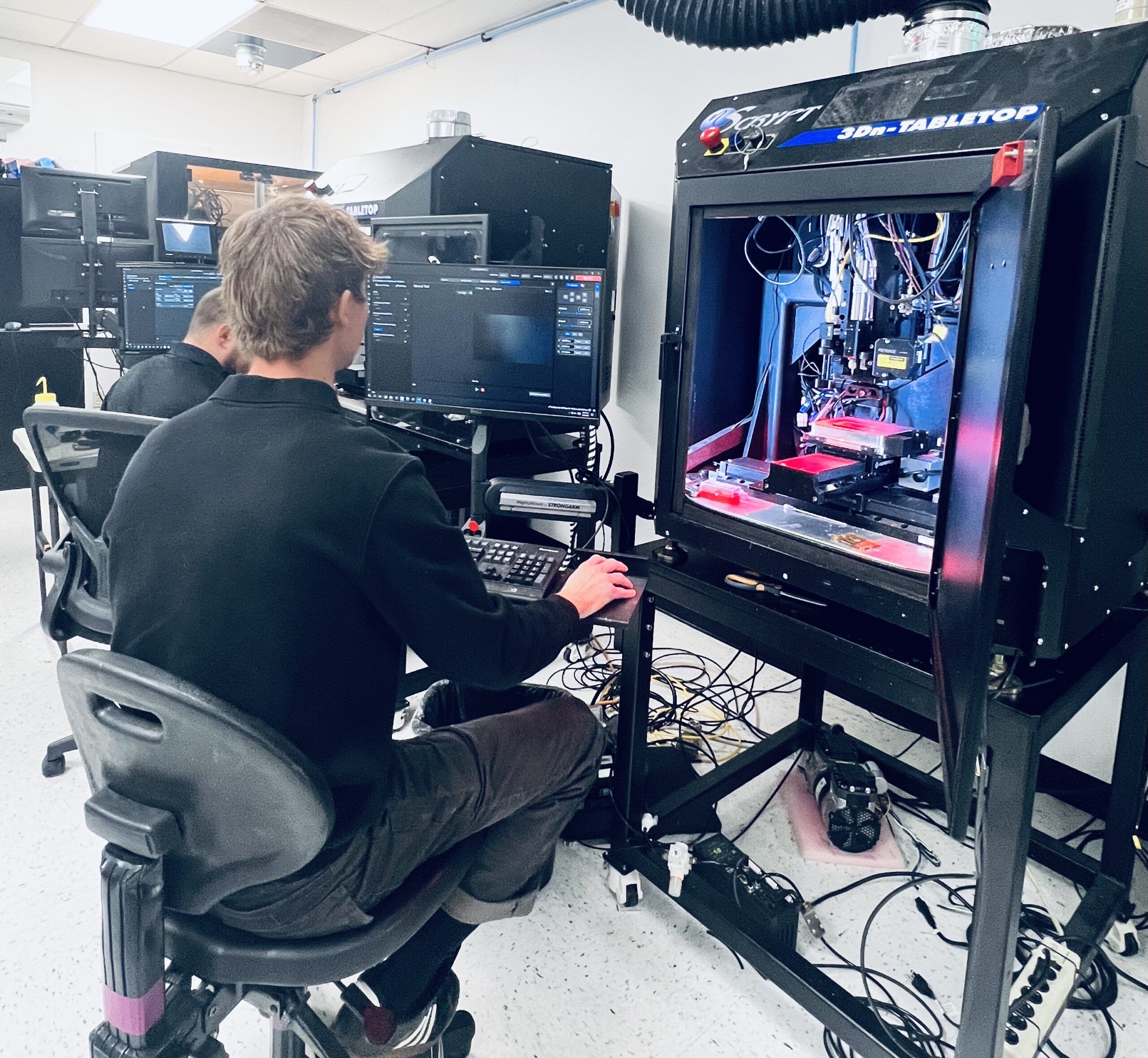
nScrypt headquarters. Image courtesy of 3DPrint.com.
After visiting nScrypt, it becomes easier to understand why additive electronics can still feel somewhat hidden, even as the technology continues to advance and, in some cases, is already being used in demanding applications. But a lot of that work happens in industries where companies are careful about what they share publicly.
For nScrypt, that is simply part of working in aerospace, defense, and other high-performance sectors, where reliability and performance matter more than publicity.
What is clear from my conversations with Church is that much of the progress in additive electronics is happening gradually, often behind the scenes, and long before it becomes widely visible.
🏷️ p3d_feed