Boston’s Additive Edge at Autodesk: MIT Experiments with 3D Printed Concrete
⚓ p3d 📅 2025-11-06 👤 surdeus 👁️ 27

At the Autodesk Technology Center in Boston, experiments don’t stay on paper for long. Ideas are tested at full scale, sometimes overnight. Among the largest machines in the space is a concrete 3D printer, designed to extrude cement into structural forms with its gantry system. During my visit, it was in the hands of an MIT team, which was using it to print bridge components that could change how we build.
The project is led by Hajin Kim-Tackowiak, a PhD candidate in civil and environmental engineering at MIT, with support from Haden Quinlan, Senior Program Manager at MIT’s Center for Advanced Production Technologies. Their goal is to explore how large-format additive manufacturing (AM) can produce lighter, stronger, and more efficient cement-based structures.
“Our lab is primarily a topology optimization group,” Kim-Tackowiak explained. “We use math to figure out the best shapes for bridges or buildings, but usually that work stays on the computer. Here, as part of the Autodesk Research Residency Program, we can print those designs at scale and actually test them.”
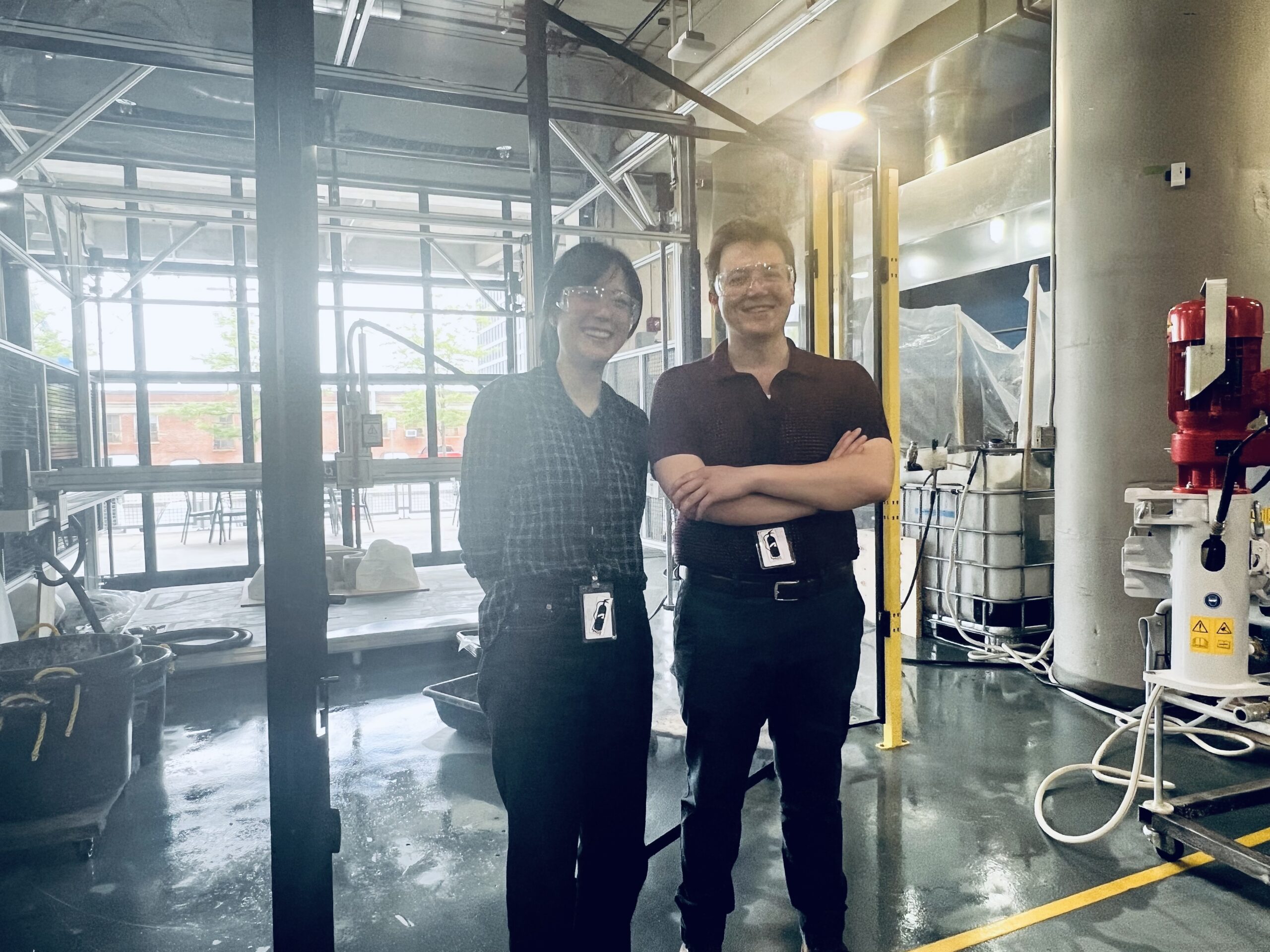
Hajin Kim-Tackowiak (MIT) and Haden Quinlan (MIT) at the Autodesk Technology Center in Boston.
Printing Bridges in One Pass
The team recently printed a small concrete bridge in Autodesk’s shop. The design came out of their optimization models, but the real challenge was translating it into something the printer could handle. Owned by MIT’s Center for Advanced Production Technologies, the Build Additive printer was purchased with support from the State of Massachusetts’ Center for Advanced Manufacturing and then installed in the Technology Center, making it accessible to research teams from different institutions.
“This machine doesn’t like to start and stop,” Kim-Tackowiak said, pointing to the large gantry system. “So our bridge had to be printed in one continuous pass. That constraint shaped the design itself.”
The result was a truss-like structure only a few layers thick. The team loaded it with 2,000 pounds (roughly the weight of a small car), and it held firm with “no deflection,” Kim-Tackowiak noted.
“It performed super well for the test we designed,” she said. “But then we moved it, and it collapsed almost immediately. That result was unexpected, but it gave us really important data. It showed how specific design assumptions matter when you bring things into the real world.”
After the data is processed, Kim-Tackowiak plans to make the necessary tweaks so that this kind of failure doesn’t happen again. Then she will run a new design and, together with the Autodesk Research team, explore how to safely integrate steel into the next version.
Toward Composite Printing
Now, the group is exploring more complexity, including the addition of steel reinforcement to their designs.
“Almost every concrete structure has steel in it,” Kim-Tackowiak explained. “So the next step is figuring out how to print with multiple materials, combining steel and concrete into one composite. That’s when it gets really interesting.”
For Autodesk, hosting this kind of experiment is part of the Technology Center’s mission: let researchers push machines in new directions.
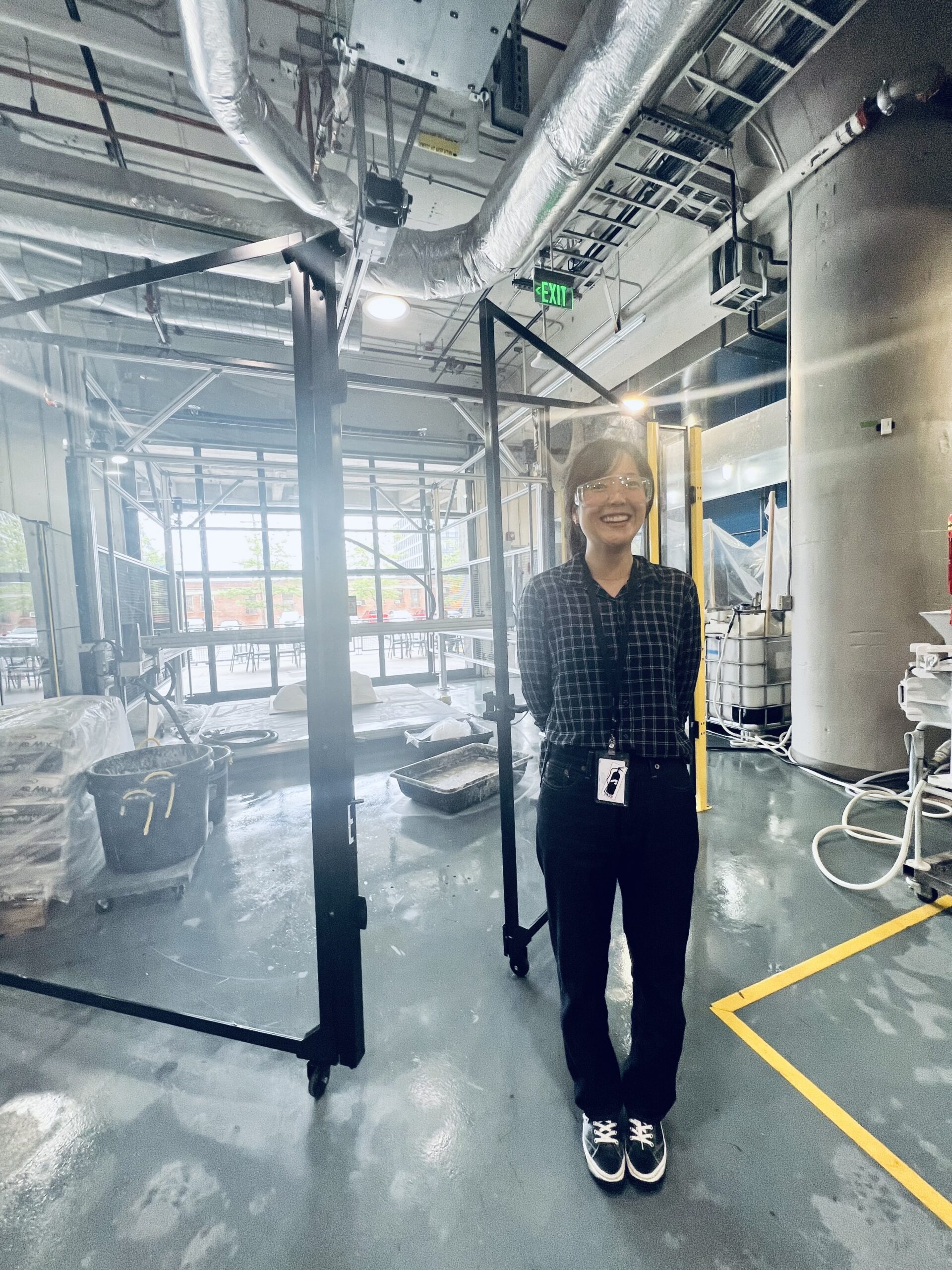
Hajin Kim-Tackowiak (MIT) at the Autodesk Technology Center in Boston.
3D printed concrete has already made headlines around the world, with notable projects including bridges and small houses. What MIT is chasing is the next stage: smarter designs that use less material, and hybrid structures that combine concrete with steel. That could mean stronger bridges with smaller footprints, or infrastructure that is easier to produce locally.
“The freedom of design that additive allows is really compelling,” Kim-Tackowiak explained. “For a lot of people, it’s hard to see a beautiful structure on the page and then imagine how it could ever be built. With additive manufacturing, you can just say, ‘Okay, let’s try it.’ We have access to a large machine that we want to utilize. In traditional construction, making something like our bridge would be nearly impossible — nobody would sign off on it. You would need custom formwork, which would require a lot of resources. Instead, with 3D printing, you put in the front-end work to set up the toolpaths, and suddenly, you’ve opened up the design space so much more. That freedom of design is really compelling.”
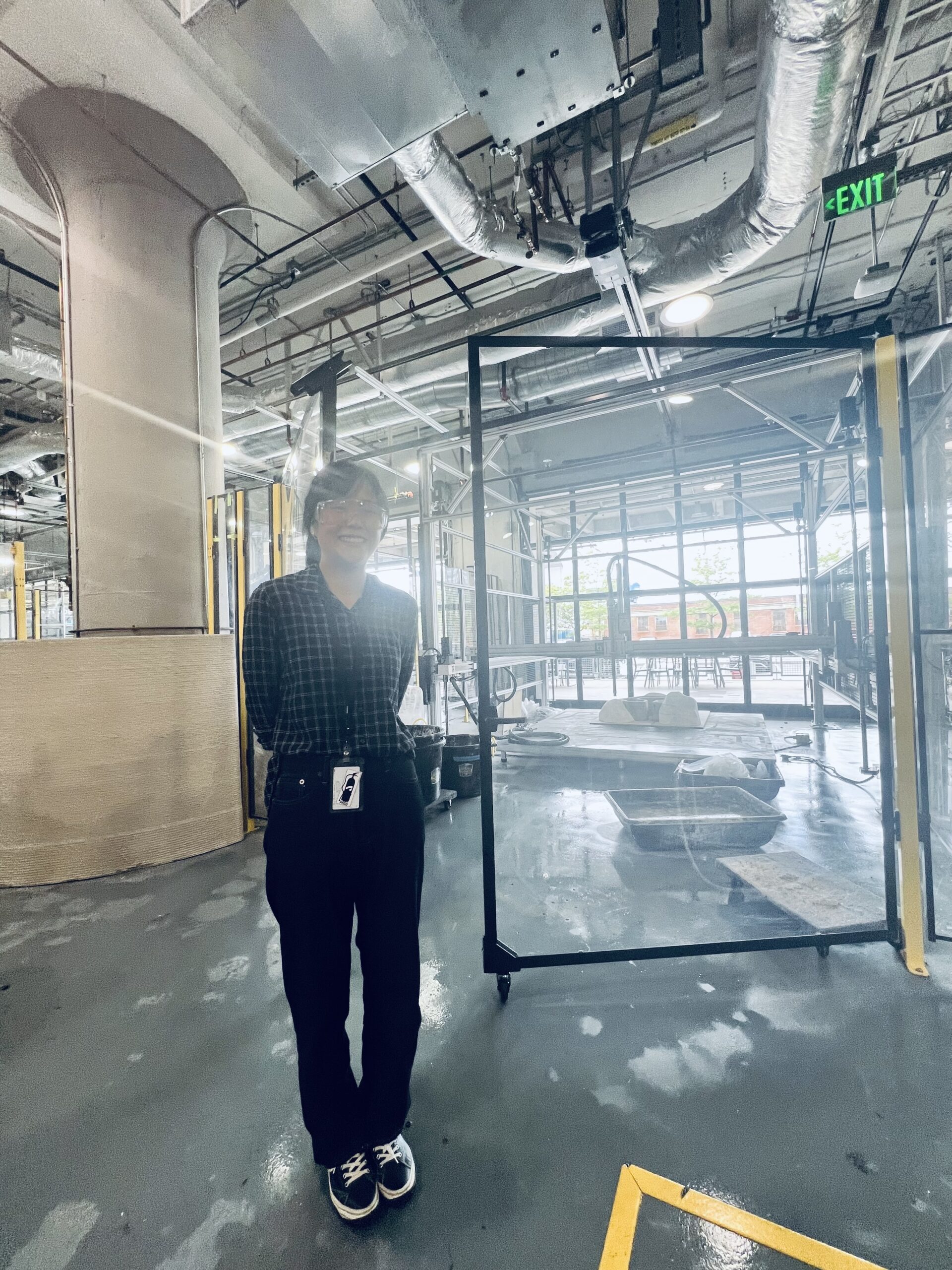
Hajin Kim-Tackowiak (MIT) at the Autodesk Technology Center in Boston.
For her, there’s also an aesthetic dimension: “The most aesthetically beautiful structures are the ones that are directly informed by physics. We want to find those elegant, unique, efficient forms that additive construction makes possible.”
As machines in the Technology Center continue to run around the clock, teams like MIT’s are showing what might soon be possible on a larger scale. From a lab model to a testbed in Boston, this is how bridges to the future get built.
This article is part of the “Boston’s Additive Edge at Autodesk” series, highlighting projects and research taking shape inside Autodesk’s Technology Center in Boston.
All images courtesy of 3DPrint.com
🏷️ p3d_feed