The Hospital Factory: Mayo Clinic’s In-House 3D Printing for the OR
⚓ p3d 📅 2025-11-25 👤 surdeus 👁️ 27

“At Mayo Clinic, 3D printing isn’t a side project, it’s a patient-specific service that runs on hospital time, helping surgeons plan and act with confidence,” says Dr. Jonathan Morris, a neuroradiologist and Medical Director and Co-founder of Anatomic Modeling Unit (AMU) in the Department of Radiology at Mayo Clinic in Minnesota.
The 161-year-old institution has built a 24/7 manufacturing service inside the hospital, and it succeeds where industry won’t. The point-of-care system takes surgeon orders straight from the Electronic Medical Record (EMR) and turns them into patient-specific tools, models, and sterilizable devices for the operating room (OR).
“It’s a manufacturing system that serves a hospital. It is a service embedded in the EMR-to-OR workflow, supporting surgeons across subspecialties. In fact, our return on investment is the best possible outcome for a patient who comes to Mayo Clinic.”
In a recent 3DPOD episode, Morris discussed the value of models and the realities of clinical adoption. In our follow-up conversation, he went further, into the devices, workflows, and quality systems that make a hospital-based factory work, and the kinds of bespoke patient needs that industry often can’t or won’t serve.
From “Cool Model” to Standard Tool
Mayo’s lab supports every surgical subspecialty, from craniomaxillofacial and orthopedics to skull-base neurosurgery, urology, and complex oncology. Some services are now routine, like life-size models for intricate planning and sterilizable cutting guides for jaw reconstruction, including fibula-to-jaw transfers.
The core idea is to use 3D printing when the case calls for it. Not every patient gets a model, because not every case needs one, explains Morris.
“We do it when it’s clinically appropriate, when the surgeon has a need. If people start calling to say, ‘I need every CT scan of a big toe 3D printed,’ then the answer is no. Just like it’s not clinically appropriate to get an MRI scan for everybody who has a headache, or it’s not clinically appropriate to operate on every back. It’s a medical tool that’s run by physicians at Mayo Clinic at the point of care, built into the entire fabric of the institution,” explains Morris. “That means any surgeon can press an order in the electronic medical record system, and we then put it through a manufacturing pipeline, which starts with radiology imaging. It’s not research funded, it’s not grant funded. It is a clinical operation that serves the needs of Mayo Clinic.”
Morris frames models as learning-curve compressors. Instead of piecing together thousands of CT/MRI slices in their heads, newer surgeons can hold the anatomy in their hands and see exactly what’s where — vessels, nerves, the tumor — so the plan clicks. Experienced surgeons don’t need a model for routine cases, but they reach for one when the anatomy is unusual or the surgery is high-stakes, such as a kidney tumor wrapped around vessels or a complex jaw rebuild, because it lets them rehearse the approach and avoid surprises.
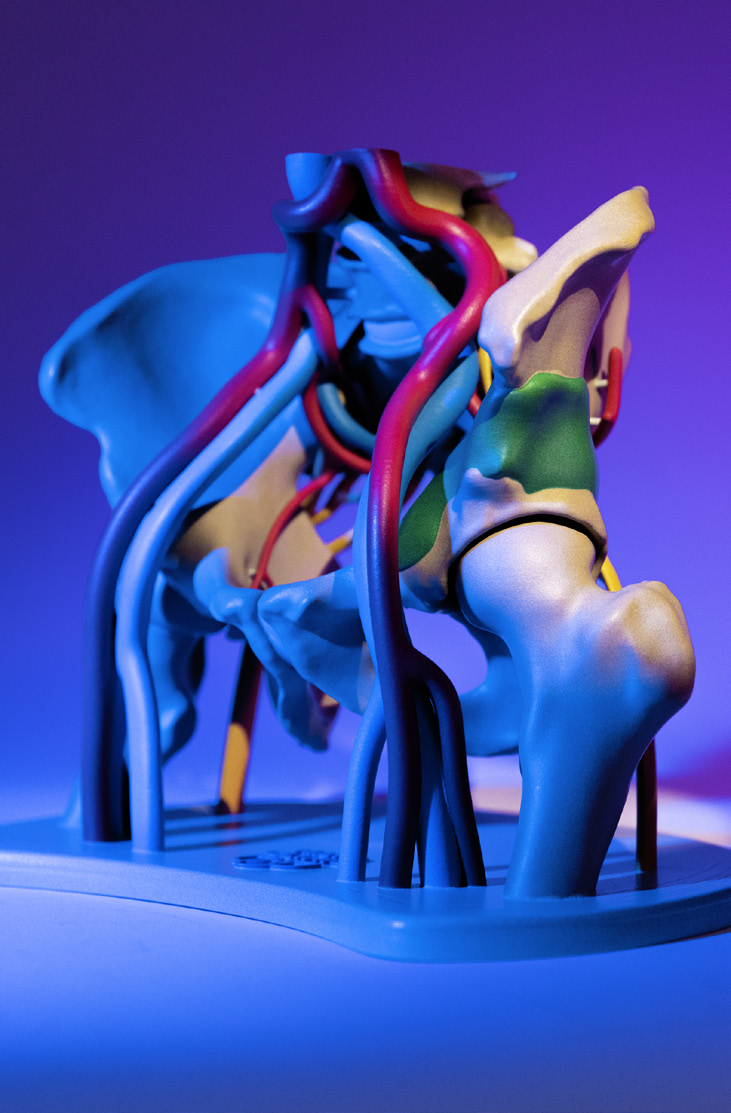
3D printed model. Image courtesy of Mayo Clinic Alumni/Mayo Clinic Alumni Magazine 2023 Issue 3 (MC4409-2303), p. 22; used with permission of Mayo Foundation for Medical Education and Research, all rights reserved.
Where this story really breaks new ground is in hospital-made devices, solutions too niche for a traditional medtech business case. External breast prostheses are a good example. A simple request from Mayo’s breast team asking, “Could we make these lighter and truly patient-specific?” turned into a full program.
“We weren’t making external breast prostheses. Now we’re making like 110 of them, lightweight, 3D printed, lattice structure, and matched to the other side. That now serves women after mastectomy and congenital cases like Poland syndrome — useful, humane, and unlikely to scale through industry for such a small population.”
And in radiation oncology, the lab prints custom boluses and mini-beam collimator adapters for exophytic tumors and ocular cases, parts that conform to anatomy and hardware to aim the dose more precisely and help reduce skin burns. None of this makes obvious commercial sense, but it makes clinical sense, explains Morris. That’s the hospital factory’s edge: patient-first return on investment (ROI).
“Our return on investment is the best possible outcome for a patient who comes to Mayo Clinic.”
Built Like a Real Factory (with Hospital Rules)
Morris’s team runs 24/7, with a fleet that spans prosumer SLA up to million-dollar industrial systems, like PolyJet, MJF, FDM, and micro-printers, supported by an 18-person cross-disciplinary staff. It’s not a “maker space.” It’s a regulated, quality-managed pipeline.
Surgeons place their requests in the EMR, and radiology runs special scan protocols to capture manufacturing-grade data. For example, a renal case might use a 0.6-millimeter, multi-phase CT rather than a standard study. From there, the file moves through a tight quality chain that includes data checks on arrival, careful segmentation, engineering for printability, controlled printing and post-processing, and final metrology before anything reaches the OR.

Dr. Jonathan Morris. Image courtesy of Jonathan Morris via LinkedIn.
“We’ve got a fairly robust quality control system, about a 0.8 mm variance on our guides. Every case goes through quality control from the order to the radiology protocols. We have radiologic protocols specific to 3D printing, for example, a kidney model might be 0.6 millimeters, with five phases on a special scanner. So it’s a different order.”
They’re very accurate. The 0.8 mm variance means the finished, sterilizable surgical guides differ from the intended dimensions by less than one millimeter on average. In practice, the holes, edges, and angles line up within that tiny margin so the guide fits the bone the way the plan says it should.
And while Mayo partners with companies for what they do best (like titanium plates from Stryker or KLS Martin), much of the planning, guides, and patient-specific tooling is now done in-house, at clinical speed.
Medicine First, Not Merchandise
On regulation and reimbursement, Morris noted that the lab operates under the practice of medicine, which means it serves Mayo patients only and does not sell devices commercially.
“We’re not a medical device company. We’re the Mayo Clinic hospital system that has a point-of-care manufacturing facility. But the FDA has been a great partner.”
Over the past decade, that has meant guidance documents, conference conversations, and exploratory sessions at Mayo to define what hospitals can safely do at the point of care. For now, the team produces class II sterilizable devices under tight internal controls, while implants (like titanium plates) continue to come through the industry as Mayo works with regulators on what’s next.
On billing, Mayo helped create Category III CPT codes for 3D printing—these are temporary “tracking” codes for new procedures. They let hospitals bill and collect data, but insurers don’t have to pay, and when they do, the payments are often limited. The goal is to build enough evidence — through registries (real-world case data) and clinical appropriateness criteria (when it should be used) — to move 3D printing to Category I. Category I codes are established, fully recognized, and far more likely to be reimbursed.
“Basically, they prove value first, then formalize payment. The principle remains the same: do what’s right clinically, then align the paperwork to that reality, not the other way around,” states Morris.
The Hard Part No One Markets: Reliability
Running lots of 3D printers is messy. Machines vary, break, and need babysitting, and post-processing isn’t standardized. In a hospital, where timing and accuracy are life-critical, the stakes really jump up.
“These printers are not mission-critical with six sigma levels of reliability. You have to operate each one like an antique car, and you have to do way more than the operators ask you to do service. We’ve had to fight to get our own staff trained at the level of a factory person instead of dealing with a third party.”
Downtime, variability between supposedly identical machines, and a patchwork of post-processing tools force Mayo to over-provision printers and train in-house factory-level technicians to keep them alive. It’s expensive. It’s frustrating. But it’s worth it—because the alternative is telling a surgeon (and a patient) that the tool won’t be ready.
At Mayo, it is so much more than just “3D printing helps surgery.” It’s a different thesis; here, hospitals can manufacture care.“When you embed printing, metrology, sterilization, and standards in the clinical fabric, new therapies appear — the ones no company can justify, but real patients need. It’s not flashy. It’s not simple. It is, however, a blueprint. Manufacturing has become part of the very fabric of how we deliver care to patients for complex problems across every surgical subspecialty.”
For the AM crowd, the angle has shifted. This isn’t just about looking at a medical model anymore; it’s about running a hospital factory. Point-of-care fills the markets no one else can reach, including congenital anomalies, rare reconstructions, and one-off radiation setups. And it’s not improvised. The “pipeline runs EMR-to-OR with ASTM-aligned quality, documented accuracy, and real sterilization validation,” explains Morris.
That leaves a clear job for industry: make hardware that’s reliable, easy to service, and built for the OR, and standardize post-processing, Morris adds. Fix those gaps, and hospitals like Mayo will move even faster, especially if that hospital owns the means of production. Then, care changes, case by case, patient by patient.
🏷️ p3d_feed